Skip to content
When a loved one can't safely make medical, financial, or day-to-day decisions, waiting for legal authority feels unbearable. Families often call a Texas guardianship lawyer because they assume the biggest problem will be getting a hearing date. In many cases, that's not the actual bottleneck.
Most delays happen earlier. A missing signature, the wrong court, an incomplete medical record, or defective notice can slow a case before a judge even has a chance to review it. That's one reason families feel blindsided. They're dealing with a crisis in real life while the legal system asks for precision, timing, and strict compliance.
Texas guardianship law is built that way for a reason. Guardianship can remove important rights, so courts under Texas Estates Code Title 3, Subtitle G require careful proof, notice, and oversight before appointing a guardian. In Texas counties such as Harris County, Dallas County, Bexar County, and Tarrant County, probate courts expect clean filings and complete evidence. If the file is solid, the process usually moves more smoothly. If the file is sloppy, delays multiply.
The good news is that many of the most common stalls are preventable. The best approach is to treat guardianship like a compliance project before you file it. That means building a checklist, confirming dates, gathering records, identifying everyone who must receive notice, and choosing the right kind of case from the start.
The Anxious Wait Understanding Guardianship Delays in Texas
A family often reaches this point after a hard week. A mother has fallen twice, unpaid bills are piling up, or a father with dementia is giving money away and refusing help. The family is ready to act, but the court cannot sign an order just because the situation feels urgent. Texas guardianship cases move through a process built to protect the proposed ward's rights, and that process takes preparation.
That is why the wait feels so personal.
In Texas, delay usually starts before the hearing is ever set. The court has to confirm that guardianship is needed, whether a less restrictive option would work, and whether the proposed guardian is appropriate. The court may appoint an attorney ad litem who is responsible for reviewing the case, meeting with the proposed ward, and reporting to the judge. If the filing packet is incomplete or the supporting proof is weak, the case can slow down early and stay slow.
Families usually ask me whether delay means the court does not understand the seriousness of the situation. In most cases, no. Delay usually points to a file problem, not indifference.
The pattern is predictable:
- Paperwork problems. The application is missing required information, filed in the wrong county, or submitted without the supporting documents the court expects.
- Evidence problems. The medical paperwork does not clearly support incapacity, is outdated, or does not match the powers requested.
- Procedure problems. Notice was not handled correctly, service was delayed, or a relative objects and turns an uncontested matter into a contested one.
The practical fix is to treat guardianship like a pre-filing compliance project. Build the file before you file the case. Confirm the correct court. Gather family names and addresses. Line up the medical exam. Check local requirements. Ask, before filing, whether every item needed for a hearing is already in hand. That front-loaded work prevents many of the delays families assume are just part of the system.
If you want a clearer sense of what timing looks like in real cases, this overview of real Texas guardianship timelines will help set expectations.
A well-prepared case can still hit obstacles. A rushed case almost always does. The difference matters when your family is already under strain.
Common Pre-Filing Mistakes That Stall Your Case
Before a guardianship application reaches the judge, the file has to survive the clerk's review, local court practice, and the statutory requirements in Texas Estates Code Chapter 1101. Often, cases lose momentum at this point. The family is focused on the loved one's condition, but the court is looking for complete information, proper venue, and a legally sufficient application.
A Harris County example makes the point. Suppose a family wants guardianship over an adult mother living in Houston. One sibling gathers some medical records, another starts filling out forms, and a third says, “We'll figure out the rest later.” That approach usually creates rework. If the application omits required relatives, if the addresses are incomplete, or if the case is filed in the wrong county, the matter can stall before a hearing is set.
The five front-end traps that cause the most trouble

Here's what families should watch for early:
- Wrong court or wrong county. Venue matters. For many Texas guardianship matters, filing in the county where the proposed ward resides is critical. Filing in Dallas County when the proposed ward resides in Tarrant County creates a preventable problem.
- Incomplete family information. The court needs a clear picture of who the proposed ward is, who the close relatives are, and where those people can be reached.
- Missing supporting records. Even a good application can stall if the medical support, proposed guardian information, or required attachments aren't ready.
- Outdated local forms or local-rule noncompliance. Probate courts often have preferred forms, checklists, and filing expectations.
- No service plan. If you file first and only then begin hunting for addresses and recipients, you've already lost time.
Build a pre-filing packet before you submit anything
A better approach is to assemble a working packet that includes:
- Basic identity records for the proposed ward, including full legal name, residence address, date of birth, and contact information if available.
- Family tree information with names, relationships, and last known addresses for relatives and other interested persons.
- Guardian suitability details about the proposed guardian, including background information the court will expect.
- Medical and functional records that support the need for guardianship or help the physician complete the required certificate.
- A less-restrictive-alternatives review because Texas courts want to know whether powers of attorney, supported decision-making, representative payee arrangements, trusts, or other narrower tools could work instead.
The fastest file is usually the one that answers the court's obvious questions before the court has to ask them.
In minor guardianship cases, front-end errors matter just as much. Pew reports that petitioners must complete multiple forms and notify all required parties at their own expense, and errors in those first steps can delay a hearing or even cause dismissal. Pew also notes that in some states petitioners may need to formally notify more than eight parties before a hearing can proceed in its report on outdated court policies and child guardianship.
What works better than rushing
What doesn't work is filing a half-finished case because the family feels pressed for time. What does work is a short, disciplined preparation phase:
| Pre-filing task | Why it matters |
|---|---|
| Confirm venue | Prevents filing in the wrong county or court |
| Gather addresses early | Avoids notice delays later |
| Check local probate requirements | Reduces clerk rejections and re-filing |
| Organize medical records | Helps the physician complete a usable evaluation |
| Review alternatives | Shows the court the case was thoughtfully prepared |
That kind of checklist won't make the case effortless. It will make it much less likely to stall for preventable reasons.
The Critical Role of the Physician's Certificate of Medical Examination
A lot of Texas guardianship cases slow down before the hearing is ever set because the medical certificate is not ready for court use. The Physician's Certificate of Medical Examination, often called the CME, is usually the main pre-filing checkpoint in an adult guardianship case. If it is missing, stale, vague, or only partly completed, the court may have no reliable way to measure incapacity or the scope of help that is needed.
That is why I treat the CME as a scheduling task, not a formality. Families often focus on the petition first. In practice, the better approach is to build the filing date around the exam date, the doctor's turnaround time, and a lawyer's review of the completed certificate before anything is filed.
Under Texas law, a diagnosis by itself is not enough. The certificate needs to connect the medical condition to real-world functioning. The court wants specifics. Can your loved one understand medical choices? Manage money safely? Remember medications? Recognize risks at home? A useful certificate also helps the court decide whether a limited guardianship may work, instead of removing more rights than necessary.

Timing can decide whether the case keeps moving
Families are often surprised by how much delay starts with the calendar. If the exam is done too early, the certificate may need to be updated. If the doctor signs late, filing gets pushed back. If the office uses its own wording and leaves out points the court expects to see, you may need corrections after filing, which is the slowest time to be fixing preventable problems.
The practical answer is front-loaded coordination. Schedule the evaluation with the court timeline in mind. Ask how long the physician usually takes to complete guardianship paperwork. Get the form to the office early. Review it before filing if possible. That is the compliance-checklist approach that prevents many avoidable resets.
Families who want a clearer picture of what Texas courts usually expect can review this explanation of the physician certificate for guardianship in Texas.
How to help the doctor complete a usable certificate
Many physicians are willing to help but have not handled guardianship paperwork recently. A short, organized packet from the family can save days of follow-up.
Use this checklist before the appointment:
- Explain the legal purpose clearly. Tell the office this is for a Texas guardianship case, not a general medical note.
- Provide functional examples. List specific problems such as missed bills, repeated medication errors, wandering, unsafe driving, falls, or inability to understand treatment choices.
- Send supporting records in advance. Recent hospital notes, medication lists, and specialist records often help the physician give a more precise opinion.
- Confirm who should evaluate the person. Sometimes the treating doctor is the right fit. In other cases, a specialist may be better positioned to address cognition, psychiatric symptoms, or decision-making limits. If your family is comparing mental health credentials, this overview of Psychiatric nurse practitioner vs psychiatrist can help you ask sharper questions.
- Ask about turnaround time. Offices vary widely, and that affects your filing plan.
- Check for completeness before you file. One blank section or one vague answer can trigger extra calls, revisions, or a hearing delay.
One phone call to the doctor's staff often saves a week.
What usually makes a CME too weak for a smooth case
The pattern is usually predictable. The certificate may be outdated. It may list diagnoses without explaining how those conditions affect daily decision-making. It may also leave the court unsure whether the family is asking for the right level of guardianship.
A strong CME does not guarantee approval. It does give the court a clear, usable record. And from a project-management standpoint, it is one of the best places to prevent trouble before the case ever reaches the courtroom.
Mastering Notice Requirements to Prevent Hearing Resets
Notice is where many otherwise solid cases go sideways. Guardianship courts take due process seriously because a proposed ward and other interested persons have legal rights. If the right people aren't served the right way, the court may reset the hearing or refuse to proceed.
That's why service should be treated like its own project, not a quick errand after filing.
A Texas family example
Consider three siblings. One lives in Harris County, one lives in Oklahoma, and one lives in Florida. Their mother lives in Houston, and the sibling in Texas files an adult guardianship application. The filer assumes email and a family group text are enough to keep everyone informed. They aren't.
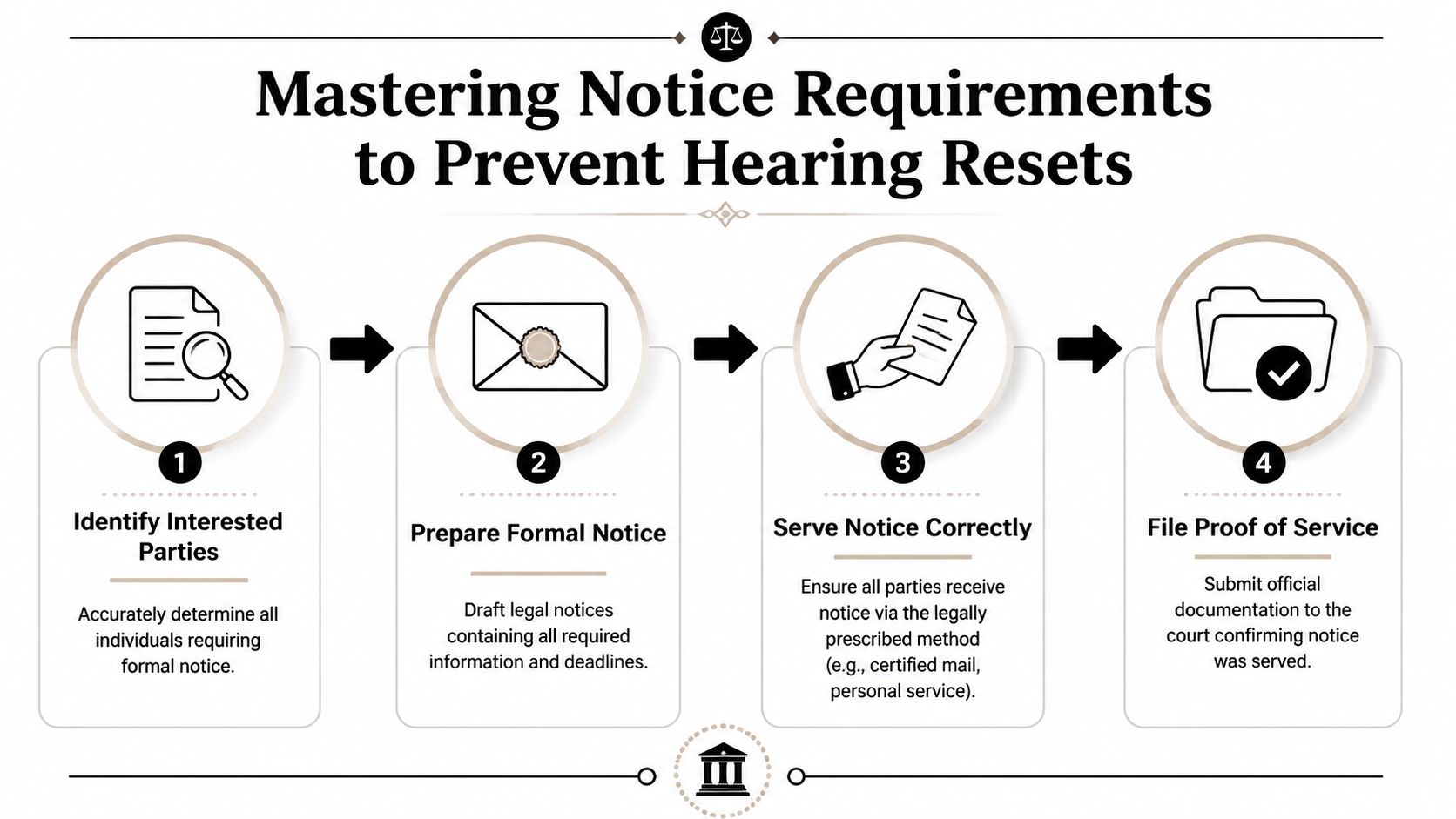
Texas guardianship procedure generally requires formal notice and citation. Depending on the person involved, service may need to be accomplished through methods recognized by the court, and proof of service must be filed correctly. The proposed ward's rights are especially protected, and the court-appointed attorney ad litem has an important role in reviewing the case and communicating with the proposed ward.
The notice checklist that prevents resets
Families should think about notice in four parts:
- Identify every required recipient. Don't rely on memory. Build a written list with names, relationships, and addresses.
- Choose the correct method of service. Some people may require personal service, while others may receive notice in a different approved manner.
- Track deadlines backward from the hearing. If service happens late, the hearing may have to be moved.
- File proof carefully. A completed return or affidavit that contains errors can create the same practical problem as no service at all.
For a county-specific and statute-based discussion, this overview of Texas guardianship notice requirements is a useful starting point.
Here's a short video that helps explain how these procedural steps affect a case in real life.
Why complete files move faster
Judges and probate staff often work under heavy caseloads. That makes complete, accurate filings even more important. The National Guardianship Association notes that high caseloads and limited resources contribute to delay and weak oversight, and a national study cited in the same presentation found that about 25% of guardianship hearings lasted less than five minutes, while approximately 94% of guardianship requests were granted in this National Guardianship Association presentation. The practical takeaway is straightforward. When the file is complete and procedurally clean, the court can move. When notice or proof is defective, the case slows down.
One wrong address can matter as much as one missing medical page. Both can force the court to wait.
What families should do before the hearing is set
Don't wait for the hearing date to start locating relatives. Confirm addresses before filing if possible. If one recipient is difficult to locate, address that problem early with counsel and the court's rules in mind. In probate courts, details that look administrative from the family's point of view are often central from the judge's point of view.
When Family Disagrees Exploring Contests and Expedited Options
A case can be perfectly filed and still slow down fast once family conflict enters the picture.
I see this often. One child believes a parent can no longer manage medications or money. Another says guardianship is unnecessary. A third agrees help is needed but objects to who should serve. At that point, delay usually comes from the dispute itself, not from the clerk's office or the medical paperwork.
A contested guardianship usually means more hearings, more sworn evidence, more records, and more time for the court to sort out credibility, capacity, and the least restrictive option. In practical terms, families should treat a likely contest as part of the pre-filing checklist. Identify the likely objections early. Gather the documents that answer those objections. Decide whether the immediate problem is long-term incapacity, a short-term safety crisis, or both.
Contested guardianship versus urgent relief
These are different tracks, and families lose time when they treat them as the same request.
| Issue | Contested guardianship | Temporary or emergency relief |
|---|---|---|
| Main purpose | Resolve who should have authority and whether guardianship is necessary | Address immediate risk while the larger issues are still pending |
| Typical pressure point | Family conflict and competing evidence | Whether the facts show present urgency |
| Court focus | Capacity, suitability, alternatives, and objections | Immediate protection of the proposed ward or property |
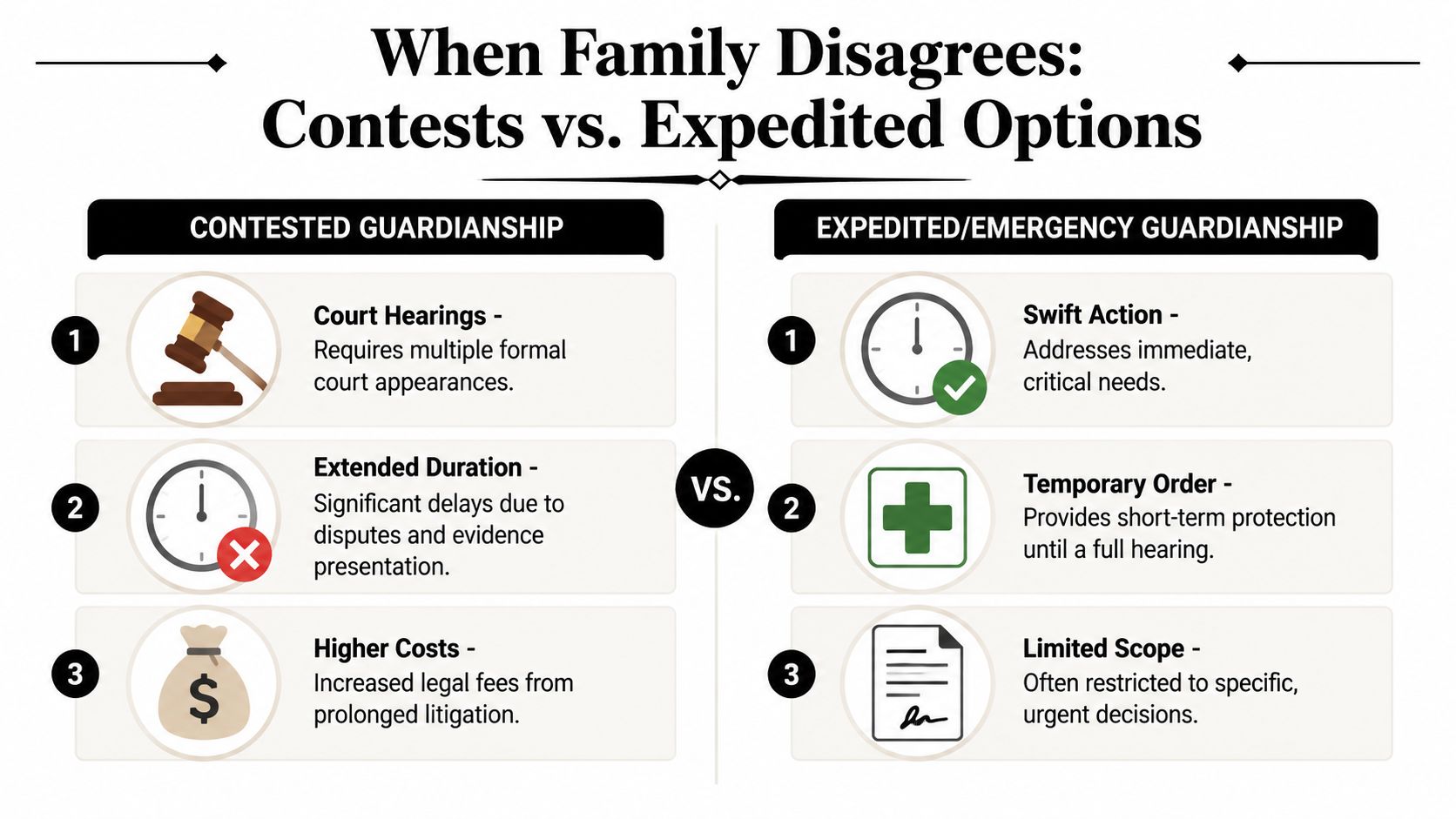
In Texas, temporary guardianship can be the right tool when someone needs protection now, but the permanent case will take longer because the facts are disputed. That might involve an elder with escalating financial exploitation, an adult with severe cognitive decline who is refusing necessary care, or a situation where no one can safely access funds to pay for housing or medication.
Courts do not grant temporary relief just because the family is worried. The evidence has to show a present need. That is why the front-loaded approach matters here too. If urgency is real, build that proof before filing. Collect discharge papers, APS reports if they exist, bank records showing unusual transfers, photographs of unsafe conditions, medication histories, and statements from people with firsthand knowledge.
When the full case may not be the fastest answer
Families under stress often aim straight for permanent guardianship because it feels like the complete solution. Sometimes that is right. Sometimes it adds delay when a narrower order would address the immediate problem more efficiently.
That trade-off deserves an honest look. A full guardianship can provide broader authority, but it also invites broader objections. A limited or temporary request may protect the proposed ward sooner while the court works through the larger dispute. The planning guidance in this discussion of planning early to avoid guardianship battles makes a similar point. Early planning and narrower tools can reduce both delay and conflict.
Decision point: If your loved one needs protection this week, ask whether the facts support temporary relief while the permanent case is being prepared.
Alternatives can reduce delay and conflict
Texas courts expect families to consider less restrictive alternatives before asking for guardianship. That is not a box to check. It is often the difference between a short hearing and a contested case.
A durable power of attorney, medical power of attorney, supported decision-making agreement, trust planning, or a representative payee arrangement may solve the actual problem without asking the court to remove broader rights. If those options were tried and failed, document that. If they were never possible because the person lacked capacity to sign, be ready to explain that clearly.
This is part of the same compliance checklist approach. Before filing, define the exact decisions that need to be made, who is blocking them, what documents already exist, and whether a limited remedy will work. Families who do that early usually save time later.
If a contest is likely, prepare differently
Contested cases require more disciplined preparation than uncontested ones. Good intentions are not enough. Judges need organized proof.
- Preserve records early that show safety risks, financial exploitation, missed care, wandering, unpaid bills, or inability to manage daily needs.
- Map the family positions before filing so counsel can anticipate who may object, who may support the application, and where the factual disputes will be.
- Avoid side agreements by text or phone that are never documented and later turn into arguments about who promised what.
- Keep the focus on the proposed ward instead of old sibling disputes, resentment about caregiving, or concerns about inheritance.
- Choose the narrowest workable request if a limited guardianship or temporary order will solve the immediate problem with less resistance.
Contested guardianship cases are hard on families. They are also more manageable when treated like a project with deadlines, documents, witnesses, and decision points identified in advance. That kind of preparation does not remove every conflict, but it prevents avoidable delay and gives the court a cleaner path to act.
Taking Control of Your Guardianship Timeline
A lot of families call my office after weeks of stress because they assumed the hard part would be the hearing. In many Texas guardianship cases, the primary delay starts earlier. The application goes in before the family has the medical records, the correct contact information, a realistic service plan, or a clear decision about what relief the court needs to grant.
The fastest cases usually look organized before filing. That is the practical shift that helps most. Treat the case like a compliance checklist, not a stack of forms. If the front-end work is done carefully, the court has fewer reasons to reset a hearing, ask for corrections, or wait on missing pieces.
A pre-filing checklist that prevents common delays
- Confirm the right court and county before anything is filed. Filing in the wrong place or using the wrong local procedure costs time you usually cannot get back.
- Define the immediate problem in plain terms. Identify the decisions that need to be made now, such as medical consent, placement, bill payment, or protection from exploitation.
- Choose the narrowest workable remedy. Some situations call for a full guardianship. Others may fit a temporary guardianship, a limited guardianship, or a less restrictive alternative.
- Assemble the medical support early. If the physician's certificate is incomplete, stale, or too vague, the case may slow down before it reaches the judge.
- Build a complete family and interested-person list. Missed names, bad addresses, and outdated contact information often create notice problems that reset hearings.
- Prepare for service before filing. If a respondent or relative is hard to locate, that issue should be identified early, not after the court date is set.
- Plan for post-appointment duties now. A proposed guardian should understand reporting duties, fiduciary obligations, possible bond requirements, and ongoing court supervision before asking the court for appointment.
Small paperwork problems can create outsized delay. One self-help filing guide warns that mailed filings and formatting errors can slow the opening of a case in this filing guidance from a self-help center. Texas courts have their own local rules, but the lesson is the same. Clean, complete filings move more smoothly than rushed ones.
Families should also look at the full legal picture before they file. Guardianship questions often overlap with Probate matters and Estate Planning options, especially if the family is trying to protect both the person and the person's property. Sorting that out early can prevent a case from becoming broader, slower, and more expensive than necessary.
If your family is facing a guardianship issue in Houston, Dallas, Austin, San Antonio, or anywhere in Texas, Law Office of Bryan Fagan, PLLC can help you build a clear plan before delays pile up. A free consultation can help you understand whether guardianship is necessary, what type of case fits your situation, what documents you'll need, and how to proceed while protecting your loved one's dignity and rights.