Skip to content
In Texas, the filing fee for a guardianship petition is usually about $250 to $400, but a simple uncontested case often costs $3,000 to $5,000 in the first year once attorney fees and court requirements are included. If the case becomes contested, legal fees can rise to $5,000 or more, and that's before the ongoing cost of reports, bond renewals, and compliance.
Many families learn this while sitting in a hospital room, talking through hard choices about a parent, an adult child with disabilities, or a relative whose judgment has sharply declined. They call the probate court, hear one filing fee, and think they have the whole picture. Then the rest starts to appear. Medical paperwork. court deadlines. bond requirements. annual reporting. Sometimes family conflict.
That's why the true cost of guardianship in Texas is almost never just one number.
A guardianship case under Texas Estates Code Title 3, Subtitle G is meant to protect someone who can't fully manage personal decisions, financial affairs, or both. But protection comes with process, and process comes with cost. If you're considering a case in a court such as Harris County Probate Court, Dallas County probate court, or a county court in a smaller Texas community, it helps to understand the full financial picture before you file.
An Honest Introduction to Guardianship Costs
Maria thought the hardest part would be deciding whether her father needed help. He had started forgetting medications, missing bills, and opening the door to strangers. By the time her family accepted that something legal might be needed, they were already emotionally worn down.
Then came the second shock. Guardianship wasn't just a form and a hearing.
For many Texas families, that's the moment the process gets confusing. They ask, “What does guardianship cost?” but what they really mean is, “What are we getting into, now and later?” That's the right question. Guardianship is a court-supervised legal relationship, and under the Texas Estates Code, the court has to confirm incapacity, protect the proposed ward's rights, and supervise the guardian after appointment.
Why families get surprised
Individuals expect a filing fee. They don't expect a stack of related expenses and recurring obligations.
Some of the confusion comes from the different types of guardianship:
- Guardianship of the person covers personal decisions such as residence, medical care, and daily needs.
- Guardianship of the estate covers money, property, and financial management.
- Combined guardianship may involve both, which can increase the work and supervision involved.
- Temporary or emergency guardianship can move faster, but urgency often creates its own legal and practical pressure.
Guardianship is often filed during a family crisis. That's exactly when clear budgeting matters most.
The law also starts from a careful position. Texas courts are supposed to consider whether a less restrictive option could work before imposing a full guardianship. That matters financially and personally. A broad guardianship can mean more court oversight, more paperwork, and more ongoing responsibility than families expect at the start.
What careful planning changes
When families understand the full path, they make better decisions. They ask better questions at the first attorney meeting. They gather records sooner. They try to reduce avoidable conflict. They also look seriously at alternatives when those options still exist.
That's the purpose of this guide. Not to frighten you, but to give you a realistic map of what families pay, what drives the cost up, and where smart planning can lower the burden.
Decoding the Initial Price Tag of a Guardianship Case
At the beginning, families usually focus on one question: “What do we have to pay to get this case filed?” The honest answer is that the first bill is rarely the whole bill.
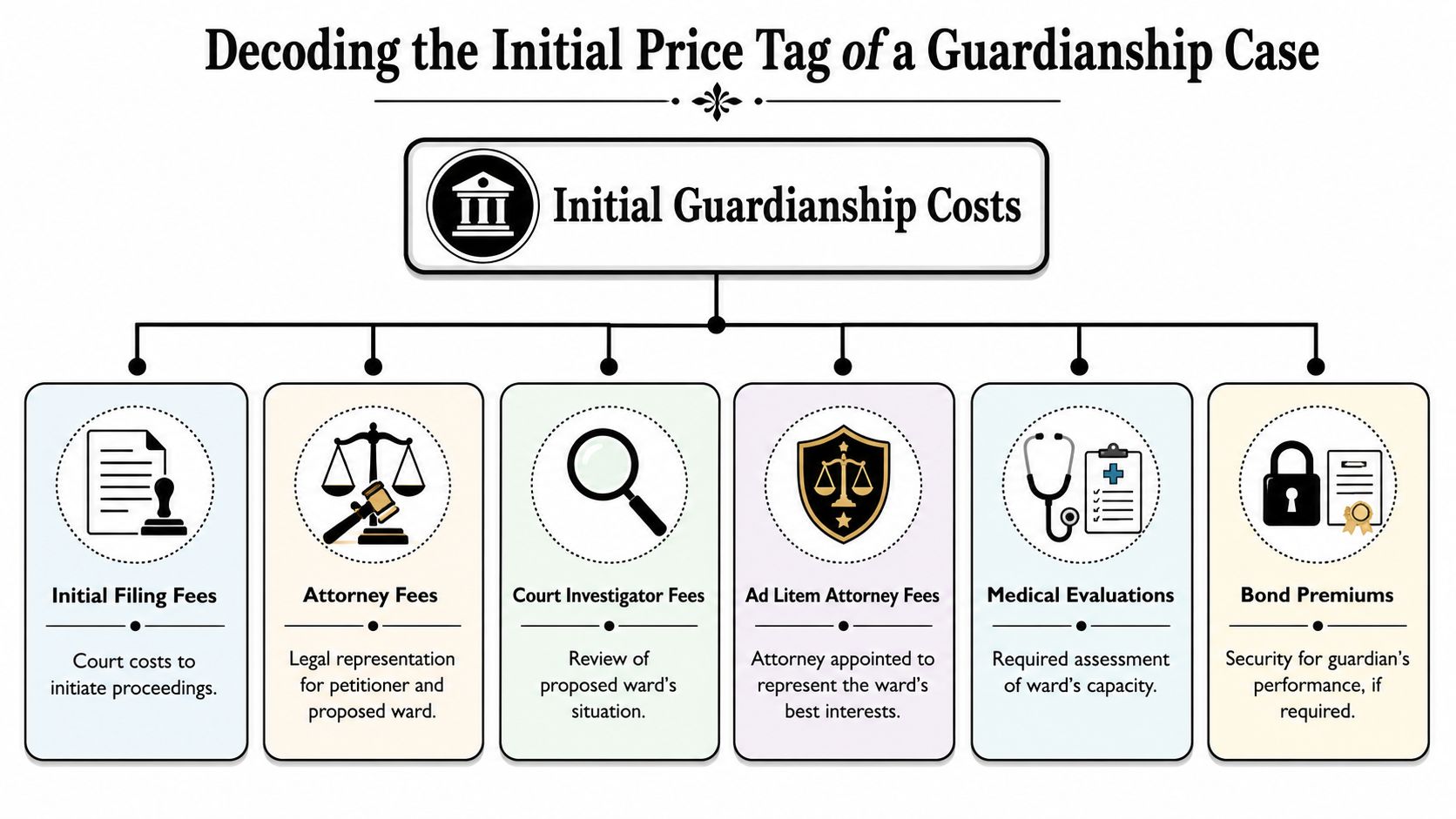
Texas guardianship cases usually open with court costs, but the larger expense is often legal work. According to this Texas guardianship cost guide, the upfront filing fee is typically about $250 to $400, and attorney fees for a simple uncontested adult guardianship are often $1,500 to $3,000. The same source notes that contested cases can rise to $5,000 or more, and that an uncontested case with minimal assets may still cost $3,000 to $5,000 in the first year.
To make that easier to picture, here is the cost stack many families face.
What the opening costs usually include
A guardianship application starts with the court filing, but the filing only opens the case. It doesn't complete the legal work.
Here's where families often spend money early:
- Court filing costs for opening the case in the proper county.
- Attorney fees for preparing the application, reviewing records, giving advice, and appearing in court.
- Medical evidence showing incapacity, usually through a physician's evaluation or related documentation required by the court.
- Notice and service costs to make sure required people receive legal notice.
- Bond-related expenses if the court requires the guardian to post bond.
- Court-appointed participation such as attorney ad litem involvement, depending on the case.
Some counties have their own local practices, so a family filing in Harris County may have a different practical experience than one filing in Travis County or Collin County. The legal framework comes from the Texas Estates Code, but local procedure still matters.
If you're trying to understand one part of that early expense, this explanation of a Texas guardianship bond requirement can help clarify when bond becomes part of the budget.
Why the first-year total is higher than the filing fee
The filing fee feels concrete, which is why families latch onto it. But most of the actual work happens around the filing, not in the clerk's fee itself.
That includes things such as:
Gathering proof of incapacity
The court won't remove rights based on family opinion alone. Medical documentation matters.Preparing the legal pleadings correctly
Errors can delay the case and create extra work.Attending hearings and responding to court requirements
Even smooth cases require time, coordination, and procedural compliance.Setting up the post-appointment steps
If the court appoints a guardian, more duties begin almost immediately.
A short video can help families understand why the process feels larger than they first expect.
A simple example
Suppose your mother in Houston needs a guardianship of the person because she can no longer manage medical decisions safely, and no one objects. The filing fee may look manageable. But once you add legal help, required paperwork, possible bond issues, and court compliance, your family may still face a first-year bill in the $3,000 to $5,000 range, as noted in the source above.
Practical rule: Don't budget for the filing fee alone. Budget for the first year of the case.
That one shift in thinking saves families from one of the most common surprises in guardianship law.
The Long-Term Financial Commitment of Being a Guardian
The hearing is only the front door.
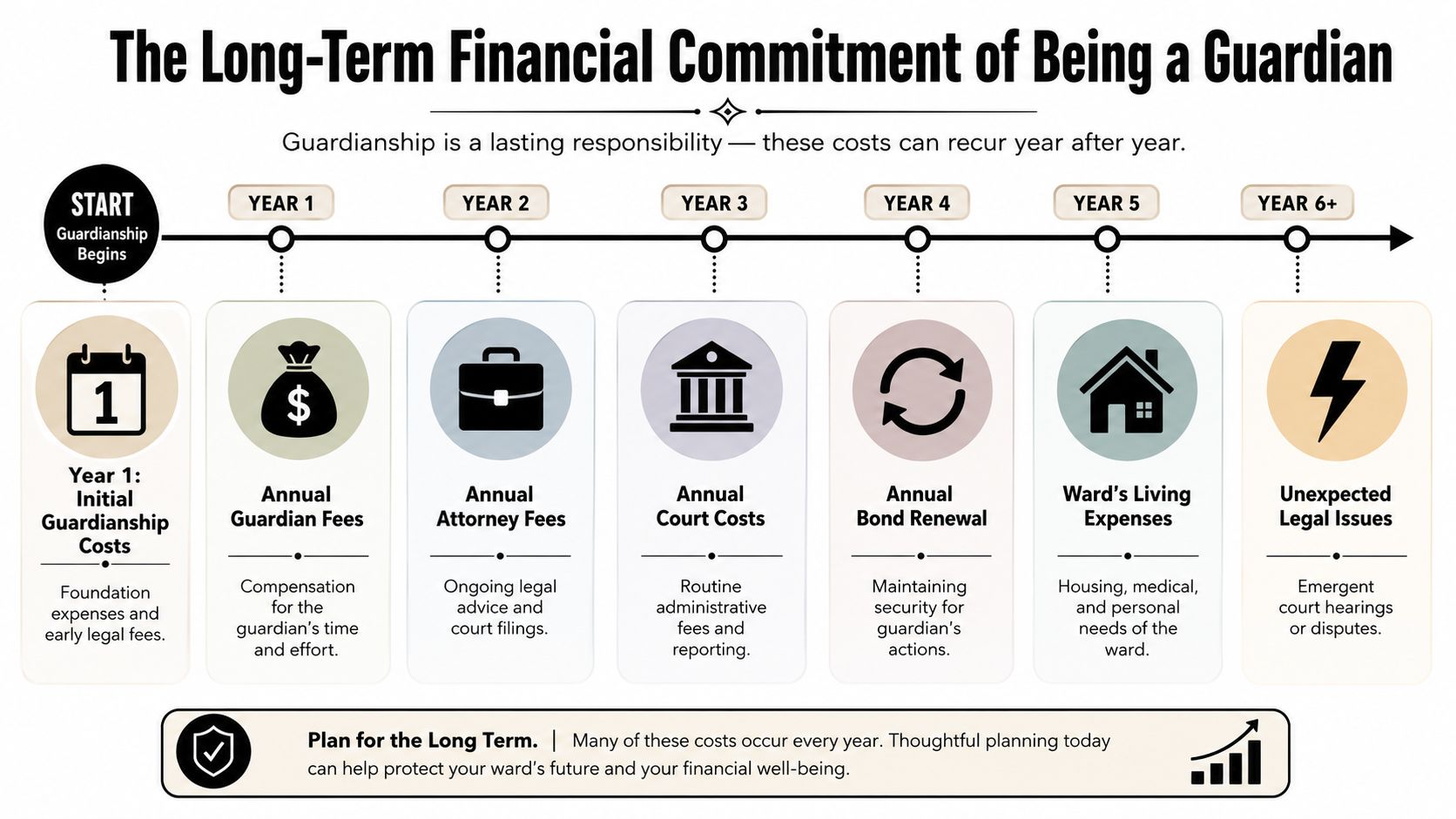
After the court signs a guardianship order, many families feel a brief sense of relief. Then the calendar starts filling up. Renewal dates, annual filings, bond requirements, updated letters, recordkeeping, and questions from the court become part of life. Guardianship in Texas works less like a one-time court victory and more like an ongoing reporting job tied to a loved one's care and money.
The recurring compliance cycle
Texas Law Help explains that Letters of Guardianship expire after 16 months unless they are renewed, and renewal generally requires current filings and continued compliance with court requirements. The same resource explains that some administrative costs may be paid from the ward's funds, while some categories are limited by Texas law.
That matters because the long-term cost of guardianship is not just legal fees. It is the repeated cost of staying current.
A simple way to understand it is this: the court does not appoint a guardian and then step away. The court keeps watching to make sure the guardian is protecting the ward, managing funds properly, and following deadlines. If your loved one has a guardianship for years, those compliance duties can repeat year after year.
What families keep paying for
The exact total depends on whether the guardian is responsible for the person, the estate, or both. But the recurring expenses usually come from the same places:
- Annual reports or annual accountings required by the court
- Bond premiums and bond renewals if a bond is required
- Fees for updated Letters of Guardianship and related court paperwork
- Attorney time for compliance questions, corrections, or court responses
- Bookkeeping and record organization for guardianship estate transactions
- Medical updates or evaluations if the court or changing circumstances require them
- Later court filings to modify powers, approve transactions, or end the guardianship
For many families, annual accounting becomes the hidden budget item. It is not dramatic, but it is persistent. If you want to see what that reporting duty can involve, this guide to annual accounting requirements in Texas guardianship cases gives a useful overview.
Bond renewals are one of the most overlooked costs
Families often plan for the filing fee and the first round of attorney work. They do not always plan for the bond to continue.
If the court requires a bond, that cost may return regularly rather than once. The premium can change based on the size of the estate, the ward's assets, and the bond company's underwriting. In practical terms, a guardianship with an estate can carry a built-in maintenance cost before anyone has a dispute or an emergency.
That is one reason the long-term financial picture matters so much. A case that seemed manageable in month one can feel very different by year three if the guardian is paying recurring bond premiums, getting help with annual filings, and correcting small paperwork issues as they arise.
Compensation and out-of-pocket cost are different questions
Families also get confused about guardian compensation. Those are not the same as the family's total cost of serving.
Texas law allows compensation in some situations, subject to court oversight and statutory limits. But even where compensation is allowed, it does not erase the work involved or guarantee that every expense will feel manageable month to month. Time spent collecting records, answering court requirements, working with a bond company, or meeting with counsel still has a financial effect, even if part of that expense can be paid from the ward's estate.
That distinction is easy to miss during the initial case. It becomes much clearer after the first annual deadline arrives.
Small compliance problems can become expensive
Late filings, incomplete records, and missing receipts often create the kind of cost families never expected. A guardian may need a lawyer to repair a reporting problem, prepare amended papers, appear at another hearing, or respond to court concerns. Those are avoidable expenses in many cases, but they are common enough that families should budget for some margin, not just a perfect year.
This is also where the total long-term cost of guardianship becomes more honest. The primary question isn't only whether your family can afford to open the case, but whether you can sustain the court's reporting system over time without falling behind.
For many Texas families, that long-term strain is the part online guides understate. They mention the opening cost. They spend less time on the recurring compliance cycle, bond renewals, and the extra professional help that becomes necessary if the guardian's paperwork slips.
How Family Conflict Dramatically Increases Guardianship Costs
The fastest way for a guardianship budget to grow is conflict.
A contested case doesn't just feel harder. It creates more legal work at almost every stage. One sibling objects. A parent's new spouse disagrees. A relative claims the proposed ward doesn't need a guardian at all. Suddenly, the case is no longer about routine filings. It becomes a dispute that the probate court has to sort out.

Why contested cases cost more
Independent Texas court materials explain that uncontested matters can still require several thousand dollars, while contested cases commonly move into the $5,000+ range. The same court materials say each disputed issue adds lawyer time, extra hearings, and often ad litem or expert involvement. They also note that Texas courts oversee an estimated $4.9 billion in assets under guardian control statewide.
That statewide asset figure helps explain the court's caution. Guardianship can involve control over real money, real property, and highly personal decisions. Judges take that seriously.
What triggers the contested case premium
A family dispute raises cost because it expands the amount of work required. Common cost drivers include:
- More hearings when parties disagree about incapacity, suitability, or scope
- More attorney time spent preparing objections, responses, and court appearances
- More investigation into family dynamics, finances, or past caregiving
- More experts or ad litem involvement when the court needs additional input
- More delay, which often means more billable time and more stress
In practical terms, every new issue creates another layer of proof. If one person says the proposed guardian is unsuitable, that claim has to be addressed. If someone argues that a less restrictive alternative would work, the court may need more evidence. If a sibling thinks the proposed ward signed valid planning documents before incapacity, that issue may become central.
A common Texas example
A son files in Dallas County to become guardian for his mother. His sister agrees their mother needs help, but she wants to serve instead. Neither side trusts the other. They start arguing over medical records, finances, past caregiving, and whether a guardianship of the estate is necessary.
The cost rises because the court isn't just deciding whether the mother needs protection. It may also need to decide who should serve, what powers should be granted, and whether a narrower alternative could work.
When families fight about guardianship, the ward's care needs don't stop. The legal expense gets added on top of an already difficult situation.
This is one reason early communication matters so much. Even limited agreement can save a family from turning a protective case into expensive litigation.
Real-World Scenarios What Texas Families Actually Pay
A family often walks into a guardianship case focused on the filing fee and the first lawyer bill. Then the case keeps going. Annual reports, accountings, bond premiums, certified copies, court visits, and occasional return trips to fix a problem can turn a one-time legal event into a long financial commitment.
That is why examples help. They show where the money tends to collect over time, much like a home repair that starts with one invoice but later includes maintenance, inspections, and insurance.
Scenario one with an aging parent in Harris County
Elena is caring for her father in Houston. He has become unsafe at home and cannot reliably manage medications, meals, or medical appointments. He has modest assets, there is no major family conflict, and the family is seeking guardianship of the person.
At first glance, this looks like the kind of case families label “simple.” In one sense, it is simpler than a courtroom fight between siblings. But “simpler” does not mean cheap, and it does not mean short-lived. Elena still has to cover the opening costs of the case, then deal with the ongoing duties that follow appointment.
Her long-term costs may include annual reporting, certified letters of guardianship when banks or doctors ask for updated proof of authority, and time spent responding to court requirements. If the court requires a bond or later wants additional documentation, those costs can repeat. Families are often surprised by that second layer. The first bill gets attention. The recurring compliance costs shape the actual total.
If Elena is also asking whether a less restrictive option could have worked, that question matters before filing. In some families, tools discussed in this guide to alternatives that may avoid guardianship in Texas can reduce both cost and court supervision.
Scenario two with siblings in Collin County
Marcus files for guardianship for his adult brother, who has serious decision-making limitations. At the start, the family agrees help is needed. Then one sibling objects to Marcus serving. Another argues that only limited authority is needed. A family friend raises older legal documents and says full guardianship should not happen at all.
The budget often changes shape at this point.
The family is no longer paying only for a guardianship case. They are paying for a dispute. That difference matters because contested cases tend to add layers of attorney preparation, responses to objections, extra hearings, and more review by the court. The “contested case premium” can become the biggest cost in the file, especially when the disagreement is about who should serve rather than whether the person needs protection.
There is also a less visible cost. Delay can leave bills unpaid, care plans unsettled, and family trust badly damaged. Those losses do not always appear on an invoice, but they still affect the total burden on the family.
Scenario three with a minor's estate
A child receives settlement funds or an inheritance that must be managed under court supervision. The family may not need broad authority over the child's daily care, but they may need a guardianship of the estate to protect and manage the money.
These cases can look administrative from the outside. In practice, they often function more like a long-term fiduciary job. The guardian may need to qualify with the court, maintain a bond, renew that bond as required, keep detailed records, and file periodic accountings. If money is invested, spent, or moved without proper approval, the family may face legal fees to correct the issue.
For that reason, the opening cost can be only the front door. The larger expense may come from years of compliance.
What these scenarios have in common
Each family starts in a different place, but the cost patterns are familiar:
| Situation | Where the money tends to build |
|---|---|
| Aging parent with no dispute | Ongoing reporting, document updates, possible bond and renewal costs |
| Adult sibling dispute | Attorney time, hearings, extra investigation, and the contested case premium |
| Minor's estate case | Bond costs, accountings, recordkeeping, and years of court supervision |
The main lesson is practical. Texas guardianship costs are shaped by duration, supervision, and conflict. A family that plans only for the filing stage may miss the larger financial commitment that follows month after month, and sometimes year after year.
Strategies to Reduce Costs and Powerful Alternatives to Guardianship
A daughter may walk into a lawyer's office expecting to ask one question. How much will it cost to get guardianship for Dad? Ten minutes later, she realizes the better question is broader. What is the least expensive legal path that still keeps Dad safe next month, next year, and three years from now?
That shift matters.
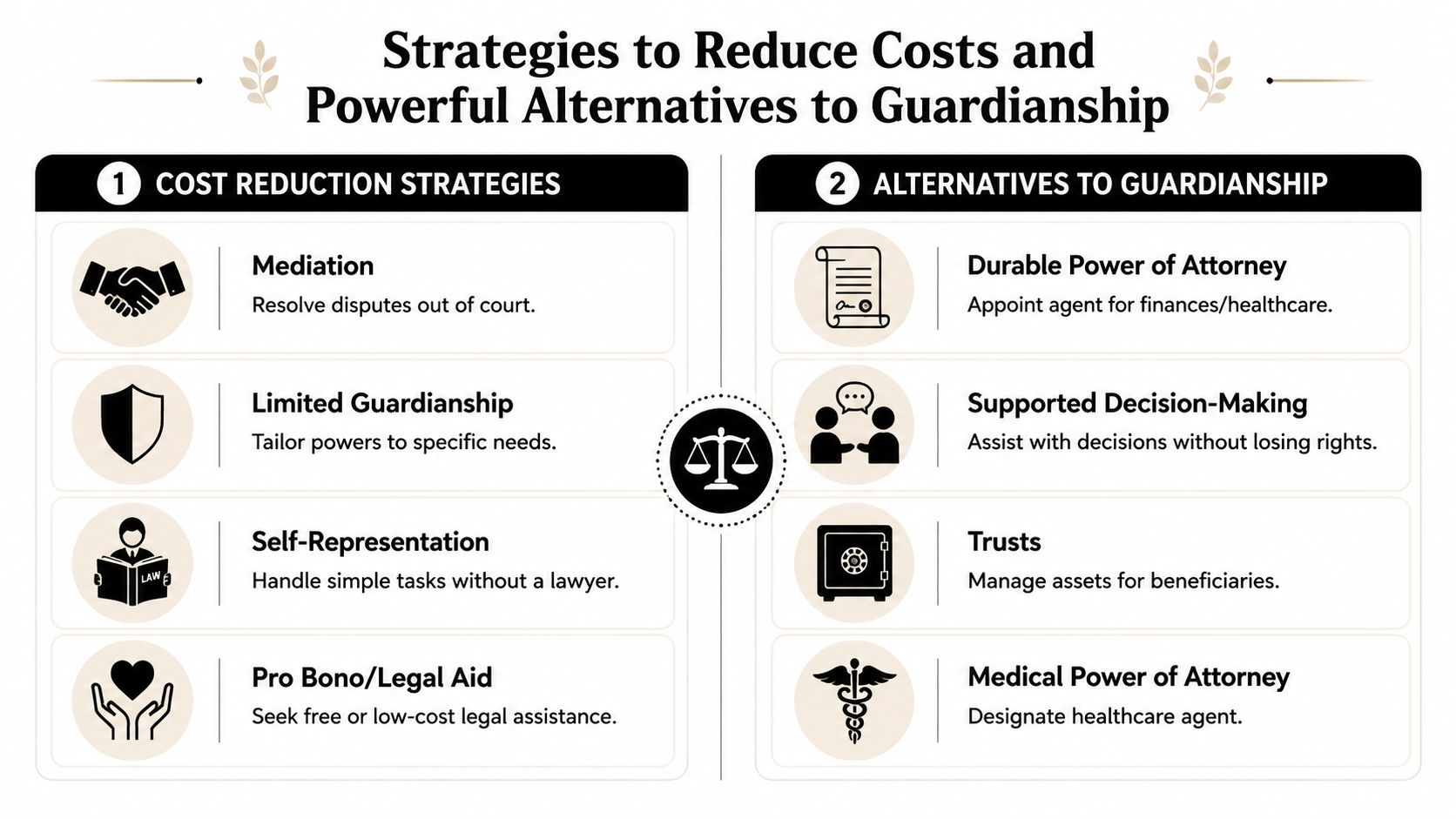
Guardianship can be necessary. It can also become the most expensive option over time because the bill is not limited to the filing. Families may face recurring court requirements, bond expenses, renewals, professional help with reports, and added legal fees if problems come up later. A good cost-saving strategy starts with a simple principle. Solve only the problem that needs solving, and do not ask the court for more control than the situation requires.
Cost-control moves that help before filing
Families who contain costs usually do one thing early. They get organized before the first petition is drafted.
That preparation saves attorney time, but it also does something more important. It helps the family see whether guardianship is truly needed, whether a limited guardianship would work, or whether another tool can solve the immediate problem with fewer long-term expenses.
A few steps often make a meaningful difference:
Gather the full paper trail before the first meeting
Bring medical records, medication lists, diagnoses, benefit information, account statements, deeds, insurance papers, monthly bills, and any prior legal documents. A lawyer can give clearer advice when the facts are on the table, and you spend less time paying someone to chase basic records.Map the decision problems, not just the diagnosis
A medical condition alone does not answer the legal question. Write down the real-world problems. Is rent unpaid? Is someone signing unsafe contracts? Are medical decisions stalled? This helps narrow the scope of the case and may support a less restrictive option.Address family friction early
Conflict is expensive in guardianship cases. If relatives disagree about who should serve, how money has been handled, or whether guardianship is needed at all, fees can rise fast. A calm family meeting or lawyer-guided discussion at the start can cost far less than a contested hearing later.Ask whether limited guardianship fits the facts
Guardianship is not all-or-nothing. If a person needs help with finances but can still make many personal choices, a limited arrangement may reduce both the loss of rights and the long-term administrative burden.Build a recordkeeping system from day one
A simple folder, spreadsheet, or dedicated account can prevent costly cleanup later. Guardianship works a lot like running a small supervised household business. If money goes in or out without a clear paper trail, fixing the problem usually costs more than preventing it.
Alternatives that may cost less and preserve more rights
Texas law generally favors the least restrictive option that will protect the person. For families, that is more than a legal principle. It is often the difference between a one-time planning expense and years of court oversight.
Depending on the situation, alternatives may include:
- Durable power of attorney for financial matters
- Medical power of attorney for health care decisions
- Supported decision-making agreements for adults who can choose with assistance
- Trust planning when asset management is the core concern
- Other incapacity planning documents prepared before a crisis
Each tool solves a different problem. A power of attorney can help with banking and bills. A medical power of attorney can help with treatment decisions. Supported decision-making can let an adult keep legal rights while receiving structured help from trusted people. Trust planning can be useful when the main concern is managing money rather than controlling daily personal decisions.
Families who want a closer look at those options can review this guide on legal strategies to avoid guardianship completely in Texas.
Why these alternatives matter to the long-term budget
The financial difference is often cumulative.
A valid planning document may cost money upfront, but it may spare the family from annual filings, bond-related expenses, renewal issues, and repeated attorney involvement. Guardianship, by contrast, can function like a subscription with variable charges. Some years are quiet. Some years bring missing records, bond questions, court requests, or disputes over spending.
That is why families should compare total cost over time, not just the opening invoice. A lower filing bill can still lead to a higher overall cost if the arrangement creates years of compliance work. The reverse can also be true. Spending more on careful planning now may reduce legal expenses later.
One practical way to compare options
At a consultation, ask questions that reveal the full financial picture:
- What problem requires immediate legal authority?
- Can that problem be solved with a power of attorney, supported decision-making, trust planning, or a limited guardianship?
- If guardianship is filed, what recurring court duties should the family expect?
- Will a bond be required, and could that cost continue or change over time?
- What events usually trigger extra legal fees after appointment?
- Is there any sign this could become contested?
Those questions help families compare pathways instead of comparing only intake fees.
Families can also compare service models. For example, Law Office of Bryan Fagan, PLLC handles guardianship applications, temporary guardianships, disputes, and compliance work for Texas families. That can matter when a case appears straightforward at first but later requires hearings, annual filings, or help correcting reporting issues.
The least expensive guardianship is often the one a family can lawfully avoid through earlier planning or a narrower legal solution.
That will not fit every case. Some families need court supervision. But every family should pause long enough to ask a careful question before filing. Is full guardianship the only safe answer, or just the first one that came to mind?
Navigating Your Next Steps with Confidence and Support
If you're weighing guardianship for a parent, spouse, adult child, or minor, you're probably carrying two burdens at once. One is emotional. The other is practical. Both deserve honest attention.
The emotional side is obvious. You're trying to protect someone vulnerable. The practical side is less obvious until bills and deadlines begin to stack up. Guardianship in Texas isn't just a courthouse event. Under Texas Estates Code Title 3, Subtitle G, it can become an ongoing legal responsibility with reporting duties, bond issues, and continued court oversight.
A calmer way to move forward
If your family is still in the decision stage, start with these steps:
- Collect existing legal documents such as powers of attorney, medical directives, trusts, and prior court papers.
- Write down the immediate problems you're trying to solve, such as unpaid bills, unsafe medical decisions, or misuse of funds.
- List family members and likely concerns so you can identify possible objections early.
- Ask whether a less restrictive option will work before filing for a full guardianship.
- Prepare for post-appointment duties, not just the hearing.
If you already know a guardianship is likely, specific legal advice matters. A family in Harris County may face different local procedures than a family in Bexar County or Travis County, even though the underlying Texas statutes are the same.
Related planning areas families often need
Guardianship questions rarely stay isolated. Families often also need help with:
- Texas probate matters
- Estate planning in Texas
- Guardianship guidance and case support
Those areas often connect. A probate issue may reveal the need for a guardian. An estate planning review may show that guardianship can be avoided. A contested guardianship may overlap with broader family fiduciary concerns.
You don't have to figure that out alone. The strongest first step is often a conversation that turns fear into a plan.
If you're trying to understand what your family may pay, and whether guardianship is the right tool at all, schedule a free consultation with Law Office of Bryan Fagan, PLLC. Our team can help you evaluate the type of guardianship involved, explain likely upfront and ongoing costs, discuss alternatives, and build a strategy that protects your loved one with clarity and care.