Skip to content
A hospital call in the middle of the day can change everything. Your mother has had a stroke in Houston. Your adult son was hurt in an accident near Dallas. A relative is confused, vulnerable, and suddenly unable to manage medical care, money, or basic safety. The family knows action is needed, but no one is sure who has legal authority to step in.
That's where many families begin searching for temporary guardianship in Texas. They're scared, short on time, and trying to protect someone they love before more harm happens. In the right emergency, temporary guardianship can give the court-approved authority needed to act fast.
But it's not the right answer in every crisis. Some families need a different legal tool, and choosing the wrong path can waste precious time. The key is knowing whether you're dealing with a true emergency under the Texas Estates Code, or a situation that can be handled through a simpler alternative.
When Your Loved One Suddenly Needs Protection
A common call to a Texas guardianship lawyer sounds like this: “My dad is in the hospital, he can't make decisions right now, and the bank won't talk to me. What do I do?”
In that moment, families aren't looking for abstract legal theory. They need a direct answer. If an adult may be incapacitated and faces immediate danger to their person or estate, a court can step in quickly through temporary guardianship. If you need a practical overview of the emergency timeline, this guide on how to get emergency guardianship fast in Texas step by step is a useful companion.
Temporary guardianship exists for urgent situations. It's designed for moments when waiting for a standard guardianship case could leave someone exposed to exploitation, missed medical care, unsafe living conditions, or serious financial loss.
A familiar emergency
Take a daughter in Harris County whose mother has advanced confusion after a sudden medical event. The hospital needs consent for treatment. Bills are going unpaid. A neighbor reports that strangers have been entering the home and taking property. The daughter has good intentions, but good intentions alone don't create legal authority.
That's when the court may be asked to appoint a temporary guardian.
Practical rule: Temporary guardianship is an emergency tool, not a shortcut for ordinary family disagreement or convenience.
Why families feel overwhelmed
The stress is real. You may be balancing work, travel, siblings' opinions, and a loved one's declining condition all at once. You may also be worried about cost, time, and whether going to probate court will make an already painful situation worse.
Those concerns are valid. The process moves quickly due to the critical nature of the matters involved, but it still requires proof, preparation, and careful compliance. When families understand the legal standard and the alternatives, they make better decisions and avoid unnecessary court fights.
Understanding Temporary Guardianship and Key Alternatives
Not every urgent family problem calls for a court order. Before filing anything, it helps to understand what temporary guardianship is, what it isn't, and when a different document may solve the problem faster.
What temporary guardianship means under Texas law
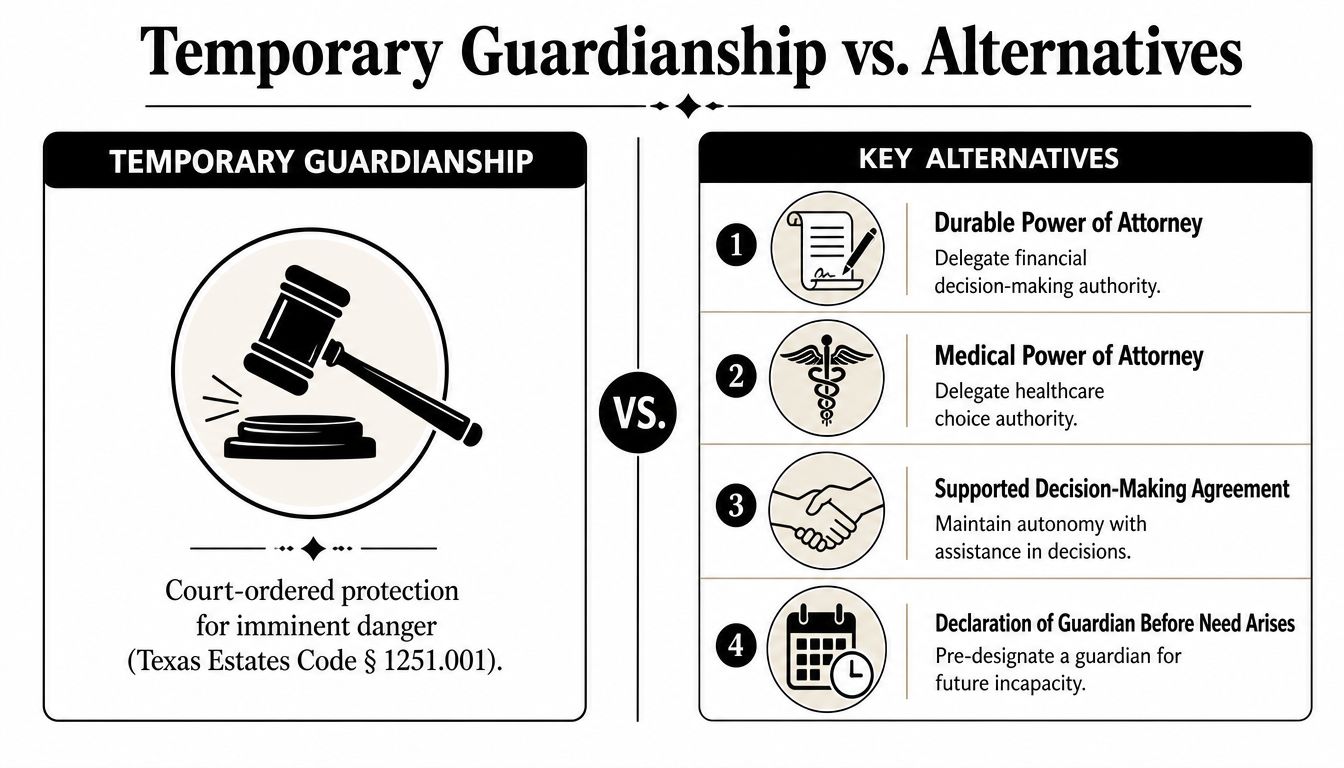
Under Texas Estates Code § 1251.001, a court must appoint a temporary guardian if there is substantial evidence that a person may be incapacitated and probable cause that the person or their estate requires immediate protection from imminent danger, as stated in Texas Estates Code Section 1251.001.
That standard matters. The court is not looking for inconvenience. It is looking for imminent danger and evidence that immediate intervention is necessary.
Temporary guardianship compared with other options
Here's the distinction many families miss. Temporary guardianship is only one tool.
| Option | Best fit | Court involved | Core function |
|---|---|---|---|
| Temporary guardianship | Emergency involving possible incapacity and immediate danger | Yes | Lets the court grant limited authority fast |
| Permanent guardianship | Longer-term incapacity concerns | Yes | Creates ongoing authority, subject to court oversight |
| Durable Power of Attorney | Adult planned ahead while competent | No | Delegates financial authority |
| Medical Power of Attorney | Adult planned ahead while competent | No | Delegates healthcare decision-making |
| Supported Decision-Making Agreement | Adult needs help but wants to retain autonomy | No | Allows assistance without transferring full control |
| Declaration of Guardian Before Need Arises | Adult wants to name a preferred future guardian | No court order at signing | Expresses future preference |
A strong set of planning documents often prevents the need for guardianship at all. That's the core issue discussed in Guardianship vs. Power of Attorney in Texas. When an adult signs valid authority documents before incapacity, families often avoid emergency court filings.
The alternative most families overlook for children
Families also confuse adult emergency guardianship with a very different option for minors. If the issue is school enrollment or medical consent for a child, the answer may not be probate court at all.
A Nonparent Caregiver Authorization under Texas Family Code §35 can allow specific caregiving authority without a court hearing. That matters when a parent is unavailable but there is no need to prove incapacity or imminent danger in probate court.
Some families pursue emergency guardianship when what they actually need is limited authority for a relative to help a child with school or healthcare decisions.
What tends to work and what usually doesn't
What works:
- Using planning documents early when an adult still has capacity.
- Choosing a less restrictive option when it will protect the person without court intervention.
- Filing for temporary guardianship only when the facts show true urgency.
What usually doesn't:
- Using temporary guardianship to settle family conflict.
- Treating it as a routine first step for every aging parent.
- Assuming the court will hand over broad powers without precise evidence.
Families in Texas often save time, money, and stress by asking one question first. Is this an emergency guardianship case, or is there a simpler legal path?
Who Can Request and Serve as a Temporary Guardian
A family emergency often exposes another problem fast. Everyone agrees someone needs help now, but no one is sure who should file, who should serve, or whether the court will view the proposed guardian as a safe choice.

Who can ask the court for help
Texas courts usually allow an interested person to request temporary guardianship. In real cases, that often means a spouse, adult child, sibling, relative, caregiver, or another person with direct knowledge of the danger facing the proposed ward.
The key question is practical. Why is this person the one bringing the application, and what facts can they prove?
Judges want specifics. A son who can describe missed medications, unpaid bills, wandering, financial exploitation, or an unsafe discharge from the hospital is in a stronger position than a relative who believes "someone should step in." Concern matters. Evidence matters more.
If you are trying to assess whether your situation fits the emergency standard, reviewing the paperwork in a temporary guardianship in Texas form guide can help you see what the court expects the applicant to allege clearly and under oath.
Who can serve as temporary guardian
The person who files the case does not always have to be the person who serves as guardian. Sometimes they are the same person. Sometimes they should not be.
The proposed temporary guardian must be an adult the court considers qualified, dependable, and able to carry out the order. That includes handling immediate decisions, communicating with doctors or facilities, protecting money or property if needed, and following the court's limits. In my experience, the best candidate is often the person who is organized, available, and calm under pressure, not merely the closest blood relative.
Courts also look for problems that make service inappropriate, including a history of abuse, neglect, exploitation, serious dishonesty, or other facts that cast doubt on the person's judgment or motives. Family conflict can also matter. If three siblings are fighting and one is asking for control, the court may scrutinize that request much more closely.
A practical example
An out-of-state daughter may still be the right applicant, or even the right temporary guardian, if she has the medical records, knows the treating physicians, can explain the immediate risk, and has a workable plan for care in Texas.
Distance is not automatically disqualifying. A weak plan is.
Judges respond well to clear facts, clean records, and a realistic plan for the next few days and weeks.
One distinction families still need to keep straight
This section deals with court appointment for an adult who needs urgent protection. The Nonparent Caregiver Authorization discussed earlier is different. It applies to caregiving authority for a child and can spare a family from filing the wrong kind of case.
That distinction matters because I often see families reach for "temporary guardianship" as a catch-all term. In Texas, the court will focus on the proposed ward's age, incapacity, the immediate harm at issue, and whether the person proposed to serve can be trusted with short-term legal authority.
Your Step-by-Step Guide to Filing the Application
A family usually reaches this point after something has already gone wrong. A parent is being discharged from the hospital but cannot understand instructions. An adult child is spiraling, and someone else is accessing the bank account. In that moment, families often say they need "temporary guardianship" when what they really need is the right legal tool, filed in the right court, with proof the judge can act on.
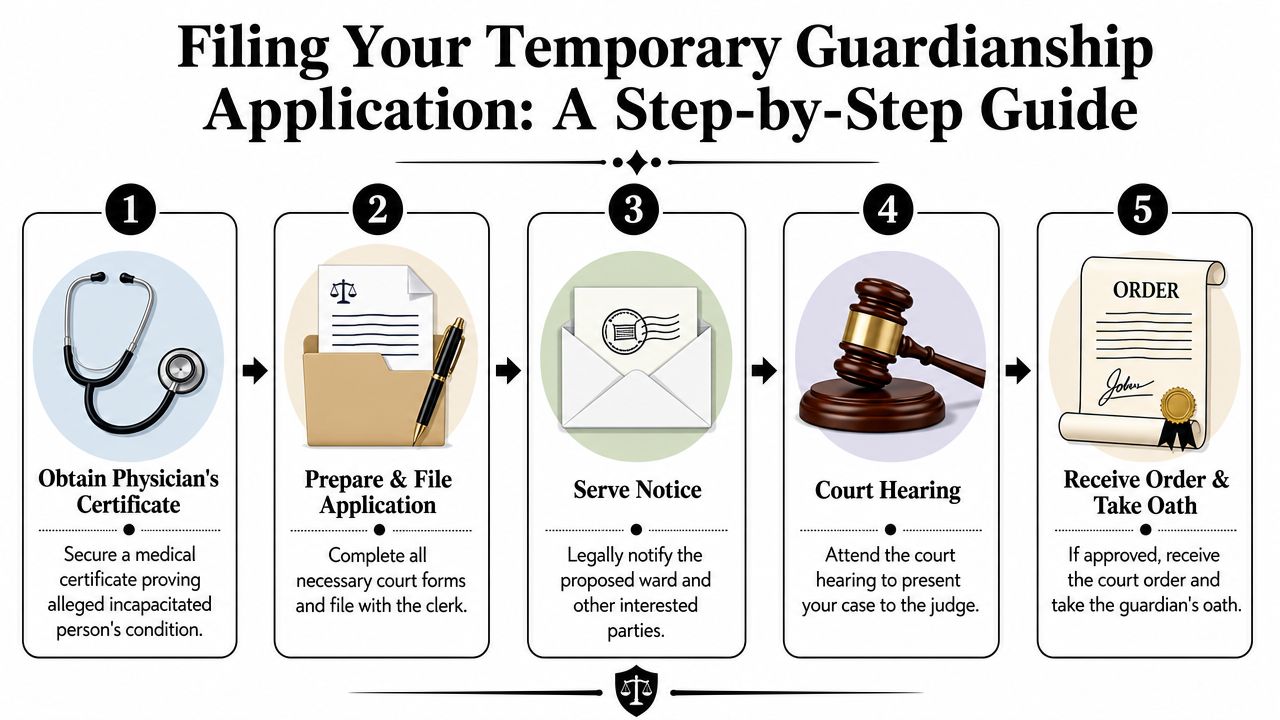
Before drafting anything, confirm that a court case is necessary. If the person needing help is a child, a non-judicial option such as a Nonparent Caregiver Authorization may solve the immediate problem without putting the family through an emergency guardianship case. If the person is an adult who may be incapacitated and immediate protection is needed, temporary guardianship may be the right path.
Start with the medical proof
For an adult temporary guardianship, the first document I look for is the Physician's Certificate of Medical Examination, or PCME. Without it, many cases stall immediately because the court needs medical support for the claimed incapacity.
The doctor must be licensed in Texas, and the certificate needs to match the emergency you are asking the court to address. A vague note that someone is "confused" is rarely enough. The better certificate explains the diagnosis, the limits on decision-making, and why prompt intervention is needed. Families who want to see how these filings are typically organized can review this temporary guardianship in Texas form overview.
The PCME is often the document that separates a true emergency case from a family dispute dressed up as one.
Draft the sworn application with facts, not conclusions
The application must be signed under oath. It needs to give the judge a clear reason to act quickly, using specific facts instead of family shorthand.
Include:
- Who needs protection, including the proposed ward's identity and present condition
- What happened recently that created the emergency
- What harm is likely without immediate court action, such as untreated medical needs, financial exploitation, unsafe living conditions, or inability to consent to care
- Who is asking to serve and why that person can carry out the job responsibly
- What powers you want the judge to grant, limited to the short-term problem that must be addressed
Details matter here. "My brother is not himself" does not help much. "My brother has dementia, wandered from home twice this week, refused prescribed medication, and cannot explain where his money went" gives the court something usable.
File in the correct court and follow that county's process
Temporary guardianship applications are generally filed in the probate court, or the county court with probate jurisdiction, for the county where the proposed ward lives or where venue otherwise belongs under Texas law. That sounds simple, but filing in the wrong place or using the wrong local procedure can cost time your family does not have.
Some counties have standing requirements about proposed orders, clerk intake, attorney appointments, or how medical records should be submitted. I tell families to treat local procedure as part of the case, not as clerical cleanup.
Expect a fast schedule
Temporary guardianship cases move quickly. Texas courts set these matters on an urgent timetable, and hearings are commonly set within days of filing. That speed is exactly why sloppy filings create problems. There may be little time to fix a missing certificate, a weak affidavit, or an unclear request for powers after the case is opened.
Gather the documents that judges and court staff actually use
Before filing, pull together a working packet, not just the petition:
- The completed PCME
- A short timeline of the recent events that created the emergency
- Names and contact information for close relatives, caregivers, and involved facilities
- Supporting records, such as discharge paperwork, APS information, account statements, police reports, or facility incident notes
- A proposed care plan explaining where the ward will stay, who will coordinate treatment, and how immediate bills or safety issues will be handled
- A proposed order that asks only for powers tied to the emergency
That last point is important. Judges are more receptive to a narrow, practical request than to a broad attempt to take over every decision at once.
A careful filing does two things at the same time. It shows the court there is a real emergency, and it shows the court your family has chosen the correct remedy instead of reaching for guardianship as a catch-all answer.
Preparing for the Temporary Guardianship Hearing
Court is stressful, especially when the case involves a parent, spouse, or child in crisis. The hearing helps the judge decide whether the emergency legal standard has been met. Knowing what the room will feel like and what questions may come up can make the experience less intimidating.
What the judge is looking for
The judge isn't deciding whether your family is worried. The judge is deciding whether the evidence shows a person may be incapacitated and needs immediate protection.
That's why the medical proof matters so much. A critical technical specification in Texas temporary guardianship is the mandatory Physician's Certificate of Medical Examination, which a Texas-licensed physician must complete. Failure to obtain this document before filing halts the entire process, as explained in this discussion of temporary guardianship requirements in Texas.
If you want a practical sense of what happens in court, this resource on an emergency guardianship hearing in Texas is a helpful reference.
Who may be in the courtroom
Depending on the county and the case, you may see:
- The judge, who decides whether temporary guardianship should be granted.
- The applicant and attorney, presenting the facts and requested powers.
- The proposed ward, if present and able to attend.
- An attorney ad litem, appointed to represent the proposed ward's interests.
- Family members or witnesses, especially if their testimony helps explain the emergency.
The courtroom tone is usually direct. Emergency cases move quickly, but judges still expect specific facts.
Questions families should be ready to answer
A typical hearing may focus on practical issues like these:
- What happened recently that created the emergency?
- Why can't a less restrictive option solve this problem?
- What exact decisions need to be made right away?
- Why is this proposed guardian appropriate?
- What powers are necessary, and which powers are not?
A daughter in Bexar County might testify that her father cannot understand medication instructions, recently signed suspicious financial documents, and now needs someone with limited authority to protect him until the court can address longer-term issues.
Bring a timeline, not just a story. Judges respond better to clear events, dates, records, and witness support than to generalized family concern.
What helps and what creates problems
Helpful evidence often includes organized medical information, records showing financial exploitation, notes from caregivers, and testimony that ties the risk to immediate action.
What creates problems is overreaching. If the family asks for broad control without showing why each power is needed, the court may narrow the request or question the filing altogether. In temporary guardianship Texas cases, precision usually works better than ambition.
Your Duties and Next Steps After a Judge Grants the Order
Getting the order is a major relief, but it also starts a new set of obligations. A temporary guardian answers to the court and must stay within the authority granted.
Your authority is limited
A temporary guardian only has the powers the court specifically grants. If the order gives authority to consent to certain care, that does not automatically include every financial or legal decision. The ward keeps all rights not transferred by the order.
That limited structure is important. Temporary guardianship is meant to solve an emergency, not erase a person's legal identity.
Immediate compliance steps
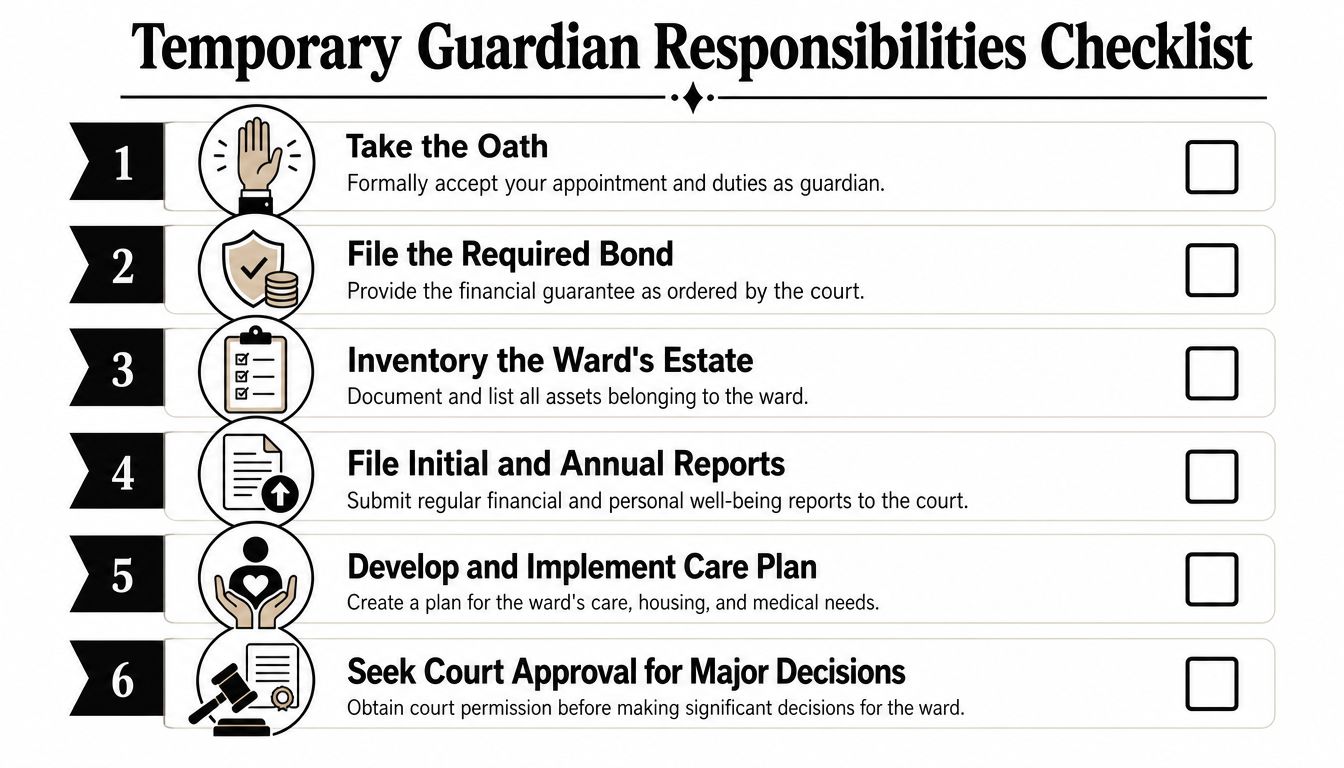
Within 20 days after appointment, the temporary guardian must file an Oath and Bond with the court, and at the end of the temporary appointment must file a sworn final accounting of estate property and acts performed as guardian, as stated in the Fort Bend County temporary guardian instructions.
That means the job begins quickly. If the court appoints you, read the order carefully, complete the oath and bond requirements on time, and keep records from the first day.
The clock is already running
In Texas, a temporary guardianship is legally restricted to a maximum duration of 60 days. If a challenge is filed, the court may extend the temporary guardianship term until the challenge is resolved. If a permanent guardianship is not established before the period expires, the respondent automatically regains all rights, as explained in this Texas temporary guardianship overview.
That short lifespan changes how you should think about the case. You are not settling into a long-term role. You are managing an urgent period while the family and the court decide what comes next.
What a careful temporary guardian should do
- Read the order line by line: Your power comes from the written order, not from family expectations.
- Act only within granted authority: If the order is silent, assume you need further legal guidance before acting.
- Keep records from day one: Save receipts, notes, communications, and decisions.
- Watch the deadline: If long-term help is needed, permanent guardianship issues must be addressed before the temporary order ends.
- Stay focused on protection: The role is fiduciary. Every action should benefit the ward, not simplify family conflict.
Short-term guardianship often fails when a guardian treats it like a blank check. Courts expect restraint, documentation, and strict compliance.
The two paths after appointment
Some emergencies stabilize. The person recovers enough to regain control, or the immediate danger passes. In that situation, the temporary guardianship ends and the ward's rights return as the law provides.
Other cases point toward a longer problem. If the incapacity and need for protection continue, the family may need to pursue permanent guardianship or another lasting arrangement. That's often where disputes emerge, especially if siblings disagree, the estate is complicated, or someone challenges incapacity.
For some families, that's the point where structured legal help becomes less optional and more practical. Firms such as Law Office of Bryan Fagan, PLLC handle guardianship applications, hearings, and post-appointment compliance in Texas probate matters.
Let Our Family Help Your Family Navigate This Process
Emergency guardianship cases are hard because they mix legal urgency with family pain. You may be trying to protect a parent while siblings disagree. You may be handling a crisis from another city. You may be worried that one paperwork mistake could slow down treatment, housing, or financial protection.
Those concerns are justified. Temporary guardianship cases move fast, but they can also become contested just as quickly. The risk grows when the medical proof is incomplete, the requested powers are too broad, or the family hasn't carefully considered whether a less restrictive option could solve the problem.
Where legal guidance matters most
Legal counsel is especially useful when:
- The emergency facts are strong but complicated, such as suspected exploitation or multiple medical providers.
- Family members disagree about incapacity, control, or who should serve.
- The ward has both personal care and financial risks, which requires precise drafting.
- A long-term solution may be needed, including permanent guardianship, probate coordination, or estate planning.
Families also benefit from understanding related legal tools before filing. A broader review of Guardianship, Probate, and Estate Planning issues often reveals whether the problem calls for court intervention or a less restrictive approach. For that same reason, many Texas courts and lawyers also look closely at alternatives, including the concepts discussed in Less Restrictive Alternatives to Guardianship in Texas.
Clear advice helps families make better decisions
The right next step depends on the facts, not on fear. Some families need to file immediately. Others need a caregiver authorization for a child, updated powers of attorney, or a strategy for a coming permanent guardianship case.
Good legal guidance should do two things at once. It should protect your loved one, and it should avoid unnecessary court action when a simpler option will work.
If your family is facing an urgent guardianship issue, Law Office of Bryan Fagan, PLLC offers free consultations to discuss your situation, explain your options, and help you decide the next step with clarity. If you're trying to protect a loved one in Houston, Dallas, Austin, San Antonio, or anywhere in Texas, schedule a consultation for personalized guidance.