Skip to content
You may be reading this in the middle of a crisis. A parent with dementia may have stopped taking medication. A sibling may have discovered unusual withdrawals from an elderly relative's bank account. A hospital may be asking for consent, while nobody in the family has legal authority to act.
In moments like that, families usually want one answer fast. Can a Texas court step in now, before the damage gets worse?
Sometimes, yes. Under Texas law, the emergency form of guardianship is called temporary guardianship. It exists for situations where waiting through the ordinary guardianship process would expose a vulnerable person, or that person's property, to immediate danger. If you're dealing with a hospital standoff, this guide on what to do when a hospital says you have no authority to make decisions can help frame the urgency.
A Guide for When a Loved One Is in Immediate Danger
A common emergency guardianship Texas case starts the same way. An adult child visits Mom and finds unpaid bills stacked on the table, food spoiled in the refrigerator, and a stranger suddenly “helping” with banking. Or a loved one with serious cognitive decline refuses care, wanders outside, and can't explain where they live.
Those facts matter because Texas courts don't use temporary guardianship for family disagreements or long-running tension. They use it when there is a present threat that requires immediate legal authority. Under Texas Estates Code §1251.001, a court may appoint a temporary guardian with limited powers if there is substantial evidence that a person may be incapacitated and probable cause exists that the person or the person's estate requires immediate appointment.
This is a powerful remedy, but it is also narrow. A temporary guardianship in Texas generally lasts no more than 60 days, as required by Texas Estates Code §1251.151 and summarized here. The authority ends automatically unless the court moves forward with a full guardianship case before that period expires. In practice, that means the order is meant to stabilize a dangerous situation, not create permanent control over someone's life.
What temporary guardianship is meant to do
Temporary guardianship can help a family:
- Stop immediate harm by giving one person legal authority to act
- Address urgent medical decisions when no valid decision-maker is in place
- Protect money and property from rapid loss, misuse, or exploitation
- Create a short window for the court to examine whether a longer-term guardianship is necessary
Practical rule: If the danger can wait for the normal court process, the judge may decide temporary guardianship isn't appropriate.
Families often feel guilty for even considering guardianship. That's understandable. But when a loved one can't protect themselves, asking the court for short-term help may be the most responsible step available.
Recognizing the Threshold for Imminent Harm
The hardest part of emergency guardianship Texas cases is usually not the paperwork. It's proving imminent harm. Judges in Texas probate courts, including Harris County Probate Court and courts in Dallas, Travis, and Bexar counties, want specific facts showing that the risk is real, immediate, and serious.
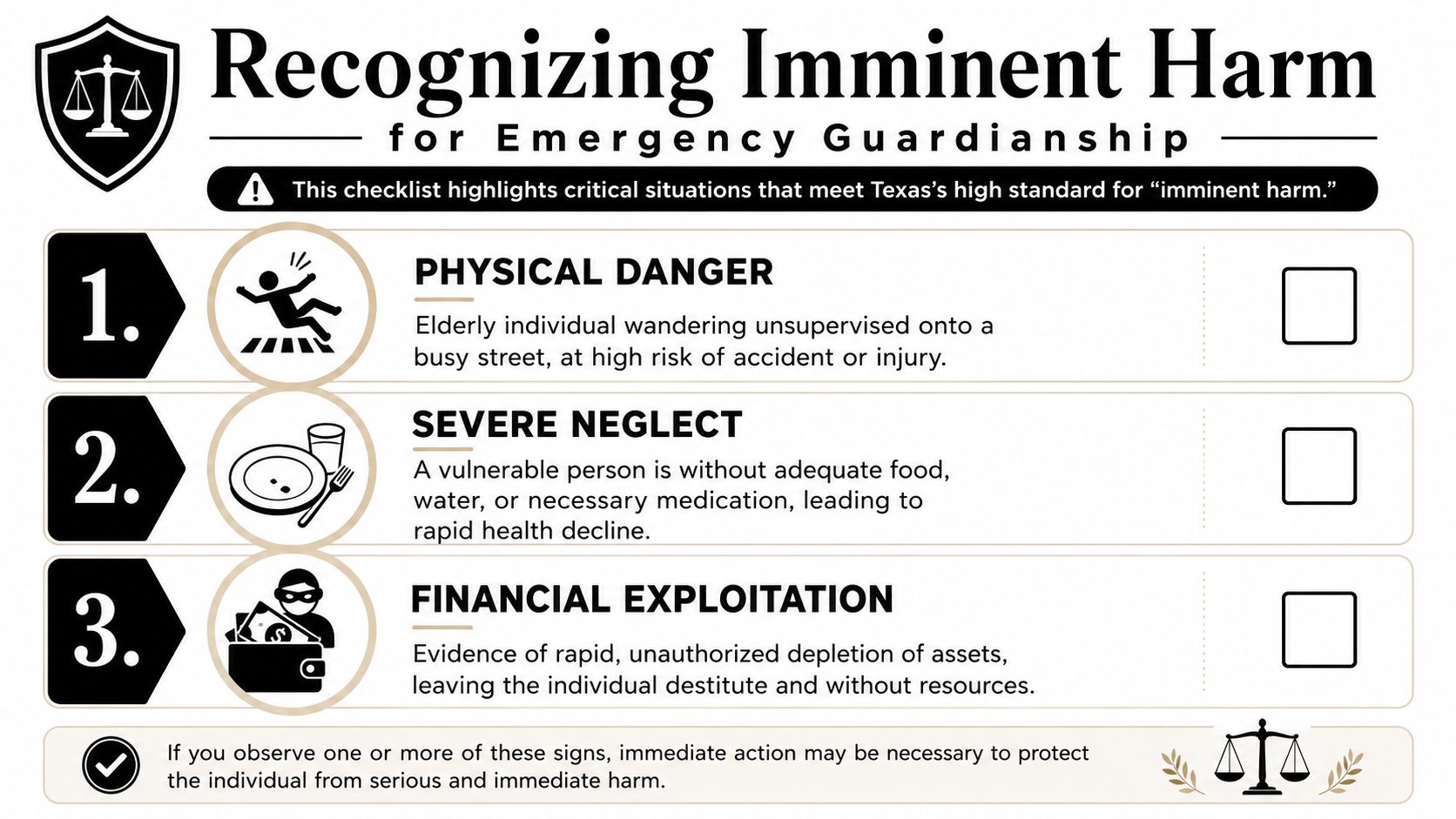
Situations that often meet the standard
A few examples make the threshold easier to see.
A man with advanced confusion keeps leaving home alone and walking into traffic. A woman with severe mental impairment has no food in the house, isn't taking prescribed medication, and can't explain how she'll meet basic needs. An older adult's accounts are being emptied by someone who recently gained access to debit cards and online banking. Those are the kinds of facts that suggest a current emergency.
Texas courts evaluating Temporary and Emergency Guardianship in Texas focus on whether a person faces immediate harm, not just whether the family is worried. That distinction is important.
The court is looking for a present danger to the person or property, not a prediction that things might become difficult later.
Situations that usually do not qualify
Not every painful family problem justifies emergency relief. A parent making unusual spending choices, refusing advice, dating someone the family dislikes, or living in a way relatives consider irresponsible may not be enough by itself.
That's especially true when the person still understands the consequences of decisions, even bad ones. Texas guardianship law protects autonomy as well as safety. A court won't appoint a temporary guardian just because one family member believes they'd manage things better.
Here's a brief explanation:
| Situation | Likely court view |
|---|---|
| Unsafe wandering, untreated medical crisis, active exploitation | May support emergency action |
| Family disagreement, eccentric spending, strained relationships | Often not enough without immediate danger |
What families should ask themselves
Before filing, ask:
- What happened recently: Can you identify specific incidents from the last few days or weeks?
- Who saw it: Is there a neighbor, caregiver, doctor, or officer who can confirm what occurred?
- What harm is likely next: Will the person miss treatment, lose housing, or lose access to essential funds if no one acts now?
This standard is demanding for a reason. Temporary guardianship can restrict important rights, so courts want strong proof that the danger can't wait.
Preparing and Filing the Emergency Petition
A daughter in Colorado gets a call at 7:10 a.m. Her mother in Houston was discharged from the hospital, went home alone, and by noon a neighbor found the front door open and the stove on. In that moment, families do not need abstract legal theory. They need a petition supported by proof that shows the judge what could happen before tomorrow.

Treat the filing as an emergency evidence package. The court paperwork matters, but the result usually turns on whether the documents show a present, specific risk and a limited request that matches that risk. Families who want a broader overview can start with this guide to filing a guardianship petition in Texas, then tighten the presentation for the emergency facts.
The documents that usually matter most
Texas temporary guardianship is governed by Texas Estates Code Chapter 1251. Courts move quickly, and judges usually focus on a short list of records that answer three questions: what happened, who saw it, and what harm is likely if no one has authority to act today.
The strongest filings usually include:
- The application identifying the proposed ward, the applicant, and the exact powers requested
- A current Physician's Certificate of Medical Examination, if one can be obtained in time, or other recent medical records that document incapacity and immediate risk
- Affidavits from witnesses with firsthand knowledge such as neighbors, caregivers, hospital staff, social workers, or family members who directly observed the events
- Objective records such as discharge papers, APS reports, police incident reports, bank records, eviction notices, photographs, call logs, or text messages showing the emergency in real time
A common mistake is filing every concerning document the family can find. Judges give more weight to a small, organized record than to a disordered stack of papers.
Building proof that a judge can trust
“Imminent danger” is usually proved through detail, not dramatic language.
Start with a timeline covering the last days or weeks. List the date, the event, the witness, and the immediate risk. If your brother missed insulin on Tuesday, signed a large check to a new “friend” on Wednesday, and was found wandering in traffic on Thursday, put those incidents in order and attach the records that support each one.
The file is stronger when the proof comes from different directions at once. Medical records may show confusion or noncompliance. Bank statements may show exploitation. A neighbor affidavit may confirm wandering or unsafe conditions. Photos may show spoiled food, no running water, or medication scattered around the home.
Practical test: If a judge reads the petition without hearing the family history, the attached records should still show why waiting creates a real risk.
This short video gives a practical look at how urgent guardianship issues are approached in Texas courts.
Local filing realities and out-of-state problems
In counties such as Harris, Dallas, Travis, and Bexar, temporary guardianship requests often land in statutory probate courts when jurisdiction is proper. Local practice can affect timing. Some clerks will reject incomplete filings. Some judges expect the requested powers to be tied closely to the specific emergency, especially when the applicant asks to control both medical decisions and property.
Out-of-state relatives face practical problems that Texas-based family members often do not see at first. Distance makes it harder to get a prompt physician exam, sign and notarize papers, arrange service, and gather affidavits from people who saw the danger. It also creates a credibility issue if the petitioner knows the crisis only through phone calls. In those cases, the petition must lean harder on records and local witnesses.
I often tell out-of-state clients to build their case from the ground up in Texas. Get the hospital records. Get the name of the responding officer or APS investigator. Get a sworn statement from the neighbor, facility staff member, or caregiver who was physically present. If you may need to appear quickly, decide early whether you can travel or whether local counsel will need to present the evidence with supporting affidavits and records already in order.
What to Expect at the Guardianship Hearing
Most families walk into the hearing worried that they'll say the wrong thing. The hearing is serious, but it's usually focused. The judge isn't looking for dramatic language. The judge wants clear facts, reliable documents, and a limited request tied to a specific emergency.

If you're new to this process, it helps to understand the people in the room. The probate judge decides whether the emergency standard has been met. The applicant, often a family member, testifies about what has happened. The proposed ward may also have representation through an attorney ad litem. If you need broader background on these cases, the firm's Texas Guardianship Lawyer page explains guardianship of the person and estate under the Estates Code.
What the judge will usually want to know
The court often narrows in on a small set of practical questions:
- What exactly is the danger: Is the threat medical, physical, financial, or a combination?
- Why is action needed now: What will likely happen if the court waits?
- What powers are necessary: Does the applicant need authority over medical care, property, or both?
- Is there a less restrictive option: Is there a valid power of attorney or another legal arrangement that could solve the problem?
A concise answer tends to work better than a broad family history. If the danger is financial exploitation, show the withdrawals and explain who gained access. If the problem is medical, connect the incapacity evidence to the urgent treatment decision.
A simple example of effective testimony
A daughter in Harris County might testify like this:
“My mother was discharged from the hospital three days ago. Since then, she has not taken prescribed medication, left the home during the night, and cannot identify her address. Yesterday I found notices showing a new person had been added to her account access. I'm asking for temporary authority to consent to treatment and secure the accounts until the court can review the full guardianship case.”
That kind of testimony works because it is concrete. It gives the judge dates, events, and a limited request.
What usually does not help
These points often weaken a hearing:
| Problem | Why it hurts |
|---|---|
| Speaking in generalities | The court needs facts tied to immediate risk |
| Asking for broad control | Temporary guardianship should be limited to the emergency |
| Turning the hearing into a family dispute | The judge is deciding protection, not old grievances |
The courtroom feels less intimidating when you remember what the hearing is for. It is a narrow inquiry into whether temporary intervention is necessary to prevent harm.
Your Immediate Duties After Appointment
The judge signs the order, and families often feel a brief sense of relief. Then the actual work starts. In a temporary guardianship, the first problem is usually speed. The second is proof. Third parties will not rely on a court order alone if the clerk has not issued your Letters of Guardianship.
Under Texas procedure, a newly appointed guardian usually must qualify by filing the required oath and posting any bond the court ordered before the clerk issues the Letters. Those Letters are what hospitals, banks, and care facilities expect to see before they will let you act. If you are an out-of-state petitioner, plan for extra delay here. Getting a bond arranged, signing paperwork, and obtaining certified copies can take longer when you are coordinating from another state.
Handle the court requirements first
Start with the items that make your authority usable:
- File the oath promptly. This is your formal acceptance of fiduciary duties and the limits set by the court.
- Post the bond if the order requires one. The bond protects the proposed ward's estate if a guardian misuses funds or property.
- Get certified Letters of Guardianship from the clerk. Ask for multiple certified copies if you will be dealing with several institutions at once.
Texas courts also expect temporary guardians to explain the ward's rights in a way the ward can understand. Bexar County's temporary guardian court instructions are a useful example of what courts look for in practice.
Do not wait to “get organized” before doing these steps. Without qualified status and Letters, you may have an order in hand but no practical control.
Put the order to work, within its limits
Read the appointment order line by line. Temporary guardianship orders are often narrow for a reason. One order may allow medical consent but not access to bank accounts. Another may allow control of a residence and medications but not authority to sell property.
That limitation matters on day one.
If the immediate risk is financial exploitation, take certified Letters to the bank, ask to freeze suspicious access where the order allows it, and keep a written log of every contact, account restriction, and document you deliver. If the emergency is medical, provide the Letters and order to the hospital, treating physician, facility, or case manager, then confirm in writing who has authority to consent and what decisions still require further court approval. If substance use is part of the crisis, families should also understand related rehab legal considerations before agreeing to treatment arrangements that may affect placement or consent.
If the danger is at home, secure medications, keys, checkbooks, firearms if lawfully necessary and appropriate, and basic identity documents. Photograph the condition of the residence and make an inventory. Those records protect the ward, and they protect you if another relative later claims property was mishandled.
Keep records from the first hour
Temporary guardianship is a fiduciary job. Courts expect disciplined recordkeeping immediately, not later when the case becomes contested.
Keep:
- a contact log
- copies of every letter, email, and discharge paper
- receipts for any money spent for the ward
- an inventory of property you secured
- notes showing why each urgent decision was necessary under the order
I tell families this often. Good records win credibility. Sloppy records create hearings you did not need.
Families also need to resist a common mistake. Temporary appointment does not give broad permission to take over every part of a loved one's life. Act only within the powers granted, preserve the ward's dignity, and return to court if the emergency grows beyond the order you have. If you are unsure where that line is, this guide on when you need a guardianship attorney and when you don't helps frame the decision.
Alternatives and Why an Attorney Is Crucial
At this stage, families often ask a hard question. Is emergency guardianship the only way to keep this person safe today, or is there a less restrictive tool the court will expect you to try first?
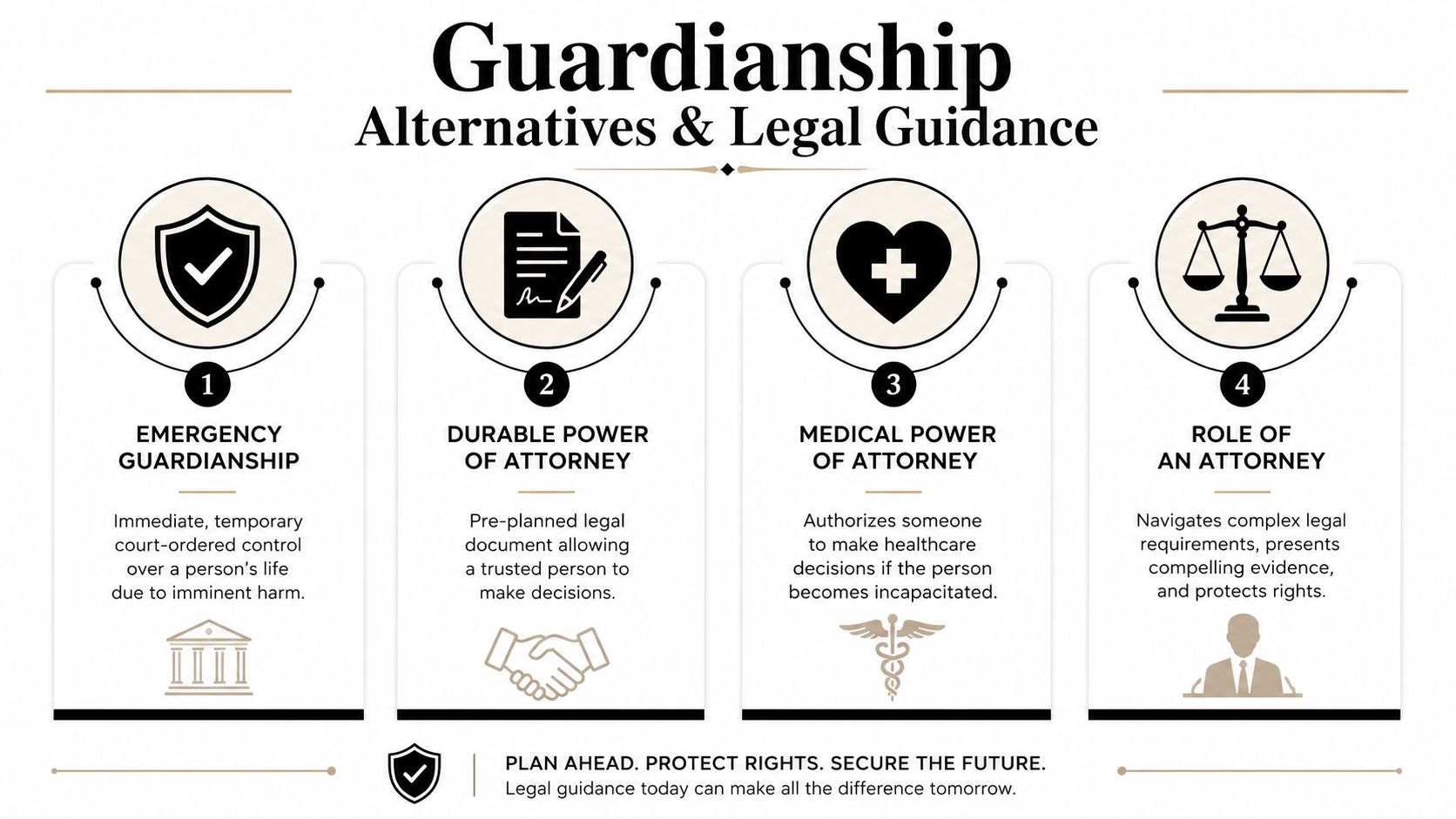
Texas courts do not treat guardianship as the default answer. They expect the petitioner to show why a narrower option will not protect the proposed ward from the immediate risk already described in the case. That matters in emergency filings, because a judge may ask why an existing power of attorney, a medical consent arrangement, facility placement, Adult Protective Services involvement, or family support was not enough.
Comparing the main options
Here is the practical difference between the tools families usually consider:
| Option | Best fit |
|---|---|
| Temporary guardianship | Immediate danger and no less restrictive tool will work |
| Durable power of attorney | Financial decision-making authority planned in advance |
| Medical power of attorney | Health care decision-making planned in advance |
| Supported Decision-Making Agreement | A person can still decide with help, structure, and support |
Durable and medical powers of attorney can solve many problems without a contested court case, but only if the person still has the legal capacity to sign them. In a true emergency, that window is often already closed.
A Supported Decision-Making Agreement can also be the right answer in the right case. It allows an adult to keep decision-making authority while receiving help understanding options, communicating with providers, and organizing information. That is a good fit for some families. It is not enough where the evidence shows immediate exploitation, medical neglect, wandering, refusal of necessary care without understanding the consequences, or rapid cognitive decline.
Why legal guidance matters in urgent cases
The hardest part of these cases is rarely the form itself. It is proving, with admissible and specific evidence, that the danger is real, current, and serious enough to justify emergency relief now.
I see the same pressure points over and over. Records are scattered between hospitals, rehab facilities, and relatives. A daughter living in another state knows something is wrong but does not yet have the chart notes, discharge papers, photographs, bank records, or witness statements needed to prove imminent harm in a Texas court. Another family has evidence, but it points to a need for help, not an emergency order.
That distinction decides cases.
A lawyer's job in this setting is not paperwork alone. It is narrowing the request to the powers the judge can justify, identifying the quickest way to get medical evidence into the file, addressing service problems before they derail the hearing, and presenting facts that meet the emergency standard instead of sounding like a general family dispute. Families weighing whether they can handle the matter themselves should read this explanation of when a guardianship attorney makes sense and when a family may handle the process alone.
Substance use cases add another layer. If the dispute involves detox, treatment placement, or consent to rehab, families should also review related rehab legal considerations before asking the court for emergency authority.
Law Office of Bryan Fagan, PLLC handles Texas guardianship, probate, and estate planning matters, including temporary guardianship filings, capacity disputes, and compliance issues under Title 3, Subtitle G of the Texas Estates Code.
If your family is in that position, get the facts organized first. Then get legal advice focused on one question. What is the least restrictive legal step that will protect your loved one today, and can you prove the need for it with evidence the court will accept?