Skip to content
When a loved one passes away, the last thing your family wants to face is a drawn-out, confusing legal ordeal. We understand the emotional and financial weight you're carrying, and our goal is to guide your family through this process with clarity and care. Think of the Texas probate process not as a legal maze, but as a roadmap with clear milestones. Just knowing the route ahead can make a world of difference during this challenging time.
So, how long does probate actually take in Texas? For a straightforward, uncontested estate with a valid will, the process usually takes between six to twelve months. But if things get complicated—say, if there are disputes among heirs, significant debts, or a complex mix of assets—the timeline can easily stretch to a year or more. Knowing this range from the start is the first step toward managing expectations during an already difficult time.

Different Probate Paths, Different Timelines
Not every estate follows the same legal path in Texas. Some are simple enough to qualify for streamlined procedures, while others need more formal court supervision. The journey through probate is guided by the Texas Estates Code, starting with an initial application filed in a local court, like the Harris County Probate Court, and ending with the final distribution of assets.
A well-organized estate with a clear will and cooperative family members will naturally move faster. For example, a Harris County family we assisted settled their father’s estate—which included a house, investments, and some minor debts—in just under six months. Their secret? They filed quickly, had their documents in order, and addressed creditor notices right away. Being proactive makes a huge difference. You can learn more at txprobatelawyer.net.
The key is figuring out which probate route fits your family’s situation. Below is a quick breakdown to help you get a sense of the common options.
Estimated Texas Probate Timelines at a Glance
This table provides a quick summary of expected timelines for the most common types of probate and estate settlement procedures in Texas. It's designed to help families identify which path their situation most closely resembles and set realistic expectations for the road ahead.
| Probate Type | Typical Duration | Best For |
|---|---|---|
| Independent Administration | 6 – 12 Months | Estates with a valid will and cooperative beneficiaries. |
| Dependent Administration | 1 – 2+ Years | Estates with disputes, significant debts, or minor heirs. |
| Muniment of Title | 2 – 4 Months | Estates with a valid will but no outstanding debts. |
| Small Estate Affidavit | 1 – 3 Months | Small estates (under $75,000) with no will. |
Each path has its own purpose, and choosing the right one can save you months of time and frustration. The goal is always to find the most efficient and least stressful route for your family.
This journey can feel daunting, but you don't have to walk it alone. Understanding the basics of Probate and how it connects with Guardianship and Estate Planning is the first step. For personalized guidance tailored to your family’s unique circumstances, schedule a free consultation with our compassionate legal team.
Mapping Out the Key Stages of Texas Probate
Trying to figure out "how long does probate take in Texas" can feel overwhelming. It's much easier when you stop thinking of it as one massive legal hurdle and instead see it as a series of connected stages. Each step has its own purpose, a typical timeline, and is guided by the rules in the Texas Estates Code.
Think of it like building a house. You can't start putting up walls before you've poured a solid foundation. Probate is the same way—each step must be completed in the right order to keep things moving smoothly. This structured approach is designed to prevent legal headaches down the road and make sure every detail is handled correctly.
Let's walk through this journey, phase by phase.
Stage 1: Filing the Will and Initial Hearing
The probate process officially kicks off when someone files an Application for Probate with the local court, such as a Tarrant County Probate Court. This application, submitted with the original will, is a formal request for the court to recognize the will as legally valid and appoint the person named as the executor.
Once that's filed, the county clerk is required to post a public notice for at least 10 days. This is a waiting period that gives anyone who might want to contest the will a chance to come forward. After the 10 days are up, the court will schedule a hearing.
During the hearing, a judge looks over the will, listens to testimony to confirm it's valid, and then officially appoints the executor. From the initial filing to the hearing, this first stage usually takes about four to six weeks, but this can easily change depending on how busy the court's calendar is.
Stage 2: The Executor Takes Charge
With the hearing complete, the court issues what's known as Letters Testamentary. This is the golden ticket for the executor. It's the official document granting them the legal power to act for the estate—things like accessing bank accounts, managing property, and starting to settle the deceased's final affairs.
Within 60 days of the will being admitted to probate, the executor has another important job: notifying every beneficiary named in the will. This practical step keeps everyone in the loop about their inheritance and the ongoing process, which goes a long way toward promoting transparency and heading off potential family squabbles.
According to the Texas Estates Code, the executor is a fiduciary. That's a legal term meaning they have a strict duty to act in the absolute best interests of the estate and its beneficiaries. This responsibility highlights just how critical careful and honest administration is at every turn.
Stage 3: Inventory and Notifying Creditors
One of the executor's biggest tasks is creating a comprehensive list of everything the estate owns. This document is officially called the Inventory, Appraisement, and List of Claims. It must be filed with the court within 90 days of the executor's appointment, though it's possible to ask for an extension if the estate is particularly complex.
At the same time, the executor needs to let the estate's potential creditors know what's happening. This is usually done by publishing a notice in a local newspaper. If there are known creditors, they should get a direct, formal notice as well. Creditors then have a set amount of time to submit claims for any outstanding debts.
The probate timeline is heavily influenced by strict deadlines at each phase. For instance, the clock starts ticking with the initial filing (2-4 weeks), followed by the hearing (4-6 weeks), the 90-day inventory requirement, and the mandatory four-month period for creditors to file claims under Texas Estates Code §308. Court backlogs can also play a major role; data shows that urban courts like those in Harris County can process cases 15-20% slower than rural ones due to higher caseloads. You can discover more insights about how these deadlines shape the probate journey and its duration.
Stage 4: Settling the Estate and Final Distribution
Once the window for creditor claims has closed, the executor can start paying off the estate's valid debts, taxes, and any administrative expenses. Sometimes this means selling property to free up the cash needed to cover everything. Throughout this stage, keeping meticulous records of every single transaction is absolutely essential.
After all the bills are paid and liabilities are settled, the executor's final job is to distribute the remaining assets to the beneficiaries, following the will's instructions to the letter. Once all assets have been handed out and the final accountings are approved, the executor can file the paperwork to formally close the estate.
This last stage brings the probate journey to an end. While a simple, uncontested estate might wrap up in six to twelve months, any complications along the way can stretch the timeline out considerably. For a deeper dive into the specifics, check out our guide on probating a will in Texas. Our team is here to provide the compassionate, professional guidance your family deserves.
Why Some Estates Take Longer Than Others
Not all estates are created equal, and their complexity is the single biggest factor dictating how long probate takes in Texas. Understanding the difference between a "simple" and "complex" estate is the key to setting realistic expectations for your family.
A simple estate is what we hope for in most cases—one that can be settled in about six to twelve months. This usually involves a clear, valid will, beneficiaries who are easy to find and are on the same page, and straightforward assets like a family home, bank accounts, and vehicles.
On the other hand, a complex estate can easily take one to three years, or even longer, to fully resolve. These estates are tangled with challenges that require a significant amount of legal work to unravel.
This timeline gives you a simplified look at the core stages of probate and how long they generally take.
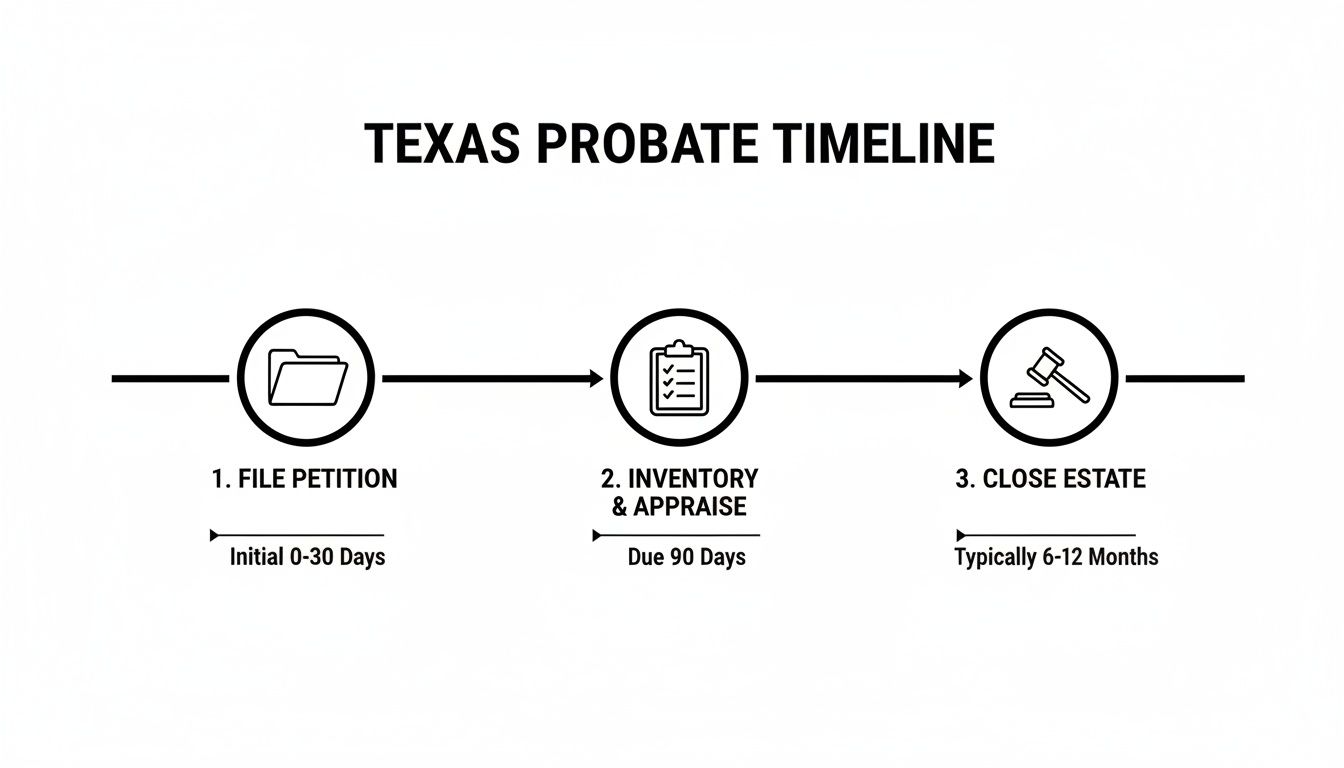
While the visual shows a straight line, the reality for a complex estate is often getting stuck in one of those phases for months due to the kinds of issues we'll explore below.
Simple Probate: A Hypothetical Scenario
To see the difference in action, let’s imagine the Garcia family. Mr. Garcia passed away with a valid will that clearly named his two adult children as beneficiaries and his daughter, Sofia, as the executor. His estate was simple: a home in Austin, a car, and a checking account.
Sofia hired a probate attorney, filed the will, and received her Letters Testamentary from the Travis County Probate Court in about six weeks. Because there were no debts beyond routine utility bills and the siblings were in complete agreement, creating the estate inventory was a quick process. After paying the final bills, she distributed the assets exactly as the will directed, and the estate was closed in just under eight months. The Garcia family's experience is a textbook example of a smooth, simple probate.
Complex Probate: A Different Story
Now, let's turn to the Thompson family. Mr. Thompson also left a will, but his situation was far more complicated.
His estate included several challenging assets and circumstances:
- A family-owned business: Valuing a private business is a specialized process that requires professional appraisers and can take months to complete accurately.
- Multiple real estate properties: He owned a primary residence in Dallas County, a rental property with active tenants, and undeveloped land in another state. Each property required separate management, valuation, and legal handling.
- Significant debts: The business had outstanding loans, and several creditors filed claims against the estate that had to be carefully verified and negotiated.
- A will contest: An estranged family member challenged the will's validity, kicking off a legal dispute that added nearly a full year to the probate timeline.
Because of these hurdles, the Thompson estate required a dependent administration. This meant the court had to approve nearly every action the executor wanted to take, adding layers of paperwork and court hearings that stretched the process to over two years.
The core difference lies in the number of variables. A simple estate has a clear path, while a complex one has multiple intersecting roads, each with potential delays.
For estates that are small and have minimal assets, there are sometimes simpler alternatives to traditional probate. To learn more about one such option, you can explore our guide on the Texas Small Estate Affidavit form. Understanding these distinctions is the first step in preparing for the road ahead.
Common Roadblocks That Can Delay Probate
Even with a perfectly drafted will, the probate journey can hit some serious turbulence. We all hope for a smooth, straightforward process, but it's smart to know about the common roadblocks that can stretch a six-month timeline into a multi-year ordeal. Understanding these potential hurdles from the get-go helps you and your attorney anticipate and navigate them, keeping things moving as much as possible.
Facing these delays is incredibly frustrating, especially when your family is already grieving. The emotional and financial weight can feel crushing, but knowing what you might be up against is the first step toward getting through it.

Will Contests and Family Disputes
A will contest is one of the most significant—and emotionally draining—delays you can face. This happens when an heir, or someone who feels they should have been an heir, officially challenges the will's validity in court.
Under the Texas Estates Code, a will can be challenged for several reasons:
- Lack of Testamentary Capacity: The argument is that the person who died wasn't of sound mind when they signed the will.
- Undue Influence: Someone claims the deceased was manipulated or pressured into creating or changing the will against their true wishes.
- Improper Execution: The will wasn't signed or witnessed according to the strict legal rules in Texas.
A will contest instantly flips a simple administrative task into full-blown litigation. We're talking depositions, court hearings, and maybe even a trial. This alone can add a year or more to the probate timeline and drive legal costs way up.
Challenges with Estate Assets and Debts
Sometimes, the estate itself is the source of the delay. Not every asset is as simple as a bank account. Complications frequently pop up with:
- Difficult-to-Value Assets: Putting a price tag on a family business, a collection of art, or multiple real estate properties isn't easy. It requires specialists and can take months to get an accurate appraisal.
- Locating All Assets: The executor sometimes has to become a detective, digging around for hidden bank accounts, forgotten investment portfolios, or unrecorded property deeds.
- Disputes with Creditors: If a creditor makes a claim the executor believes is invalid, it can spark negotiations or even a lawsuit. That dispute has to be settled before the estate can be.
Each of these issues adds another layer of work, pushing back the final distribution of assets to the beneficiaries who are waiting.
Administrative and Logistical Hurdles
Then there are the delays that have nothing to do with family fights or complex assets—they're just part of the system. These administrative snags are common and can be a huge source of frustration.
For instance, simply locating beneficiaries can be a massive challenge if the will is old or family members have moved and lost touch. The executor has a legal duty to find them, which might mean hiring an investigator and can take a surprisingly long time.
On top of that, the probate courts themselves, especially in busy areas like Harris County or Dallas County, often have packed dockets. This can mean waiting weeks or even months just to get a hearing scheduled, bringing the whole process to a dead stop.
The table below breaks down some of these common delays and shows just how much time they can add to the process.
Common Probate Delays and Their Impact on Timelines
| Factor Causing Delay | Potential Time Added | How an Attorney Can Help |
|---|---|---|
| Will Contest | 12 – 24+ months | Represents the estate in litigation, files motions to dismiss frivolous claims, and negotiates settlements. |
| Complex Assets | 6 – 12 months | Connects the executor with qualified appraisers and financial experts to accurately value and manage assets. |
| Creditor Disputes | 3 – 9 months | Formally rejects invalid claims, negotiates with legitimate creditors, and defends the estate in court if necessary. |
| Finding Heirs | 2 – 6 months | Utilizes legal search tools and professional investigators (genealogists) to locate missing beneficiaries efficiently. |
| Court Backlog | 2 – 4 months | Files all paperwork correctly the first time to avoid administrative rejections and monitors court dockets to seize the earliest available hearing dates. |
As you can see, what seems like a small issue can easily tack on months, or even years, to the probate timeline. Having an experienced guide is crucial.
Court data reveals that complex probate cases in Texas, involving disputes or high-value assets, frequently extend to 1 to 3 years or longer. It's not uncommon for high-conflict estates to last 18 months to over 3 years. Contested wills, which affect roughly 20-25% of probates, can double the timeline as litigation begins. Discover more insights about how long it takes to probate a will in Texas and the factors driving these delays.
Getting through these roadblocks requires patience, careful work, and expert legal guidance. While you can’t sidestep every potential delay, a proactive approach makes a huge difference. If your family is facing a complex probate, understanding these issues is key. For guidance tailored to your family's situation, we invite you to schedule a free consultation with our compassionate team.
How You Can Help Speed Up the Probate Process
While you can't control every factor in the probate timeline, like the backed-up court schedules in Harris County, you can take practical steps to make the process as efficient as possible. Doing so can give you a much-needed sense of control during a difficult time. These practical tips will help you manage your responsibilities and cut down on frustrating delays.
Getting organized and communicating clearly from day one can make a huge difference in how long probate takes in Texas.

Get Your Paperwork Ready Early
Gathering all the essential documents before you even file the probate application can prevent major headaches later on. Think of it as preparing your case long before you ever step into the courtroom.
Start by tracking down these key items:
- The Original Will: This is the most important document of all. Make sure you have the final, signed version, as copies usually won't cut it.
- A Certified Death Certificate: You'll need several official copies for closing bank accounts, claiming life insurance, and handling other estate matters.
- Financial Records: Collect everything you can find—bank statements, investment account details, real estate deeds, car titles, and recent tax returns.
- List of Debts: Put together a list of all known outstanding bills, like mortgages, credit card balances, and medical expenses.
Having this information organized and ready will speed up the inventory process and show the court you’re on top of your duties.
Keep Communication Open and Honest
One of the biggest reasons for probate delays is family conflict. When beneficiaries are left in the dark, misunderstandings and suspicion can fester, sometimes escalating into a full-blown will contest. You can head off many of these disputes simply by communicating.
Keep all the beneficiaries in the loop on major milestones. A quick email update after a court date or when the estate inventory is filed can work wonders. This kind of transparency builds trust and helps everyone feel like part of the process.
Proactive communication isn't just a courtesy; it's a strategic tool. When an executor keeps beneficiaries informed, it dramatically reduces the chances of suspicion and legal challenges that can add months, or even years, to the probate timeline.
Hire an Experienced Probate Attorney Right Away
Trying to navigate probate on your own, especially while grieving, is a recipe for stress and expensive mistakes. A seasoned Texas probate attorney is your best asset. They will make sure all the paperwork is filed correctly, deadlines are met, and every legal requirement under the Texas Estates Code is satisfied.
Just as importantly, a good lawyer provides objective advice, helps mediate family disagreements, and handles all communication with creditors and the court. Their expertise is invaluable for getting through the system efficiently.
Choose Independent Administration Whenever Possible
In Texas, Independent Administration is a far more streamlined type of probate. It gives the executor more freedom to act without needing the court's permission for every little thing. If the will allows for it, or if all the beneficiaries agree to it, this path can speed things up dramatically. It cuts down on the number of court hearings and slashes administrative red tape.
By taking these steps, you can actively shorten the probate journey. For some estates that don't have any debts, there might be an even simpler option available. You can learn more by checking out our guide on using a Muniment of Title in Texas.
Why an Experienced Probate Attorney Is Your Best Ally
Trying to navigate the Texas probate system on your own can feel like attempting to cross a river without a bridge. An experienced probate attorney is that bridge, offering clear-headed guidance and a steady hand when you need it most.
While the process might seem straightforward at first, unexpected challenges can pop up, and that's when professional help becomes absolutely invaluable. A good attorney does more than just settle an estate; their job is to protect your loved one’s legacy, honor their wishes, and shield you and your family from personal liability and unnecessary stress.
When Legal Guidance Is Essential
Some situations are simply too complex or high-stakes to handle alone. Hiring an attorney isn't just a good idea in these cases—it's essential to prevent long, expensive delays and protect the estate.
You absolutely need a lawyer if you're facing:
- A Contested Will: If a family member disputes the will's validity, this is no longer just an administrative task. It’s a lawsuit. An attorney is non-negotiable to defend the estate and the will.
- Complex Assets: Valuing and distributing assets like a family business, commercial real estate, or tangled investment portfolios requires a deep understanding of legal and tax obligations. One misstep can be costly.
- Family Disagreements: Even without a formal will contest, simple disagreements between beneficiaries can grind the entire process to a halt. An attorney can act as a neutral mediator, focused on enforcing the will’s terms and resolving disputes.
- Executor Overwhelm: Serving as an executor is a demanding role with serious fiduciary responsibilities. If you’re feeling overwhelmed by the legal paperwork and deadlines, an attorney can manage the legal burdens so you can focus on what matters—your family.
We understand that this is more than a legal case; it’s a deeply personal journey. Our mission is to provide compassionate, clear guidance that empowers you to move forward with confidence and peace of mind.
At The Law Office of Bryan Fagan, we see our role as your dedicated partner through the complexities of Probate law. If you are just starting this process or have already run into complications, please know you don’t have to handle it alone.
Schedule a free, no-obligation consultation with our team today. Let us help you find the clearest and most efficient path forward for your family.
Frequently Asked Questions About Texas Probate Timelines
Going through the probate process naturally brings up a lot of questions for families. We've compiled some of the most common concerns we hear to give you clear, straightforward answers about what to expect on your journey.
We know this is a difficult time, and our goal is to provide clarity and practical information to help ease some of the burden.
Can Probate Be Finished in Less Than Six Months?
It’s possible, but it's not the norm. Getting probate wrapped up in under six months really only happens in the simplest, most straightforward cases. Think of a scenario with a clear, valid will, no outstanding debts, easy-to-find assets, and beneficiaries who are all on the same page.
Streamlined procedures like a Muniment of Title can also cut the timeline down to just a few months. But for most families, these faster timelines are the exception, not the rule.
Does Not Having a Will Make Probate Take Longer?
Absolutely. Not having a will (which is legally known as dying "intestate") almost always adds significant time to the probate process. Without a will to guide the court, a formal proceeding to determine heirship is required to legally identify who the heirs are.
This process involves appointing an attorney ad litem to represent any potential unknown or missing heirs. It adds extra steps, more court hearings, and a lot more waiting, easily tacking on several months compared to probating a valid will.
How Does a Will Contest Affect the Timeline?
A will contest can bring the probate process to a grinding halt, often adding a year or more to the timeline. When someone formally challenges the will's validity, the administrative side of things stops, and the whole matter shifts into a legal battle.
This means lawyers, discovery, depositions, and court hearings to resolve the dispute before the estate administration can even think about moving forward. The length of the delay really depends on how complex the fight is and how much disagreement there is between everyone involved.
The Texas Estates Code (specifically Title 3, Subtitle G) provides the legal framework for guardianship, which sometimes intersects with probate when an incapacitated person is an heir. Understanding both is crucial for protecting vulnerable family members during estate settlement.
What if the Executor Is Not Doing Their Job?
An executor who isn't performing their duties—maybe they're missing deadlines for filing the inventory or just not communicating with beneficiaries—can cause major delays. Beneficiaries do have rights. You can petition the court to force the executor to act or, in more serious cases, ask to have them removed and replaced.
While taking this legal step is sometimes necessary, it will add more time and expense to the probate process. If you're dealing with an inactive executor, getting legal advice early is the best way to get things back on track.
Navigating these complexities requires a steady, experienced hand. At The Law Office of Bryan Fagan, PLLC, we are dedicated to guiding Texas families through probate and Guardianship with clarity and care. Schedule a free consultation with us today to find the support and answers you need.