Skip to content
When you begin the journey of seeking legal protection for a loved one, you'll often hear the term "letter for legal guardianship." This phrase can be a bit misleading. In Texas, there isn't one single, official document with this name. Instead, the guardianship process is built on a collection of crucial written documents, each serving a specific purpose. Understanding these documents is the first practical step toward building a strong case to protect your family member.
We know this process can feel overwhelming, both emotionally and legally. Our goal is to demystify these requirements and provide clear, compassionate guidance for Texas families.
The Role of Letters in Texas Guardianship Cases
When a Texas family makes the difficult decision to pursue guardianship, written statements provide the court with the hard facts it needs to make a ruling. These aren't just formalities—they are the backbone of your legal application. They offer clear, compelling evidence to a judge, whether you're in a Harris County Probate Court or the probate courts of Tarrant County.
Think of these "letters" as the building blocks of your case. For example, a sworn statement from a doctor is what officially establishes an adult's incapacity under the Texas Estates Code. A signed consent letter from a parent can make the path for a minor's guardianship much smoother. Each document tells a part of the story, helping the judge see exactly why guardianship is necessary and in the best interest of the person you're trying to protect.
Key Written Documents and Their Purpose
The exact documents you'll need depend on your unique family situation. Whether you're seeking to protect an aging parent or a minor child, having the correct paperwork makes all the difference.
To give you a clearer picture, here’s a quick look at the different types of written communications you’ll encounter in a typical Texas guardianship case.
Key Written Documents in Texas Guardianship
| Type of Written Document | Primary Purpose | When It's Used |
|---|---|---|
| Physician’s Certificate (CME) | Provides medical evidence of the proposed ward’s physical and mental condition, proving incapacity. | Absolutely essential for all adult guardianship cases. This is often the most critical piece of evidence. |
| Parental Letter of Consent | Shows the court that a child's legal parents agree to the appointment of another adult as guardian. | Required in most minor guardianships, unless parental rights have been terminated or parents are unavailable. |
| Affidavits & Declarations | Offer sworn, firsthand accounts from family, friends, or caregivers about the person's inability to make safe decisions. | Recommended to add personal context and strengthen the case, especially when the need for guardianship isn't clear-cut. |
| Petition Cover Letter | A formal letter accompanying the main guardianship application, summarizing the request and attached documents for the court clerk. | While not always mandatory, it's a good professional practice that helps organize your filing. |
These documents work together to paint a comprehensive picture for the court, grounding the judge's decision in solid evidence rather than ambiguity.
Here’s a bit more on the most common ones you’ll see:
Physician’s Certificate of Medical Examination (CME): This is arguably the most critical document for any adult guardianship. In it, a physician details the proposed ward’s physical and mental condition, explaining why they lack the capacity to manage their own affairs, as laid out in Title 3, Subtitle G of the Texas Estates Code.
Parental Letter of Consent: For minor guardianships, this notarized letter is your proof to the court that the child's parents are on board with appointing another responsible adult as guardian.
Affidavits and Declarations: These sworn statements from family members, caregivers, or even friends can provide powerful, personal context. They offer firsthand accounts of an individual's inability to make safe decisions, which can be incredibly persuasive.
When you're navigating the complexities of Texas guardianship, it's often a good idea to consult with experienced law firms and attorneys to ensure every document is prepared correctly.
A Crucial Distinction: While these documents are often called "letters" in casual conversation, the single most important one you’ll get from the court after a successful hearing is the Letters of Guardianship. This official certificate is your legal proof of authority to act for the ward. You can learn more about what Letters of Guardianship are in our detailed guide.
Ultimately, preparing these documents correctly isn't just about checking boxes. It’s about laying a solid foundation for a successful outcome that truly serves the needs of your loved one.
Writing a Parent's Consent Letter for Minor Guardianship

When the guardianship involves a child, a parent's written consent is one of the most powerful documents you can hand to a Texas judge. This specific type of letter for legal guardianship speaks volumes, showing the court that everyone is on the same page and focused on one thing: the child's best interests.
Presenting a letter like this can dramatically simplify the legal process. It tells a judge in a Harris County or Dallas County probate court that the parents are voluntarily and knowingly agreeing to the arrangement, which is a huge step in the right direction.
Imagine a single parent who is an active-duty military member about to be deployed overseas. They need to know, without a doubt, that their child will be legally and safely cared for by a grandparent. A clear, well-drafted letter of consent is the cornerstone of making this transition legally sound and officially recognized by the courts.
Core Components of a Texas Consent Letter
To be effective, your letter needs to be more than a simple note. It must contain specific, precise information that satisfies the requirements of the Texas Estates Code. Any ambiguity can cause delays or even create legal challenges down the road, so clarity is absolutely key.
Your letter should always include these essential elements:
- Full Legal Names: Identify everyone involved with their complete legal names as they appear on official documents. This means the child (the "proposed ward"), both legal parents, and the person or people you want to appoint as guardian (the "proposed guardian").
- An Unambiguous Statement of Consent: The letter must explicitly state that you consent to the court appointing a specific person as the legal guardian for your child. Phrasing like, "I, [Parent's Name], hereby give my full and unconditional consent to the appointment of [Proposed Guardian's Name] as the legal guardian of my minor child, [Child's Name]," leaves no room for misinterpretation.
- Reason for Guardianship: Briefly and factually explain why the guardianship is necessary. For our military parent, this would be their upcoming deployment and the need for stable care during their absence. Other common reasons might include a medical emergency, incarceration, or a parent's temporary inability to provide care.
Making Your Letter Legally Sound
Just writing and signing the letter isn't enough to give it the legal weight it needs in court. There is one final, crucial step you must take.
The parent’s signature on the consent letter must be notarized.
A notary public serves as an impartial witness, verifying your identity and confirming that you signed the document of your own free will. This simple formality transforms your letter from a personal note into a sworn statement that a probate judge can accept as valid evidence. Without that notary stamp, the court might question the letter's authenticity, potentially complicating or even derailing the entire guardianship process.
By taking the time to draft a detailed and properly notarized consent letter, you provide the court with a clear directive. This simple but vital action helps ensure your wishes for your child's care are understood and legally honored during a challenging time.
This letter will then be attached as an exhibit to the formal Application for Appointment of Guardian that is filed with the court. It becomes a permanent part of the official record, powerfully supporting your case from the very beginning.
Establishing a guardianship involves many emotional and financial considerations. For personalized guidance on drafting your letter and navigating the court process, we invite you to schedule a free consultation with our experienced legal team. We are here to help protect what matters most.
Documenting Incapacity for an Adult Guardianship

When you realize an adult loved one can no longer make safe decisions for themselves, written statements suddenly become the most powerful tool you have. Unlike a minor guardianship where a parent can simply consent, an adult case hinges on your ability to prove incapacity. This is where a formal letter for legal guardianship, specifically a physician's evaluation, becomes absolutely non-negotiable.
This isn’t about judging them; it's about protecting them. It's a heartbreaking reality many families face, especially when an elderly parent with dementia becomes vulnerable to financial scams or self-neglect. A judge in a Travis County or Harris County Probate Court needs objective, factual evidence to see why a guardian is needed.
Gathering the Hard Evidence
The single most important piece of paper you will file is the Physician's Certificate of Medical Examination (CME). This isn't just a simple doctor's note. Mandated by Title 3, Subtitle G of the Texas Estates Code, the CME is a comprehensive medical evaluation that lays out the proposed ward’s physical and mental state, explaining exactly why they can't manage their own affairs.
Beyond the doctor's report, sworn affidavits from family members and caregivers provide crucial context. These letters need to document specific, firsthand observations. Think of it as painting a clear picture for the judge.
- Financial Red Flags: Have they fallen for scams? Are they sending money to strangers or struggling to pay their bills on time? Document it.
- Medical Mismanagement: Note any missed doctor's appointments, obvious confusion about their medications, or an inability to follow medical advice.
- Safety Concerns: Describe specific events like wandering off, leaving the stove on, or a noticeable decline in basic personal hygiene.
These detailed accounts move your case from general statements to concrete examples of why intervention is necessary.
A Common Crossroads: It's no surprise that dementia and cognitive decline are the top reasons families seek guardianship, making up 30 percent of cases. Financial management issues are a close second at 14 percent, which really highlights the dual threat of declining health and the vulnerability of their assets.
A Real-World Example
Let's say your mother, who has always been incredibly sharp with her money, suddenly starts making large, unexplained withdrawals from her bank. You soon discover she's been sending cash to a "friend" she met online who promised her a sweepstakes prize.
In your affidavit to the court, you would factually state:
- The specific dates and amounts of the withdrawals.
- Your mother's explanation for where the money went.
- Any other signs of confusion you've seen, like her forgetting recent conversations or misplacing important documents.
This kind of specific, respectful documentation is infinitely more persuasive than just saying, "Mom is getting confused." It gives the court tangible evidence to work with. Remember, the legal standard for proving incapacity in Texas courts is quite specific and requires this level of detail.
By carefully documenting what you see and securing a thorough medical evaluation, you build a strong, evidence-based case. It's a compassionate approach that shows the court your only goal is to protect your loved one’s well-being and assets from any further harm.
Getting the Legal Details Right in Your Guardianship Documents
When you're preparing for a guardianship case, every single piece of paper matters. Whether it’s a letter from a parent consenting to the arrangement or a doctor’s formal evaluation, Texas courts require specific legal elements to be included. If you miss even one small detail, you could be looking at frustrating delays. The best approach is to treat each document like a checklist to make sure you get it right the first time.
At a bare minimum, every letter or affidavit needs to clearly identify everyone involved by their full legal names and current addresses. This means the person who needs protection (the “proposed ward”), the person asking to be guardian (the “applicant”), and anyone else relevant, like parents or physicians. You also need a direct, unambiguous statement explaining exactly what the document is for.
Translating “Legalese” into Plain English
The Texas Estates Code—specifically Title 3, Subtitle G—is the rulebook for these proceedings, and it uses very precise legal language. A judge in a Bexar County or Montgomery County probate court will be looking for wording that lines up with these statutes.
It’s crucial to understand what these terms actually mean in a legal context:
- Incapacity: This is more than just being sick or getting older. Legally, it means an adult is "substantially unable to provide food, clothing, or shelter for himself or herself, to care for the person's own physical health, or to manage the person's own financial affairs." Your letters need to give concrete examples of this inability.
- Best Interest of the Ward: This is the North Star for every decision a judge makes in a guardianship case. Your documents must always connect back to how appointing you as guardian serves the proposed ward’s safety, health, and overall well-being.
A common mistake we see is people using vague descriptions. Don't just say a parent is "forgetful." Instead, your affidavit should describe specific events, like, "On three separate occasions in May, he was unable to recall if he had taken his daily heart medication."
How Minor and Adult Guardianship Documents Differ
The information you need to provide will change depending on whether you're seeking guardianship for a minor or an adult. Getting these details right from the start is key to a smooth process. Since a lot of official legal paperwork can be complex, you might find it helpful to learn more about different document types by understanding XFA forms.
To help clarify, here is a table that outlines the different legal elements needed for each type of case.
Required Information for Guardianship Declarations Minor vs Adult
| Required Element | Minor Guardianship | Adult Guardianship |
|---|---|---|
| Proof of Need | Focuses on parental consent or unfitness. A parent's letter of consent is key evidence. | Requires a Physician's Certificate of Medical Examination (CME) to prove incapacity. |
| Key Justification | Must show the appointment is in the child’s best interest, often due to parental absence or inability to provide care. | Must demonstrate the adult is incapacitated and unable to manage their personal or financial affairs safely. |
| Parental Rights | Documents must address the status of parental rights. If parents are living, their consent is typically needed. | Parental rights are not a factor. The focus is solely on the proposed ward's functional limitations. |
When you meticulously include these legally required elements, your letters and affidavits become powerful, persuasive tools for the court. This kind of careful preparation demonstrates that you understand the gravity of your responsibilities and are truly focused on protecting your loved one—which is, after all, the entire point of a guardianship proceeding.
What to Do After Your Guardianship Letter Is Written
Getting that guardianship letter written—whether it's a parent’s formal consent or a detailed physician’s evaluation—feels like a massive win. And it is. But it’s crucial to understand that this letter is just one piece of a larger legal puzzle. By itself, it has no legal power.
Think of these letters and any supporting affidavits as crucial evidence. Once they are signed and notarized, they officially become exhibits. You’ll attach them to the primary legal document you're preparing: the Application for Appointment of Permanent Guardian. This application is what truly kicks off the guardianship case with the court.
Moving Forward With The Court Filing
Your complete application package, with every supporting letter attached, needs to be filed with the probate court in the Texas county where your loved one lives. This is a non-negotiable procedural step. For example, if you're in San Antonio, your case belongs in the Bexar County Probate Court.
It's a path many families are walking. Right now, around 1.3 million adults in the U.S. are under some form of guardianship, with courts overseeing a staggering $50 billion in assets. As our population ages, these numbers are only expected to grow. You can read the full research on guardianship statistics to get a better sense of the national landscape.
This flowchart breaks down the absolute essentials your documents need before they're ready for filing.
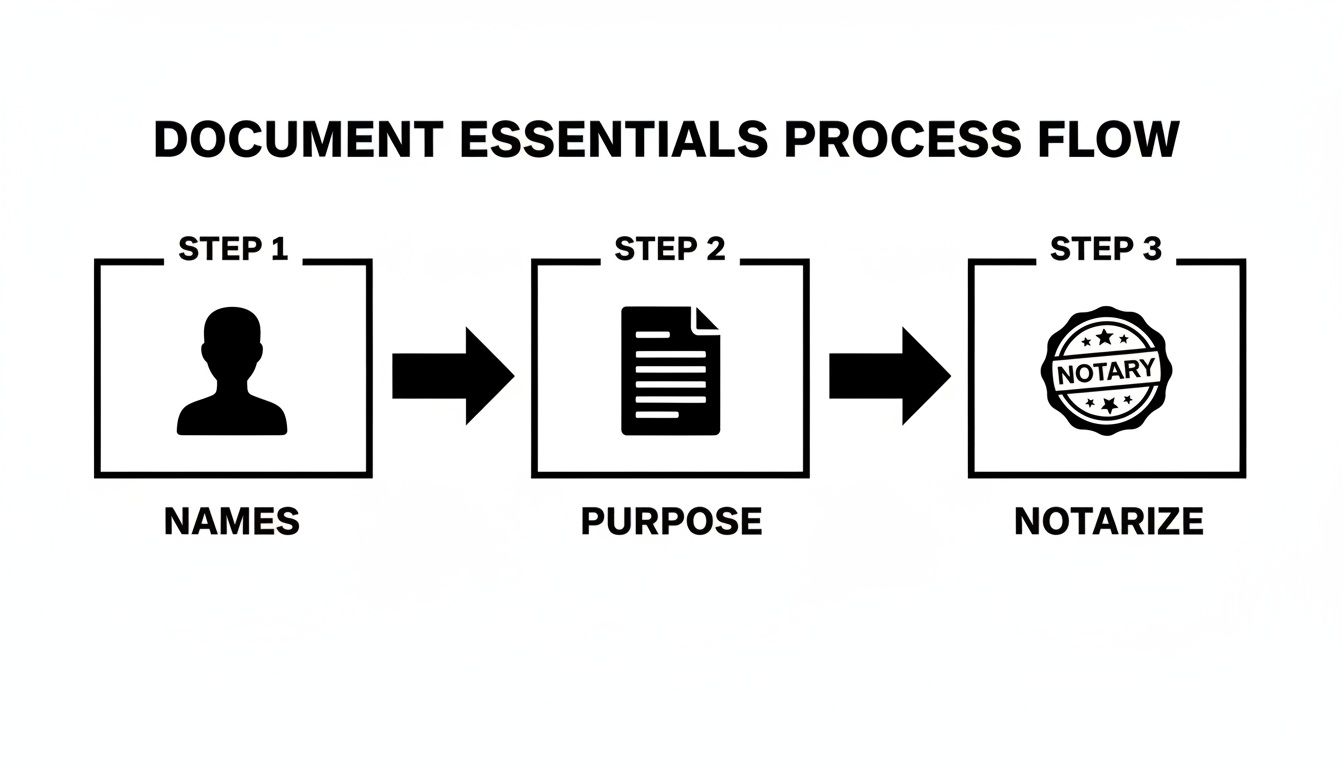
As you can see, getting the fundamentals right—correctly identifying everyone, clearly stating the document's purpose, and getting it notarized—is what gives your letter legal weight.
The Next Steps in the Legal Process
Once you file your application, the court system takes the reins. The first thing a judge will do is appoint an attorney ad litem. This is a neutral attorney assigned to represent the best interests of the person you're seeking to protect (the proposed ward).
The ad litem will conduct their own investigation, which includes interviewing you, the proposed ward, and anyone else involved. They'll then write up a report with a recommendation for the judge.
The ad litem's report carries immense weight in the courtroom. This is precisely why having all your documentation perfectly in order from day one is so critical. A well-organized application with strong, clear supporting letters makes the ad litem's job easier and significantly strengthens your case.
After the ad litem submits their report, the court will schedule a hearing. At the hearing, the judge will review all the evidence you’ve submitted, including your letters and the ad litem’s findings, before making a final decision.
If the judge rules in your favor, you will be issued official Letters of Guardianship. This is the document that serves as the legal proof of guardianship you'll need to manage your loved one’s affairs.
The process after filing can be complex and a bit intimidating. To make sure you’re fully prepared for the hearing and know what to expect, schedule a free consultation with our team to go over the specifics of your case.
Common Questions About Guardianship Letters in Texas
When you're trying to establish guardianship, the process can feel like a maze of legal documents and confusing terminology. It’s natural to have a lot of questions. Over the years, we've heard just about every question you can imagine, and we know that getting clear, straightforward answers can make all the difference.
Let’s break down some of the most common questions that come up about guardianship letters in Texas.
Does a Notarized Letter Automatically Grant Guardianship?
This is a big one, and the short answer is no, it does not. A notarized letter, like a consent form from a parent, is a crucial piece of evidence. It tells the court that a key person involved agrees with the guardianship, which carries a lot of weight.
But that letter by itself doesn't grant any legal power. A Texas probate judge has the final say. They will look at the entire picture—the application, every supporting document, and the report from the court-appointed attorney ad litem. Only a formal court order signed by the judge can legally create a guardianship. This process ensures the decision is truly in the best interest of the child or incapacitated adult, as required by the Texas Estates Code.
What If One Parent Refuses to Sign a Consent Letter?
If you're seeking guardianship of a minor and one parent digs in their heels, refusing to sign a consent letter, the game changes. Your case immediately becomes a contested legal matter. It's no longer a simple administrative process but will require a formal hearing where both sides get to present their case to the judge.
The person applying for guardianship now has the burden of proving to the court why their appointment is in the child’s best interest, even over that parent's objection. This usually means gathering significant evidence, finding witnesses, and presenting a compelling argument—a situation where having an experienced attorney is absolutely essential.
Can I Use an Email Instead of a Formal Letter?
We see this question a lot in our digital age. While an email might clearly state someone's intentions, it almost never holds up in a formal guardianship proceeding here in Texas. Courts in counties like Harris or Dallas have strict rules and expect properly signed and often notarized documents to be submitted as official evidence.
An email might be useful as supplemental information in a few rare situations, but it cannot replace a formally executed document like a sworn affidavit or a notarized letter of consent. Trying to rely on informal messages is a common mistake that can bring your case to a screeching halt.
Where Do I File the Letter for Legal Guardianship?
This is another point of frequent confusion. You don't actually file a "letter for legal guardianship" on its own. Instead, that letter acts as a supporting document—an exhibit—that gets attached to the main Application for Guardianship.
The complete package, with the application and all its exhibits, is then filed with the probate court in the county where your loved one lives. An attorney can make sure every piece of paper, including your letters, is correctly organized and filed in the right courthouse, getting your case started on the right foot from day one.
Understanding the specific roles of these documents is key to protecting your loved one. The experienced attorneys at the Law Office of Bryan Fagan are here to offer the clarity and compassionate guidance your family needs. We can help you build a strong, legally sound case designed for your unique situation. Schedule a free, no-obligation consultation with us today by visiting our website at https://texasguardianshiplawyer.net.