Skip to content
When you need to ensure a loved one is taken care of, making your wishes clear through a formal document is essential. Many Texas families search for a "letter of guardianship sample," but in our state, this legal intention is captured in a powerful document called a Declaration of Guardian.
This declaration is your official voice in a legal proceeding. It’s how you tell a court who you trust to care for your minor children or even for yourself, should you ever become incapacitated. The process can feel daunting, but understanding how this document works is the first step toward peace of mind.
Why a Guardianship Letter Matters in Texas

Navigating the future for a family member can feel overwhelming, but putting a plan in place is an incredible act of care. Think of a Declaration of Guardian not as a stuffy legal document, but as a roadmap you create for a judge. It clearly and legally states your wishes, offering priceless guidance if a court, like the Harris County Probate Court, ever needs to appoint a guardian.
This document is a critical piece of any solid Estate Planning strategy. It gives you peace of mind, ensuring your loved ones are cared for by the person you trust most, as guided by Title 3 of the Texas Estates Code.
Without it, the court has to make this monumental decision without your input. That could easily lead to a choice you would never have made yourself, adding emotional and financial strain to an already difficult time for your family.
Real-World Scenarios
Let's look at a few common situations where this document becomes absolutely essential for Texas families:
- Parents with Young Children: You can name a trusted family member or friend to step in and care for your children if you and your spouse were to pass away.
- Adults Planning for Incapacity: You can appoint someone to manage your personal and financial affairs if you’re ever unable to handle them yourself due to illness or injury.
- Caregivers of Adults with Disabilities: Parents can use it to ensure a smooth transition of care for an adult child with special needs when they are no longer able to provide it.
In Texas, a Declaration of Guardian isn't just a simple letter; it's a formal legal instrument. To be considered valid by a court, it must be executed with the same strict formalities as a will.
There are different types of guardianship letters, each tailored for specific needs—like temporary care for kids, making medical decisions, or handling finances. These documents empower a designated person to make crucial decisions for a minor or an incapacitated adult. You can explore various examples of guardianship letters to understand their specific functions.
Understanding the purpose and power of a Declaration of Guardian is the first real step in protecting your family's future. For personalized guidance on your specific Guardianship needs, schedule a free consultation with our team today.
Anatomy of a Texas Declaration of Guardian

To hold up in court, your Declaration of Guardian needs to include specific elements required by Texas law. Think of it like building a house—each piece is crucial for a strong structure that a judge will recognize and respect. This document is your direct line of communication to the court, making your wishes crystal clear.
Let's break down each part without the confusing legal jargon. Our goal is to empower you with the understanding of why each section matters, so you can feel confident your document is built on a solid foundation.
Decoding the Declaration of Guardian
Think of this document as having a few key building blocks. Each one serves a distinct purpose, from identifying the people involved to outlining their specific powers. Getting these details right is what makes the document legally sound.
| Component | Legal Purpose | Plain-Language Explanation and Tip |
|---|---|---|
| The People | To legally identify all parties involved, removing any ambiguity. | This is where you name yourself (the Declarant), the person needing care (the Proposed Ward), and your chosen caregiver (the Proposed Guardian). Tip: Always name at least one alternate guardian. Life happens, and you need a backup plan. |
| The Powers | To define the scope of authority granted to the guardian. | You need to decide if the guardian will handle personal decisions (Guardian of the Person), financial matters (Guardian of the Estate), or both. Tip: Be specific. Vague instructions can lead a judge to limit the guardian's authority in ways you never intended. |
| The Signatures | To execute the document according to state law, making it valid. | You, two credible witnesses (at least 14 years old), and a notary must all sign. Tip: The witnesses can't be the people named as guardians. They are there simply to confirm they saw you sign the document. |
When you put these components together correctly, you create a powerful legal tool that ensures your wishes are known and followed, should the need ever arise.
Key People and Their Roles
First things first, the document has to clearly identify everyone involved. This part is non-negotiable for the document to have any legal weight.
- The Declarant: That's you—the person making the declaration. Your full legal name and county of residence must be stated.
- The Proposed Ward: This is the individual who would be cared for. For parents, this would be your minor children. If you're an adult planning for your own potential incapacity, you are both the declarant and the proposed ward.
- The Proposed Guardian: This is the person you’re entrusting with this critical role. You absolutely must name at least one alternate guardian, just in case your first choice can't serve.
Imagine a couple in Houston with two young kids. Their declaration would name themselves as declarants, their children as proposed wards, and perhaps their trusted sister as the guardian, with a close family friend listed as the alternate. It's all about clarity.
Defining the Guardian's Powers
Next up, you have to spell out exactly what authority the guardian will have. Texas law lets you get specific, which is a good thing. You'll need to state whether you're appointing a:
- Guardian of the Person: This person makes decisions about daily life—where the ward lives, their medical care, and schooling.
- Guardian of the Estate: This individual is in charge of all things financial, like managing property, paying bills, and handling assets.
- Guardian of the Person and Estate: This combines both roles, giving one person authority over personal and financial matters.
Being precise here is vital. If you're not clear, a court might get involved and limit the guardian’s powers in a way you didn't want, creating confusion and roadblocks. Clearly defining these duties empowers your chosen person to act effectively. You can learn more about what this all entails in our guide to a guardian's responsibilities in Texas.
According to Title 3, Subtitle G of the Texas Estates Code, for a Declaration of Guardian to be valid, it must be signed by you in the presence of two credible witnesses who are at least 14 years old. These witnesses must also sign the document, affirming they saw you sign it. The document also needs to be notarized.
A Look at a Texas Guardianship Letter Sample
Seeing a real-world example can help make the legal concepts feel more concrete. To give you a better understanding of what a Texas Declaration of Guardian looks like, we’ve put together a straightforward, customizable sample. Think of this as a solid starting point—a way to understand the language and structure involved in these critical documents.
Of course, this is purely for educational purposes. Every family’s situation is unique, and this template is absolutely not a substitute for personalized legal advice from an attorney who knows Texas law inside and out. A lawyer is the only person who can ensure your final document truly reflects your wishes and stands up to legal scrutiny in a Texas court.
The Bones of the Declaration
This sample gives you a tangible framework. You’ll see clear placeholders like [Your Full Name] and [Name of Chosen Guardian], which are where you’d plug in your own specific information. We’ve also added some annotations to explain what each part of the document is actually doing.
DECLARATION OF GUARDIAN IN THE EVENT OF LATER INCAPACITY OR NEED OF GUARDIAN
I,
[Your Full Name], of[Your County], Texas, make this Declaration of Guardian.1. Appointment of Guardian for My Children:
If a guardian is needed for my minor child(ren),[List Full Names and Birthdates of Children], I designate[Name of Chosen Guardian]as guardian of their person and estate. If[Name of Chosen Guardian]is unable or unwilling to serve, I designate[Name of Alternate Guardian]as their successor.
Annotation: This section is where parents name a guardian for their minor kids. It covers both their personal care (the "person") and their finances (the "estate").2. Appointment of Guardian for Myself:
If a guardian needs to be appointed for my own person or estate, I designate[Name of Chosen Guardian for Self]as guardian. If they are unable or unwilling to serve, I designate[Name of Alternate Guardian for Self]as their successor.
Annotation: This part is for an adult planning ahead for their own potential future incapacity.This Declaration is to be interpreted under the laws of the State of Texas. It is not my intent to create a trust.
Signed this
[Day]day of[Month],[Year].
[Your Signature][This document must be signed in the presence of two credible witnesses, aged 14 or older, who also sign. It must then be notarized.]
Making the Right Choices for Your Family
As you look over this sample, you'll notice some key decisions you need to make. A big one is the difference between a guardian of the person versus a guardian of the estate. They aren't always the same role, nor should they be.
For example, the person you trust to raise your kids with the right values might be completely different from the person best suited to manage their inheritance and investments. This distinction is one of the most important ways you can protect your loved ones from all angles.
Talking through these nuances with an experienced attorney is the best way to get it right. To get some clarity on your own situation, schedule a free consultation with our team today. We're here to help you make these important decisions with confidence.
What Happens After You Draft the Document
Creating your Declaration of Guardian is a powerful first step, but it’s crucial to understand what comes next. Simply writing and signing the document doesn’t automatically put a guardianship in place.
Think of it as a clear instruction manual for a judge. It’s compelling evidence of your wishes, but it takes a court order to bring those wishes to life.
For the document to even be considered valid under Texas law, it has to be executed with the same formalities as a will. This means it must be signed, witnessed by two credible individuals, and notarized. Once that’s done, store it somewhere safe where your chosen nominee can easily find it when the time comes.
This visual guide breaks down the initial steps for getting your document ready.
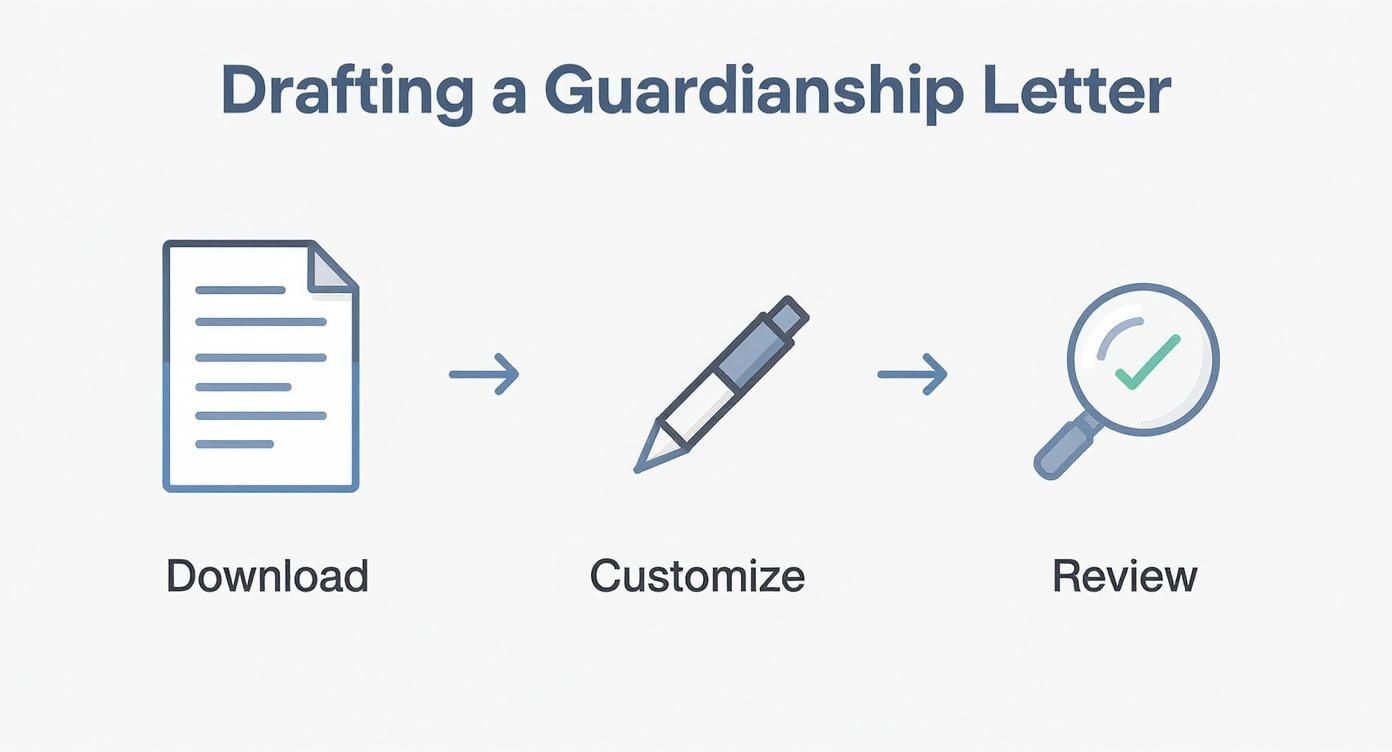
Following this workflow helps you put together a solid draft before it goes to a legal professional for review.
Taking the Document to Court
When the time comes that a guardian is needed, your nominated person can’t just show the letter to a doctor or a bank and take charge. They have to start a formal legal process.
This begins by filing an application with the proper Texas court—like a Harris County or Travis County Probate Court—to officially establish the guardianship. This is a critical step in the legal process.
The court’s main job here is to protect the proposed ward. A judge will schedule a hearing to review the application, your declaration, and any other evidence to determine what’s truly in the best interest of the child or incapacitated adult. We have a detailed guide that walks you through what to expect at a Texas guardianship hearing if you want to know more about that step.
A signed Declaration of Guardian does not bypass the court; it guides it. The judge makes the final decision, but your documented wishes carry significant weight in the proceedings.
Once the court appoints them, a guardian takes on a wide range of duties. This can include everything from making healthcare decisions to ensuring proper medication management to protect the ward’s health and well-being.
Understanding this journey from paper to legal action helps set realistic expectations for everyone involved. If you have questions about this process, schedule a free consultation to get guidance for your specific situation.
Common Mistakes to Avoid With Your Guardianship Plan
Even the most well-intentioned Declaration of Guardian can crumble because of simple, preventable mistakes. We have seen Texas families make the same missteps time and again, which can cause serious delays or even lead a court to ignore their wishes entirely. Steering clear of these common pitfalls is the key to creating a plan that actually works when your family needs it most.
One of the biggest errors is naming only one person as guardian without any backups. Life is unpredictable. Your first choice might be unable or unwilling to serve when the time finally comes. If you don't have a designated alternate, the court is forced to make the decision from square one, leaving your loved ones in a stressful limbo.
Vague Language and Outdated Plans
Another frequent mistake is using language that's too fuzzy or broad. A judge in a Bexar County Probate Court needs to see clear, specific instructions. When a document has vague descriptions of the guardian's powers, it can force the court to limit their authority, preventing them from acting the way you wanted them to.
The strongest guardianship plans are treated as living documents. Failing to review and update your declaration after major life events—like a divorce, a move, or a change in your chosen guardian's circumstances—can render it obsolete.
Finally, so many people simply forget about the strict legal requirements. A document that isn't properly signed, witnessed by two credible adults, and notarized is just a piece of paper in the eyes of the law. Every single one of these formalities is required under the Texas Estates Code. For a deeper dive, take a look at our guide on the common mistakes to avoid in Texas guardianship cases.
Making sure you avoid these errors will turn your document into a powerful tool that truly protects your family. If you need help reviewing your plan, feel free to schedule a free consultation to speak with our team.
Your Texas Guardianship Questions Answered
When you start planning for something as important as guardianship, a lot of questions pop up. It's completely normal. Here, we'll tackle some of the most common concerns we hear from Texas families, giving you clear, direct answers.
Can a Notarized Letter Let Me Skip Court?
This is a big one we get asked all the time. The short answer is no. A notarized letter of guardianship sample or even a properly signed Declaration of Guardian won't let you bypass the court system.
In Texas, only a judge has the authority to legally appoint a guardian. While your written declaration is powerful evidence of your wishes for the court to consider, the person you've nominated still has to file an application and get an official court order from a judge, for instance in a Dallas County Probate Court.
Temporary vs. Permanent Guardianship
Think of a temporary guardianship as a short-term fix. It’s usually granted in emergencies to address an immediate need where a loved one faces imminent harm. Typically, it lasts for no more than 60 days—just long enough to get a more permanent solution in place through a full guardianship hearing.
A permanent guardianship, on the other hand, is exactly what it sounds like. It's an ongoing appointment that continues until a minor ward turns 18 or until a court decides it's no longer needed for an adult.
Can I Name a Married Couple as Co-Guardians?
Yes, you absolutely can name a married couple to serve together as co-guardians. It’s a common choice for parents who want their children to be raised in a two-parent household.
However, it's smart to think through the "what-ifs." What happens if they divorce? It's not a pleasant thought, but planning for potential complications like this is crucial. Talking these scenarios over with an attorney helps you create a much more resilient plan for your children’s future.
What Happens if I Don't Name a Guardian?
If you don't legally name a guardian, the decision falls to the court. A judge, without your input, will appoint someone they believe is acting in the best interest of the proposed ward.
The problem is, the court's choice might not be who you would have wanted. This is why being proactive is so important—it’s the only way to ensure your wishes are known and considered. Not having a plan can lead to family disputes and uncertainty when your loved ones are at their most vulnerable.
Navigating the complexities of Texas guardianship law requires both compassion and precision. At the Law Office of Bryan Fagan, PLLC, our experienced attorneys are dedicated to helping you protect your loved ones with a legally sound plan that honors your wishes and provides security for the future. To discuss your unique situation and get clear answers, schedule your free, no-obligation consultation with us today.