Skip to content
When a loved one passes away, the legal maze of settling their estate can feel overwhelming during an already emotional time. We understand that your family is grieving, and the last thing you need is a complex legal battle. Fortunately, Texas law provides a simplified path called a Muniment of Title. Think of it as an express lane for probate, designed specifically for situations where your loved one left a valid will and didn't have any outstanding debts. This process allows a court to officially recognize the will, clearing the way for property to be transferred to family members without a full, lengthy court administration.
At The Law Office of Bryan Fagan, our mission is to guide Texas families through these challenges with clarity and care. This guide will walk you through the process, answer your questions, and empower you with the knowledge to make the best decision for your family.
Understanding This Simplified Probate Option
Losing a family member is hard enough. The legal steps that follow shouldn't add to your stress. Fortunately, not every estate needs to go through the drawn-out process of traditional probate.
The term "muniment" might sound like old-fashioned legal jargon, but it simply means evidence or proof of a right to property. So, a muniment of title is a legal action where a Texas probate court, like one in Harris County, essentially validates a will. This court order confirms the will as the official proof of who now owns the deceased’s property.
Key Aspects of a Muniment of Title
Imagine the court stamping the will with its seal of approval. That stamp effectively turns the will into a new title document, much like a deed. This court order gives beneficiaries the legal authority they need to take ownership of assets, especially real estate, directly.
The beauty of this process is its simplicity. There is no need to appoint an executor or go through the hassle of a formal estate administration. It’s a streamlined option built for straightforward situations where:
- The deceased left a legally sound will.
- There are no unpaid debts, other than mortgages or liens attached to real estate.
- The main goal is to simply get the title to property officially transferred to the people named in the will.
How It Helps Texas Families
The purpose of a muniment of title is to offer families a more efficient and less expensive route to settling an estate. By sidestepping the need for an executor and the requirement to file a detailed, public inventory of assets with the court, you save a significant amount of time, money, and emotional energy. The process is much quicker than traditional probate, often wrapping up in a matter of weeks instead of months or even years.
This approach, laid out in the Texas Estates Code, ensures that the wishes in your loved one’s will are honored without needless delays. For a better sense of how properties are handled in estate administration, you might want to learn more about what is a probate listing.
At The Law Office of Bryan Fagan, we know the challenges you're facing. If you believe your loved one's estate might qualify for this simpler process, Schedule a free consultation to discuss your options with our compassionate team.
How Do You Qualify for This Simplified Probate Process?
Figuring out if your loved one's estate can use the muniment of title process is the critical first step. This streamlined probate path isn't a one-size-fits-all solution; the estate must meet specific criteria laid out in the Texas Estates Code. Getting this right from the beginning can save your family from hitting roadblocks down the line and helps you choose the correct legal strategy.
The two most important requirements are straightforward but absolute. First, there must be a valid, written will. Second, the estate can't have any unpaid debts, though there's one major exception to this rule.
The No-Debt Rule, Explained
This "no-debt" requirement is often where families need the most clarity. Under Texas Estates Code § 257.001, an estate can only be probated as a muniment of title if there are no outstanding financial obligations. The key exception here is any debt secured by real property—like a home mortgage.
Let's walk through a couple of hypothetical scenarios to make this clear:
- Scenario A (Qualifies): Sarah’s mother passed away, leaving behind her home, which still had a mortgage, but no other debts. Her will names Sarah as the only person to inherit everything. Because the only debt is the mortgage tied directly to the real estate, her estate is a good candidate for a muniment of title.
- Scenario B (Does Not Qualify): David’s father left a will and owned his home free and clear. However, he also had $15,000 in credit card bills and a personal loan when he died. These are unsecured debts, which unfortunately makes the estate ineligible for this process. A full probate administration would be needed here to properly handle notifying and paying off those creditors.
Understanding this distinction is crucial. If you're not sure about any potential debts, it’s wise to investigate before filing anything with the court. An attorney can help you determine if any existing bills would disqualify the estate. For smaller estates that might have debts, you might want to explore our guide on the Texas Small Estate Affidavit.
The Valid Will Requirement
The entire muniment of title process hinges on one thing: a legally sound will. The court's primary job in this proceeding is to officially recognize that the will is valid and that it legally transfers ownership of the property to the beneficiaries named within it. If there is no will, or if someone is challenging the will's validity (a guardianship dispute, for instance), this streamlined option is completely off the table.
A Texas court, whether it's in Harris County or Dallas County, has to be completely satisfied that the will was executed properly and truly represents the final wishes of the person who passed away. Without that certainty, the judge simply cannot issue the order that serves as the new proof of title.
The muniment of title process is a major shortcut for settling an estate in Texas. Families who go this route can often wrap everything up—from filing the application to getting the final order from a judge—in about four to eight weeks. This is a significant relief compared to traditional probate, which can easily drag on for many months.
If you think your loved one’s estate checks these boxes, you could be on track to save a considerable amount of time, money, and stress. Schedule a free consultation with The Law Office of Bryan Fagan today, and let our compassionate team help you confirm the best path forward for your family.
Muniment of Title vs. Traditional Probate
When you’re dealing with a loved one’s estate, understanding your legal options is the first step toward choosing the right path for your family. Both a muniment of title and a traditional probate administration are ways to settle an estate when there's a will, but they work in very different ways. The biggest distinction is that a muniment of title in Texas avoids appointing an executor and sidesteps the intense court supervision that a full administration requires.
Think of it like this: traditional probate is a closely managed project. The court appoints an executor to act as the project manager, who is then responsible for everything—notifying creditors, paying bills, and filing a detailed inventory of every single asset. This process is thorough and often necessary for complex estates, but it's also more time-consuming and expensive.
A muniment of title, on the other hand, is like having the court simply review and approve the will. The judge's order confirms the will is valid and legally transfers ownership of the property directly to the beneficiaries. For grieving families with straightforward estates, this direct approach can save a significant amount of time, money, and stress.
Key Differences at a Glance
For families in places like Harris County or Dallas County, the practical benefits of a muniment of title shine when you compare the two processes side-by-side. The biggest wins are the drastically reduced administrative hassle and the lower overall cost.
Let’s break down exactly how these two paths diverge.
Comparing Muniment of Title and Full Probate in Texas
| Aspect | Muniment of Title | Full Probate Administration |
|---|---|---|
| Executor/Administrator | None appointed. The court order directly transfers title to the beneficiaries. | An executor is appointed by the court to manage the entire process. |
| Court Oversight | Minimal. It’s typically limited to a single hearing to validate the will. | Extensive. The court oversees the executor's actions from start to finish. |
| Timeline | Much faster, often wrapping up in just 4-8 weeks. | Significantly longer, typically taking many months or even years to complete. |
| Cost | Generally much lower due to fewer court filings and required legal steps. | Higher due to more extensive legal work, court fees, and potential executor fees. |
| Estate Inventory | Not required. Beneficiaries do not have to file a public list of assets. | Required. A detailed inventory of all estate property must be filed with the court. |
Seeing it laid out like this makes it clear why so many qualifying Texas families prefer the muniment of title route when it's available.
Real-World Impact for Your Family
These aren't just dry legal technicalities; they have a direct impact on your family’s experience during an already difficult time. A muniment of title avoids the need to file a public inventory of your loved one's assets, which offers a great deal more privacy. It also eliminates the administrative tasks an executor would normally handle, like formally notifying creditors, which simplifies the entire journey.
This streamlined path means quicker access to the assets needed to settle affairs and move forward. By cutting out these extra steps, the muniment of title in Texas translates into less stress, fewer court appearances, and lower legal fees. For estates that qualify, it offers a truly compassionate and efficient alternative to a lengthy court procedure.
If you are unsure which path is right for your family, the compassionate attorneys at The Law Office of Bryan Fagan are here to help. Schedule a free consultation today for personalized guidance on your next steps.
Your Step-By-Step Guide to the Filing Process
Dealing with the court system while grieving a loved one can feel like an impossible weight to carry. The good news is that the muniment of title in Texas offers a clear, manageable path designed to be far less overwhelming than a full probate administration. When you understand the steps involved, the whole process becomes much more predictable and less intimidating.
Think of this as your straightforward roadmap, guiding you from the initial application all the way to finalizing the property transfer. The journey is logical, but getting the details right is crucial—which is why having an experienced guide can make all the difference.
This simple flowchart breaks down the core stages of what you can expect.
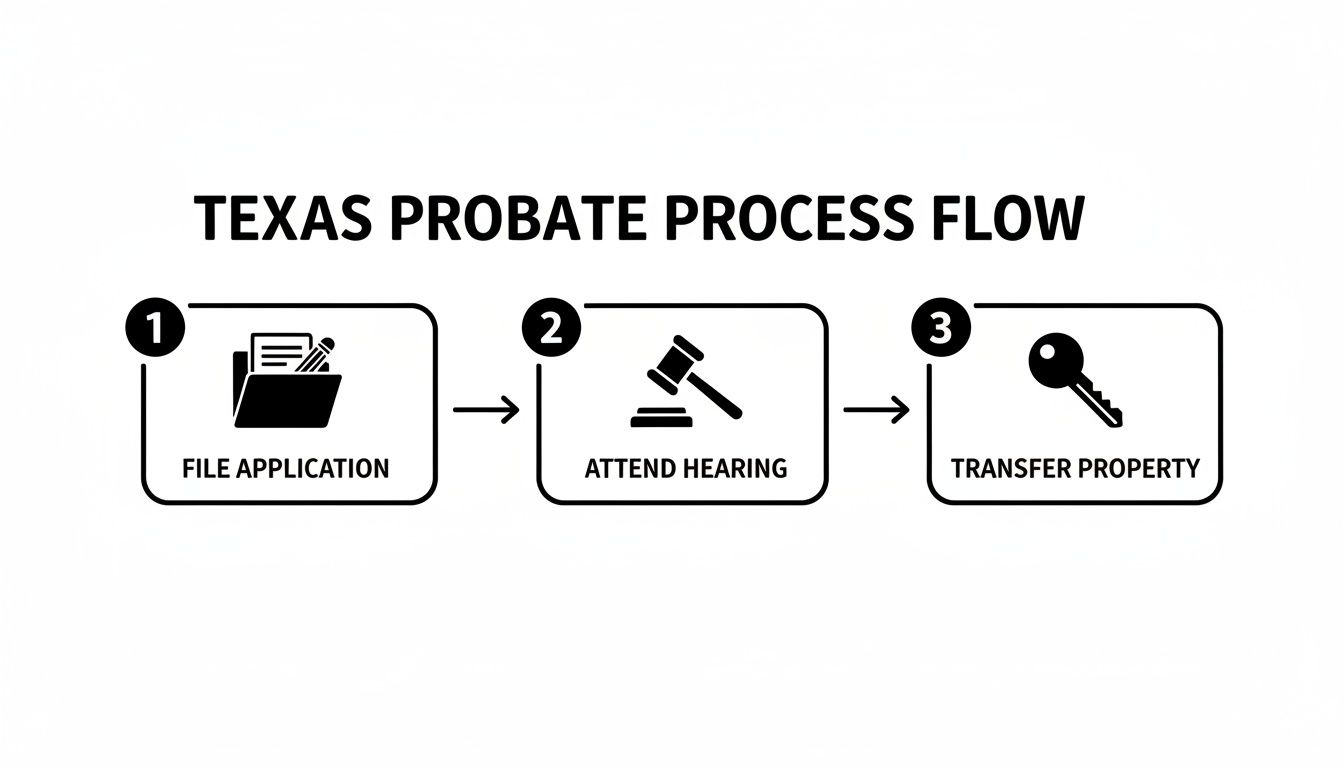
As you can see, the process really boils down to three key phases: filing the right paperwork with the court, attending a hearing to get the Will validated, and then using the court's final order to legally transfer ownership.
Step 1: Filing the Application
The first move is to formally ask the court to recognize the Will. You'll do this by filing a document called the "Application to Probate Will as a Muniment of Title" with the correct probate court. This is almost always done in the county where your loved one lived, such as the Harris County Probate Court or the Dallas County Probate Courts.
This application is a sworn statement that must include specific information, including:
- The original, valid Will of the person who passed away.
- A clear statement confirming the estate has no unpaid debts, other than any mortgage on real estate.
- The names and current addresses of every beneficiary named in the Will.
Step 2: The Court Hearing
Once the application is filed, the court will schedule a brief hearing. This is not a dramatic trial you see on TV. It's a formal, often quick, proceeding where a judge confirms the Will is legitimate. You or your attorney will need to be there to provide testimony.
During the hearing, the judge just needs to verify a few key facts:
- Is this a legally valid Will?
- Has the person who signed the Will passed away?
- Does this court have jurisdiction over the case?
The purpose of this hearing is for the court to officially confirm that all legal requirements under the Texas Estates Code have been met. Once the judge is satisfied, they will sign an order admitting the Will to probate as a muniment of title.
Step 3: Finalizing the Transfer of Property
That signed court order is the key—it's the document that makes everything official. This order, when paired with a certified copy of the Will, essentially becomes the new deed or proof of ownership for any property passed to the beneficiaries.
To finish the process, you must file a certified copy of both the Will and the order in the real property records for every county where the deceased owned property. This final step officially updates the public record and finalizes the title transfer. While this process is simpler than full probate, getting these details right is absolutely essential. To understand how this fits into the bigger picture, you can find valuable insights by learning more about probating a will in Texas.
If these steps still feel like a lot to handle, you're not alone. The compassionate team at The Law Office of Bryan Fagan is here to guide your family through this with clarity and care. Contact us today for a free consultation to talk about your specific situation.
Common Pitfalls and Why Legal Counsel Is Essential

While the muniment of title in Texas is a more direct path for settling an estate, it's not a DIY project. What looks simple on the surface can get tangled up fast, leading to frustrating delays and more stress for a grieving family. Understanding these common tripwires makes it clear why having an experienced probate lawyer isn't just a good idea—it's your best protection.
Even a small, overlooked detail can bring the whole process to a screeching halt. The most common problem we see is an unexpected debt popping up after the application has already been filed.
Navigating Unexpected Debts and Claims
Let's consider a hypothetical situation. You've started the muniment process, confident that your dad's estate was completely debt-free. But then, a $5,000 medical bill from a recent hospital stay arrives in the mail. Just like that, the estate is no longer eligible for a muniment of title.
An even bigger complication is a claim from Medicaid. If your loved one received state benefits, the Texas Medicaid Estate Recovery Program (MERP) will likely have a legal claim against the estate to recover those funds. This is a non-negotiable debt that must be addressed.
An experienced probate attorney does the homework upfront, investigating to uncover any potential debts or claims before a single form is filed with the court. This proactive step saves your family from the headache of starting a process only to have it thrown out, forcing you back to square one with a full probate administration.
Challenges to the Will and Other Roadblocks
Even with no debts, other issues can derail the process. For example, what happens if a family member appears to challenge the will's validity? A will contest stops a muniment of title dead in its tracks and forces the matter into a more formal, and expensive, court proceeding, much like a guardianship dispute.
Here are a few other roadblocks we've seen clients run into:
- Out-of-State Banks: Financial institutions outside of Texas often don't understand a muniment of title order. They might refuse to release funds, incorrectly demanding Letters Testamentary—documents that are only issued in a full probate.
- Confused Title Companies: Some title companies right here in Texas can be hesitant to accept a muniment of title as sufficient proof of ownership. This can cause major delays if you're trying to sell or transfer a property.
- Complex Asset Distributions: If the will splits property in a complicated way or includes assets that need active management (like a family business), a muniment is simply not the right tool for the job.
A skilled attorney can see these problems coming. They know how to negotiate with stubborn institutions and ensure the court filings in busy jurisdictions like Harris County or Dallas County are perfect the first time. This expertise helps you sidestep costly mistakes and keeps the process moving forward as smoothly as possible.
Don't add legal stress to an already difficult time. The team at The Law Office of Bryan Fagan is here to guide your family through every step with compassion and clarity. Schedule a free consultation today to see how we can help.
Common Questions About Muniment of Title
When you're sorting out an estate, it's natural for practical questions to arise. To give you some extra clarity, let's walk through a few of the most common concerns Texas families have when considering a muniment of title. These are the real-world questions we hear all the time, and our goal is to provide straightforward answers to help you feel more prepared.
Can a Muniment of Title Transfer More Than Just Real Estate?
Absolutely. A muniment of title isn't just for houses and land. Once a judge signs the order admitting the will to probate as a muniment of title, that court order acts as the legal authority to transfer other assets, too. This can include bank accounts, investment portfolios, and even vehicles.
The hiccup you might run into, however, is a practical one. Some financial institutions, especially national banks or brokerages with headquarters outside of Texas, may be unfamiliar with this specific process. They might incorrectly demand Letters Testamentary, which are only issued in a full probate administration. An experienced attorney can communicate with the institution, explain Texas law, and provide the necessary documents to get those assets released to your family.
What Happens if We Find a Debt After the Fact?
This is a very important question, and it highlights a major risk of navigating this process without legal guidance. If a surprise debt—like a forgotten medical bill or an old credit card balance—comes to light after the muniment of title is granted, it can invalidate the entire process.
The Texas Estates Code is very clear: the estate must have no debts, aside from a mortgage or other debt secured by real estate. If a valid debt is discovered later, you will likely have to go back to court and open a more formal probate administration to handle creditors properly.
How Long Do I Have to File for a Muniment of Title?
In Texas, you generally have four years from your loved one's date of death to file an application to probate their will, and that includes filing it as a muniment of title. Waiting longer than four years creates a significant legal hurdle.
It’s not completely impossible to probate a will after the deadline, but it’s difficult. The person filing has to prove to the court they weren't "in default" (or negligent) for failing to file sooner. That's a high legal bar to clear, and the judge has the final say. Your best course of action is always to act promptly to avoid this complication.
Is a Muniment of Title a Public Record?
Yes, it is. Just like other probate court cases, a muniment of title proceeding is a public record. The application you file, the will itself, and the judge's final order are all filed with the county clerk, making them accessible to the public.
However, there's a key privacy advantage here. Unlike a full probate, you are not required to file a detailed inventory of the estate's assets. In a traditional administration, the executor must submit an "Inventory, Appraisement, and List of Claims," which lists every single asset and its dollar value for the public to see. Using a muniment of title can help a family keep the specific financial details of their loved one's estate more private.
Navigating the specifics of a muniment of title in Texas requires careful attention to detail to ensure your family is protected. If you have questions about your unique situation, the experienced and compassionate attorneys at The Law Office of Bryan Fagan, PLLC are here to help. Schedule a free consultation to receive personalized guidance and take the first step toward peace of mind.