Skip to content
When you realize a loved one can no longer make safe decisions for themselves, it’s a difficult and often heartbreaking moment. Texas guardianship laws provide a legal path forward, creating a court-supervised process to protect vulnerable adults who have become incapacitated. This guide is designed to help your family navigate this journey with clarity and care, recognizing the emotional and financial challenges you may be facing.
Understanding Guardianship in Texas
Facing the reality that a parent, spouse, or even an adult child might need a guardian is an emotional journey. At its heart, a guardianship is a legal relationship created by a court, like the Harris County Probate Court, to protect an individual—legally called the "ward"—who can no longer care for themselves or manage their own affairs. This entire process is laid out in Title 3, Subtitle G of the Texas Estates Code.
It's absolutely critical to understand that Texas courts view guardianship as a last resort. The law strongly favors an individual's independence, and a judge will only grant a guardianship when there's clear proof it's necessary and no less restrictive options, like a Power of Attorney, will work.
To help you get a quick handle on these core concepts, here is a simple breakdown of the key elements involved.
Key Aspects of Texas Guardianship at a Glance
This table provides a quick summary of the core concepts of Texas guardianship, helping families quickly understand the key roles and legal standards involved.
| Concept | Description | Governing Law (Texas Estates Code) |
|---|---|---|
| Ward | An individual who a court has found to be incapacitated and in need of a guardian. | § 1002.030 |
| Guardian | A person or entity appointed by the court to care for the ward and/or their property. | § 1002.017 |
| Incapacitated Person | An adult who, because of a physical or mental condition, is substantially unable to provide food, clothing, or shelter for themselves, or to manage their own financial affairs. | § 1002.017 |
| Guardianship of the Person | Grants authority over the ward's personal, medical, and daily care decisions. | § 1151.051 |
| Guardianship of the Estate | Grants authority over the ward's financial affairs, assets, and property. | § 1151.101 |
| Best Interest | The primary standard the court uses to make all decisions regarding the ward. | § 1054.001 |
Understanding these terms is the first step in demystifying the legal process and focusing on what truly matters: protecting your loved one.
The Two Primary Types of Guardianship
To see how this works in the real world, let's imagine an adult child in Houston who is worried about their elderly mother. Her dementia has gotten worse; she’s forgetting to pay her bills and has started missing important doctor's appointments. In a situation like this, the family would likely look into two specific types of guardianship:
- Guardianship of the Person: This gives the guardian the power to make personal and medical decisions for the ward. Think of it as stepping in to decide where they live, consent to medical procedures, and make sure they get the day-to-day care they need.
- Guardianship of the Estate: This puts the guardian in charge of the ward’s finances. They become responsible for managing income, paying bills, protecting assets, and making financial choices that are in the ward’s best interest.
In many situations, a judge will appoint one person to handle both roles. However, these can be split. For instance, one family member might take on the personal care duties while a trusted professional is brought in to manage the Estate Planning and financial assets.
The single most important goal in any Texas guardianship case is to promote and protect the well-being of the incapacitated person. A judge's decisions are always guided by what's best for the ward, not by what's most convenient for the family.
Ultimately, making your way through Texas guardianship laws requires a solid grasp of the legal steps and a compassionate mindset for what is a very sensitive family matter. The process involves filing a formal application, submitting medical proof of incapacity, and going to a court hearing where a judge will make the final call.
If you find yourself facing this difficult road, please know you don't have to walk it alone. Understanding your options is the first, most powerful step toward protecting someone you love. For clear guidance on your family’s unique circumstances, we invite you to schedule a free consultation with our experienced legal team.
The Texas Guardianship Process Step-by-Step
Navigating the legal roadmap for guardianship can feel overwhelming, especially when you're already dealing with an emotionally charged situation. But the Texas guardianship process, while detailed, is a structured journey designed to protect your loved one. It’s not just a pile of paperwork; it’s a series of specific filings, court appointments, and a formal hearing to ensure every decision is truly in the proposed ward's best interest.
Let’s walk through this together. Imagine the Garcia family. Their son, Leo, just turned 19 and has a severe developmental disability. His parents have always managed his care, but now that he’s a legal adult, they need the court’s authority to keep making medical and financial decisions for him. They're starting the process in their local Bexar County Probate Court.
Filing the Application and Medical Certificate
The first real step is filing an Application for Appointment of Guardian with the court. This is the official starting pistol. This document, governed by the Texas Estates Code, lays out all the essential information for the judge: who you are (the applicant), who needs protection (the proposed ward), and exactly why a guardianship is necessary.
But an application alone isn't enough. The Garcias must also submit a critical piece of evidence: a Physician's Certificate of Medical Examination (PCME). This is a specific form completed by a doctor within the last 120 days. It’s the doctor’s professional, sworn opinion on Leo’s condition and his capacity to make his own decisions.
This medical evidence is the bedrock of the entire case. Without a doctor's statement confirming incapacity, the court simply cannot move forward. This isn't about family preference; it's about establishing a clear medical and legal need.
The Role of the Attorney Ad Litem
Once the application is filed and accepted, the court appoints an Attorney Ad Litem. This is an independent lawyer whose only client is the proposed ward—in this case, Leo. The Attorney Ad Litem doesn't work for the Garcias or for the judge. Their one and only job is to be Leo's advocate.
This attorney will meet with Leo to explain what’s happening in a way he can understand and to figure out what his wishes are. They’ll also interview the Garcias, dig into the medical records, and investigate the whole situation to form an independent recommendation for the court. This is a crucial safeguard built into Texas guardianship law, ensuring the proposed ward’s rights are protected every step of the way.
The Attorney Ad Litem acts as the eyes and ears of the court, providing an unbiased perspective on what is truly in the proposed ward's best interest. Their report carries significant weight in the judge's final decision.
This is the point where the court begins to determine what kind of guardianship is actually needed.
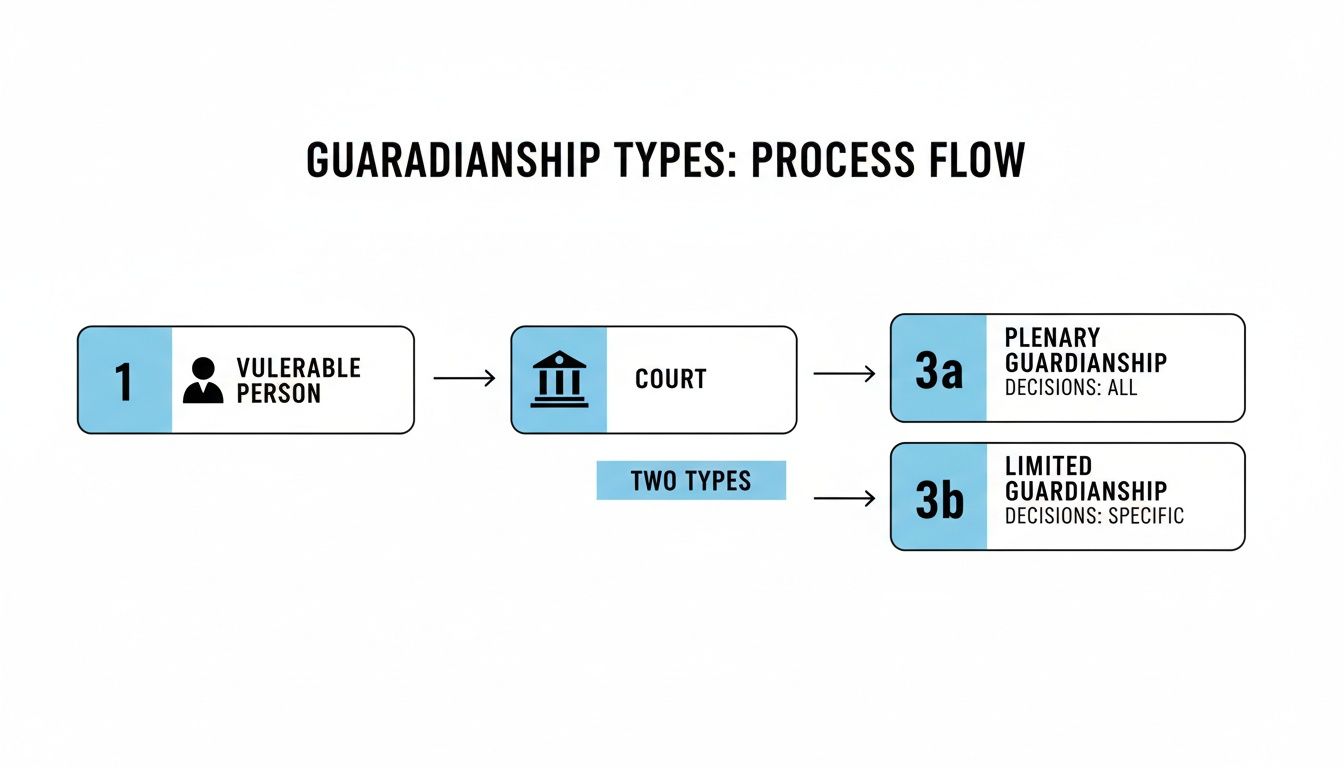
As you can see, the court’s involvement is the central point that directs the case toward the right type of guardianship, whether it’s a comprehensive one or one that is limited to specific needs.
The Guardianship Court Hearing
The final step in getting the guardianship established is the court hearing. This is a formal proceeding where a judge reviews all the evidence, from the application to the Attorney Ad Litem’s report, and listens to testimony. The Garcias, their attorney, and the Attorney Ad Litem will all be there. The judge will ask questions to confirm that a guardianship is truly the only option and that the Garcias are qualified and suitable to serve as Leo's guardians.
To succeed, the applicant must prove their case with "clear and convincing evidence." This is a high legal bar, much higher than in many civil cases, and it reinforces just how seriously the courts take the process of removing someone's legal rights.
If the judge is convinced, an order will be signed appointing the Garcias as Leo's guardians. From there, they will have to take an oath, post a bond (if required), and finally receive their "Letters of Guardianship." This is the official document that proves they have the legal authority to act on Leo's behalf. The Probate court will then continue to oversee the guardianship to ensure compliance.
The journey can seem complicated, but each step is a building block toward securing your loved one's future. If you're considering this path, you don't have to figure it out on your own. You can schedule a free consultation with our team to get clear, personalized guidance for your family's unique situation.
Guardian Qualifications and Responsibilities
Deciding to pursue guardianship is a profound act of love, but who is legally qualified to take on this role? And what does it really involve day-to-day? Understanding the qualifications and responsibilities is essential, as the court is entrusting you with the well-being of a vulnerable person.

Not just anyone can step in as a guardian. The Texas Estates Code lays out specific requirements to make sure the person appointed is both trustworthy and capable. Generally, a potential guardian must be a private individual, though in certain situations, a qualified private or public agency can serve.
Who Is Eligible to Be a Guardian in Texas
Texas law is designed to place a ward in the most caring and familiar hands possible. To that end, Texas Estates Code Section 1104.102 creates a clear pecking order for who the court will consider. This hierarchy starts with the incapacitated person’s spouse, then moves to the nearest of kin, and finally considers other qualified people.
Beyond just family ties, a potential guardian has to meet several core criteria:
- Be at least 18 years old.
- Be a resident of Texas (though the court can make exceptions for close relatives).
- Have a clean record, with no convictions for crimes of dishonesty or violence.
- Demonstrate the ability to prudently manage the ward’s affairs.
The court carefully vets every applicant to ensure they are a suitable and safe choice. For example, someone with a conflict of interest—like owing a significant debt to the proposed ward—would almost certainly be disqualified.
Understanding the Dual Roles of a Guardian
Guardianship isn't a one-size-fits-all job. The responsibilities are often split into two distinct categories based on what the ward needs. This separation ensures that both the personal and financial sides of the ward’s life are managed with focused attention.
1. Guardian of the Person
This role is all about the ward’s daily life and well-being. A Guardian of the Person is responsible for:
- Deciding where the ward will live, making sure the environment is safe and appropriate.
- Consenting to medical, dental, and psychological care.
- Making decisions about social and educational activities.
- Providing food, clothing, and shelter using the ward’s funds.
Essentially, this guardian steps into the ward's shoes to make the personal decisions they can no longer make for themselves.
2. Guardian of the Estate
This role is laser-focused on the ward’s financial life. A Guardian of the Estate is tasked with:
- Managing the ward’s money, property, and other assets.
- Paying bills and handling all tax matters.
- Investing assets prudently to protect and hopefully grow the estate.
- Keeping meticulous financial records for the court to review.
In many cases, one person serves as both Guardian of the Person and of the Estate. However, a court can appoint different people for each role, like a family member for personal care and a financial professional to manage the estate.
The Fiduciary Duty: A Guardian’s Highest Obligation
Above all else, a guardian owes a fiduciary duty to the ward. This is the highest standard of care recognized by law. It means the guardian must act solely in the best interest of the ward, pushing aside any self-interest or conflicts.
Acting as a fiduciary means every decision—from choosing a nursing home to investing funds—must be made with the ward's welfare as the single guiding principle. It's a promise of loyalty, prudence, and unwavering care.
This duty is not taken lightly. The court maintains strict oversight to ensure guardians are living up to their obligations. Guardians have to file an annual "Report on the Condition and Well-Being of the Ward" to update the court on the ward's health and living situation. For the estate, a detailed annual accounting of every single financial transaction is mandatory.
These reporting requirements are a critical part of Texas guardianship laws, creating a system of checks and balances that protects the ward from neglect or exploitation. Understanding the profound responsibilities of a legal guardian is the first, most vital step for anyone considering this role.
If you have questions about whether you qualify to be a guardian or what the role truly entails, our team can help. Schedule a consultation to discuss your family’s situation with clarity and compassion.
Exploring Alternatives to Guardianship
Guardianship is a profound legal step. It’s powerful, yes, but it also strips an individual of some of their most fundamental rights. Because the stakes are so high, Texas law is very clear: families and courts must first look at less restrictive ways to offer support.
Taking the time to explore these options before heading to the courthouse can save your family a world of emotional and financial stress. More importantly, it preserves your loved one's dignity and independence.

Think of it less like taking control and more like building a strong support system. These alternatives are proactive tools that often accomplish the same protective goals without ever needing a judge’s intervention. They empower your loved one to stay in the driver's seat of their own life for as long as possible.
Powers of Attorney: The Go-To Proactive Solution
One of the single most effective alternatives to guardianship is putting Powers of Attorney in place. These legal documents let an individual (the "principal") choose a trusted person (the "agent") to make decisions for them if they ever become unable to.
- Durable Power of Attorney: This is for financial matters. It gives your agent the power to pay bills, manage bank accounts, handle investments, and even sell property on your behalf. The key word here is "durable"—it stays in effect even if the principal later becomes incapacitated.
- Medical Power of Attorney: This document gives an agent the authority to make healthcare decisions when the principal can't. This includes everything from choosing doctors and care facilities to consenting to or refusing specific medical treatments.
The critical thing to remember is that the principal has to sign these documents while they still have the mental capacity to understand what they are doing. This is why proactive Estate Planning is an absolute must for every family.
Supported Decision-Making Agreements
A newer and truly empowering option in Texas is the Supported Decision-Making Agreement. This is a formal arrangement that lets an adult with a disability select trusted supporters—like family or friends—to help them process information, understand their choices, and communicate their decisions.
Unlike guardianship, this agreement doesn't take away a single right. It simply creates a support system. For instance, a young adult with an intellectual disability could use this agreement to get help understanding a new apartment lease or talking through medical options with their doctor, but they are still the one making the final call.
This approach is about assistance, not substitution. It honors the individual's ability to direct their own life, providing a collaborative framework for making important choices.
You can learn more about this incredibly valuable tool in our comprehensive guide to Supported Decision-Making. The Texas Estates Code is built on this principle, forcing courts to ensure that tools like these are explored before a guardianship is even considered.
Other Practical Alternatives
Beyond the big legal documents, several other straightforward strategies can help manage a loved one’s affairs and potentially avoid guardianship altogether.
- Joint Bank Accounts: Simply adding a trusted family member to a bank account can give them the ability to help pay bills and handle day-to-day finances without any fuss.
- Representative Payee: For government benefits like Social Security, you can be officially appointed as a "representative payee." This allows you to manage those specific funds for your loved one.
- Advance Directives (Living Wills): These documents clearly state a person’s wishes for end-of-life medical care, removing any guesswork and ensuring their preferences are respected.
Diving into these alternatives can make a world of difference. If you're feeling overwhelmed and unsure which path makes the most sense for your family, scheduling a free consultation can give you the clarity and direction you need.
Handling Complex Guardianship Situations
While we hope for a smooth process, some family situations are simply too urgent or complicated for the standard guardianship timeline. When a loved one faces immediate danger or family members can't agree on the best way forward, Texas guardianship laws have specific tools to manage these difficult moments with legal precision.
These scenarios are incredibly stressful, piling family conflict on top of what is already an emotional journey. Understanding the options available, like temporary orders and how to handle disputes, is key to protecting your loved one effectively.
When a Crisis Demands Immediate Action
Sometimes, you just can't wait weeks for a standard guardianship hearing. Maybe an elderly parent is being financially exploited right now, or a loved one with a sudden medical crisis needs someone to make life-or-death decisions immediately.
For these exact situations, Texas law provides for a Temporary Guardianship.
- What It Is: This is a short-term court order, usually lasting no more than 60 days, built to address a true emergency.
- The Standard: A judge, for instance in a Dallas County Probate Court, has to see clear evidence of imminent danger to the proposed ward's physical health or their financial estate.
- The Goal: Think of it as a legal emergency brake. It gives a guardian immediate authority to step in, pay critical bills, consent to urgent medical procedures, or stop further harm while the permanent guardianship case moves forward.
This process is much quicker than a standard guardianship, but the bar is high. You must convincingly show the court that without this immediate intervention, your loved one will suffer real, irreparable harm.
A temporary guardianship is a powerful protective measure. Its sole purpose is to stabilize a crisis and prevent immediate harm, creating a bridge to a more permanent, stable solution.
Navigating Contested Guardianships
It's a painful reality, but sometimes the very family members who should be united in protecting a loved one end up in a legal battle. A contested guardianship happens when someone objects to the guardianship application itself or challenges the person nominated to serve as guardian.
These conflicts are deeply personal and emotionally draining. However, understanding the valid legal reasons for a contest can help shift the focus from emotion to what truly matters: the well-being of the proposed ward.
Valid grounds to contest a guardianship often include:
- The belief that the proposed ward isn't actually incapacitated.
- An argument that a less restrictive alternative, like a Power of Attorney, would be more appropriate.
- Doubts about the fitness of the proposed guardian, perhaps due to a criminal history, a conflict of interest, or a history of poor financial judgment.
- Presenting yourself or another person as a more suitable candidate to serve.
If you find yourself in a contested situation, evidence is everything. You'll need to gather financial records, medical opinions, or testimony from credible witnesses. Getting through these disputes requires a calm, strategic approach that relies on facts, not just feelings.
Whether you're facing an emergency or a family dispute, you don't have to figure it out alone. Schedule a free consultation with our compassionate team to discuss your specific situation and get the clear legal guidance your family deserves.
How Guardianships End or Change Over Time
A guardianship is a powerful legal tool, but it's rarely set in stone forever. People's lives and circumstances change, and Texas law is designed to adapt right along with them. Understanding how a guardianship can be modified or even terminated brings peace of mind, assuring families that this legal protection can evolve as their loved one's needs do.
It's important to know that ending or changing a guardianship is a formal legal process. It’s not something a guardian can just decide to do on their own. Any changes require a petition to the same court that originally established the guardianship and, ultimately, a judge's order. This ensures the ward’s best interests are always the top priority.
Common Reasons for Ending a Guardianship
Several key events can bring a guardianship to a natural and legal conclusion in Texas. The court will officially close the guardianship once specific conditions are met, ensuring the arrangement ends appropriately.
Here are the most common reasons a guardianship ends:
- The Ward Regains Capacity: If an individual’s condition improves to the point where they can once again manage their own affairs, they (or someone acting on their behalf) can petition the court to restore their legal rights. This almost always requires fresh medical evidence demonstrating their recovered capacity.
- A Minor Ward Turns 18: For minors, guardianship is a temporary bridge to adulthood. It automatically terminates when the ward turns 18 and is legally considered an adult. The guardian will then need to file a final accounting with the court to formally close the estate.
- The Ward Passes Away: When the ward dies, the guardianship of the person ends immediately. The guardian of the estate, however, has a few final duties, like managing final affairs, paying any outstanding debts, and preparing to transfer the remaining assets to the administrator of the ward’s Probate estate.
Modifying or Contesting an Existing Guardianship
Sometimes, the goal isn't to end the guardianship but simply to change it. A modification might be necessary if the ward's needs have shifted or if the current guardian can no longer serve. For instance, a family might ask the court to appoint a successor guardian if the original guardian becomes ill or moves away.
As circumstances evolve, a guardianship must be flexible enough to continue serving the ward’s best interest. The court can modify the guardian's powers, change the guardian, or adjust the terms to reflect the ward's current reality.
It is also possible to contest a guardian’s actions if you have serious concerns about misconduct or a breach of their duties. If you believe a guardian is not acting in the ward’s best interest, you have the right to petition the court for their removal. You can learn more about the specific conditions for removal and when does guardianship end in our detailed article.
Whether you need to terminate a guardianship, modify its terms, or address concerns about a current guardian, the legal process can feel overwhelming. Schedule a free consultation with The Law Office of Bryan Fagan to get compassionate, clear guidance on the next steps for your family.
Frequently Asked Questions About Texas Guardianship
When families are facing the prospect of guardianship, questions and uncertainties are completely normal. The legal landscape can feel complex, and you're looking for clear, practical answers to guide your decisions. Below, we’ve addressed some of the most common questions we hear from families just like yours.
How Long Does It Take to Get a Guardianship in Texas?
The timeline for a guardianship can really swing depending on the court's calendar and the unique details of your case. If everyone is on the same page and the evidence of incapacity is straightforward, you could see a guardianship established in as little as 30 to 90 days. It's a fairly streamlined process when it's uncontested.
On the other hand, things can take several months if the guardianship is contested or if proving incapacity becomes more involved. For those urgent situations where someone is in immediate danger, Texas law provides for an emergency or temporary guardianship, which can be granted in just a matter of days.
What Happens If a Guardian Mismanages the Ward’s Finances?
Texas courts are extremely serious about a guardian's fiduciary duty—that's the legal and ethical obligation to always act in the ward's absolute best interest. If a guardian is found to have misused, neglected, or simply mismanaged the ward's money, the consequences can be severe.
A judge has the power to:
- Force the guardian to repay any funds that were lost or misused.
- Remove the person from their role as guardian immediately and appoint someone new.
- In serious cases involving theft or fraud, pursue civil penalties or even criminal charges.
To prevent this, the Texas Estates Code requires guardians to file a detailed accounting with the court every year. This is the primary way a judge keeps a close eye on the guardian's actions and ensures the ward's assets are protected.
The court's oversight is a fundamental protection for the ward. A guardian is not just a helper; they are a court-appointed fiduciary held to the highest legal and ethical standards.
Can a Person with Dementia Choose Their Own Guardian?
This is a great question, and the answer hinges on their legal capacity at the time of the decision. If a person still understands the implications of their choice, they can absolutely name a future guardian in a legal document known as a "Declaration of Guardian." This is an incredibly valuable part of Estate Planning because it lets a person's wishes be known before they lose capacity.
If someone becomes incapacitated without this document, the court will still give significant weight to their personal preferences, assuming the person they've chosen is qualified and eligible to serve. Ultimately, the judge's guiding principle, as laid out in the Texas Estates Code, is to do what is truly in the best interest of the ward.
Navigating the details of guardianship is a crucial step in protecting a loved one. While the legal process is designed to be thorough, it can be overwhelming to handle on your own. At The Law Office of Bryan Fagan, PLLC, we help Texas families find clarity and peace of mind. For straightforward advice on your specific situation, schedule a free, no-obligation consultation with our experienced team today.