Skip to content
A Lady Bird Deed, known more formally in Texas as an Enhanced Life Estate Deed, is a straightforward legal tool that lets you pass your home to a loved one automatically when you die—completely skipping the probate court process.
Think of it like this: you hold a special key to your home that gives you total control for your entire life. When you're gone, that same key simply passes directly to the person you've named, no courts or lawyers required. It's a compassionate way to plan ahead, ensuring your family is protected during a difficult time.
Understanding a Lady Bird Deed in Simple Terms

For most Texas families, their home isn't just their biggest asset; it's the heart of their family, filled with memories. We understand that the idea of that home getting stuck in a long, expensive court process after you're gone is a huge source of anxiety.
A Lady Bird Deed is designed to eliminate that worry. It's a practical step you can take to plan ahead, making sure your property transfers smoothly and immediately to your children or another family member. This powerful document acts as a safeguard, bringing peace of mind to families across Harris, Fort Bend, and Montgomery counties.
The best part? You give up zero control. With an Enhanced Life Estate Deed, you keep complete authority over your property for as long as you live.
This means you can sell it, refinance it, rent it out, or even change your mind and name a different beneficiary down the road. You never need permission from the person who will inherit it.
Core Features of a Lady Bird Deed
Unlike other estate planning tools that can be rigid or complicated, a Lady Bird Deed offers a unique combination of control and simplicity. It's specifically designed to keep your real estate out of probate, which is often the most difficult part of settling an estate. Knowing the difference between what goes through probate and what doesn't is crucial; you can learn more in our guide on probate and non-probate assets.
To give you a clearer picture, here is a quick breakdown of what makes a Lady Bird Deed so useful for Texas homeowners.
Quick Guide to Lady Bird Deed Features
| Feature | What It Means for You |
|---|---|
| Retain Full Control | You are the complete owner during your lifetime. Your beneficiary has no say or legal rights to the property until you pass away. |
| Avoid Probate | The property transfers automatically upon death, saving your family time, money, and the stress of court proceedings. |
| Maintain Flexibility | Life changes, and so can your plans. A Lady Bird Deed can be changed or completely revoked by you at any time. |
These features work together to provide a powerful, yet flexible, solution for passing on your most valuable asset.
And what about that unusual name? It has a pretty interesting backstory. Though many people connect it to President Lyndon B. Johnson and his wife, Lady Bird Johnson, the name actually came from a Florida attorney in the 1980s. He used the Johnsons as fictional characters in a legal example to explain how this new type of deed worked, and the catchy "Lady Bird Deed" name just stuck. You can find more details about the origins of the Lady Bird Deed on ftic.net.
At The Law Office of Bryan Fagan, we know that planning for the future is really an act of love for your family. If you're thinking about the best way to protect your home, we're here to help. Schedule a free consultation to talk about whether a Lady Bird Deed is the right fit for your family's unique situation.
How a Lady Bird Deed Actually Works in Texas

Knowing the definition of a Lady Bird Deed is one thing, but seeing how it operates in the real world is where the confidence comes from. The good news is that the process is far more straightforward than most families think. It all boils down to two key roles laid out in the document.
Let's pull back the curtain on the mechanics by looking at the people involved and the specific powers they hold.
The Key Players: The Grantor and The Remainderman
Every Lady Bird Deed has at least two parties. Understanding their official titles makes it much easier to see how the deed functions.
- The Grantor: This is you, the current property owner. As the grantor, you're the one who creates and signs the deed. You are "granting" a future interest to someone else while keeping every single right for yourself during your lifetime.
- The Remainderman (or Beneficiary): This is the person (or people) you've chosen to inherit the property. They hold what's called a "future interest," which is a plain-English way of saying their ownership rights only kick in after you pass away.
Until the moment the grantor dies, the remainderman has absolutely no say over the property. This is the critical feature that makes the Lady Bird Deed so uniquely powerful—you stay in the driver's seat, 100%.
The magic of a Lady Bird Deed lies in the "enhanced life estate" it grants to the owner. This legal concept means you can live your life and manage your property as if the deed doesn't even exist, offering unparalleled control and flexibility.
This structure is a well-established part of Texas property law, designed to create a clean, legally sound transfer of real estate that completely sidesteps the probate court system.
A Practical Houston Family Scenario
Let's imagine Maria, a retired teacher with a home she loves in Houston. Her goal is simple: she wants her son, David, to get the house when she's gone, but she’s heard horror stories about the costs and delays of going through the Harris County Probate Court.
Maria sits down with her attorney and creates a Lady Bird Deed. In this deed, Maria is the grantor, and David is named as the remainderman. Once signed and notarized, the deed is filed with the Harris County Clerk, making it official.
So, what power does Maria still have? Everything.
- She Can Sell the House: A few years later, Maria decides she wants to downsize and move closer to her new grandkids. She can list her home, accept an offer, and sell it to a new buyer without ever needing David's permission or even his signature. The sale automatically cancels out the Lady Bird Deed.
- She Can Borrow Against the Property: If Maria faces an unexpected medical bill, she has the full freedom to take out a home equity loan or a reverse mortgage. David’s future interest doesn’t get in the way of her using her home as collateral.
- She Can Change Her Mind: What if her family situation changes? No problem. Maria can simply file a new deed that revokes the old one. She could name a different beneficiary, add a second beneficiary, or get rid of the Lady Bird provisions altogether.
This incredible level of control ensures that your estate planning strategy adapts to your life’s changes, not the other way around.
What Happens When the Grantor Passes Away
Let's fast-forward. Maria lives happily in her home for the rest of her life. The moment she passes away, David’s role as the remainderman is automatically activated.
By law, ownership of the property transfers to him instantly. David does not need to hire a lawyer or open a probate case. To make it official in the public record, all he typically needs to do is file a certified copy of Maria's death certificate with the Harris County property records office.
That simple step creates a clear and undisputed chain of title, showing the world that he is the new legal owner. The house never becomes part of Maria’s probate estate, which shields it from most creditor claims and avoids the entire court process. This seamless handoff is exactly what the Lady Bird Deed is designed to achieve.
If you're trying to figure out the best way to handle your property and protect your loved ones, you don't have to do it alone. Schedule a free consultation with our team, and we can explore whether a Lady Bird Deed is the right tool to secure your family’s future.
The Key Benefits for Your Family's Future
Understanding the mechanics of a Lady Bird Deed is one thing, but seeing the real-world benefits it offers is what brings Texas families true peace of mind. This isn't just a legal document for transferring property; it’s a shield designed to protect your family’s emotional and financial well-being when they're most vulnerable. The advantages are tangible, immediate, and can secure your legacy for generations.
The most profound and instant relief it provides is allowing your loved ones to sidestep the entire court system. With this simple deed, your home passes directly to your chosen beneficiary, preserving both your family’s resources and their emotional energy when they need it most.
Avoiding the Stress and Cost of Probate
One of the biggest reasons families choose a Lady Bird Deed is to avoid the often lengthy and costly probate process. When a home has to go through probate in a Texas court, it can drag on for months, sometimes even more than a year, before the title is legally transferred. In the meantime, your family is stuck dealing with court dates, filing deadlines, and mounting legal bills.
A Lady Bird Deed cuts right through all that red tape. Since the property transfers automatically to your beneficiary the moment you pass away, it never becomes part of your probate estate. This means:
- No Court Involvement: Your loved ones won’t have to step foot in a Harris County or Fort Bend County courthouse to claim their inheritance.
- Immediate Access: They can take control of the property right away, without waiting for a judge’s permission.
- Significant Savings: Your family gets to keep the money that would have otherwise been spent on court costs, attorney’s fees, and other administrative expenses, which can easily run into thousands of dollars.
This single benefit provides immense comfort, knowing you’ve lifted a heavy legal burden from your family’s shoulders.
Protecting Your Home from Medicaid Recovery
For many Texans, planning for long-term care is a serious concern. If you ever need to rely on Medicaid to help pay for nursing home care, the state has a right to seek reimbursement from your estate after you die. This is known as the Medicaid Estate Recovery Program (MERP).
This is where a Lady Bird Deed becomes a critical tool for asset protection. Because the home transfers outside of your probate estate, it is generally shielded from a MERP claim. In other words, the state cannot force the sale of your home to repay the benefits you received. For countless families, this protection is the key to preserving the family home as a legacy for their children.
Gaining Important Tax Advantages
A Lady Bird Deed also comes with a significant tax benefit called the "step-up in basis." In simple terms, this means your beneficiary inherits the property valued at its fair market value on the date of your death—not the price you originally paid for it.
Example: Let's say you bought your home in Austin 30 years ago for $80,000. Today, it’s worth $450,000. If your child inherits the property through a Lady Bird Deed and decides to sell it right away for $450,000, their taxable capital gain is zero.
Without that step-up in basis, they would have faced a hefty tax bill on the $370,000 increase in value. This rule alone can save your family tens of thousands of dollars, preserving the full value of your most important asset.
Retaining Ultimate Flexibility and Control
Perhaps the greatest feature of a Lady Bird Deed is the absolute control it leaves in your hands. Life is unpredictable. Your financial situation might change, family dynamics can shift, or you might simply change your mind. This deed is designed for that reality.
While you are alive, you are free to sell the property, take out a mortgage on it, or even change the beneficiary at any time—all without needing anyone's signature or permission. This flexibility ensures your estate planning strategy can evolve with you. It’s a tool that empowers you to make the best decisions for yourself today, while still providing a seamless, protective transfer for your loved ones tomorrow.
Navigating these benefits requires careful legal guidance. The Law Office of Bryan Fagan is here to help your family understand if this powerful tool is right for you. Schedule a free consultation with our compassionate team to get the clarity and direction you deserve.
Comparing Lady Bird Deeds to Other Planning Tools
Choosing the right estate planning tool can feel overwhelming, especially when the legal terms start blurring together. It’s critical to get a clear picture of your options so you can pick the one that best protects your family and your home. A Lady Bird Deed is a powerful and flexible choice in Texas, but seeing how it stacks up against other common strategies really highlights its unique advantages.
Each tool comes with its own purpose, costs, and level of control. This comparison will help demystify the choices you’re facing.
The chart below gives a great visual of how a Lady Bird Deed’s key benefits—probate avoidance, Medicaid protection, and tax savings—all work together.
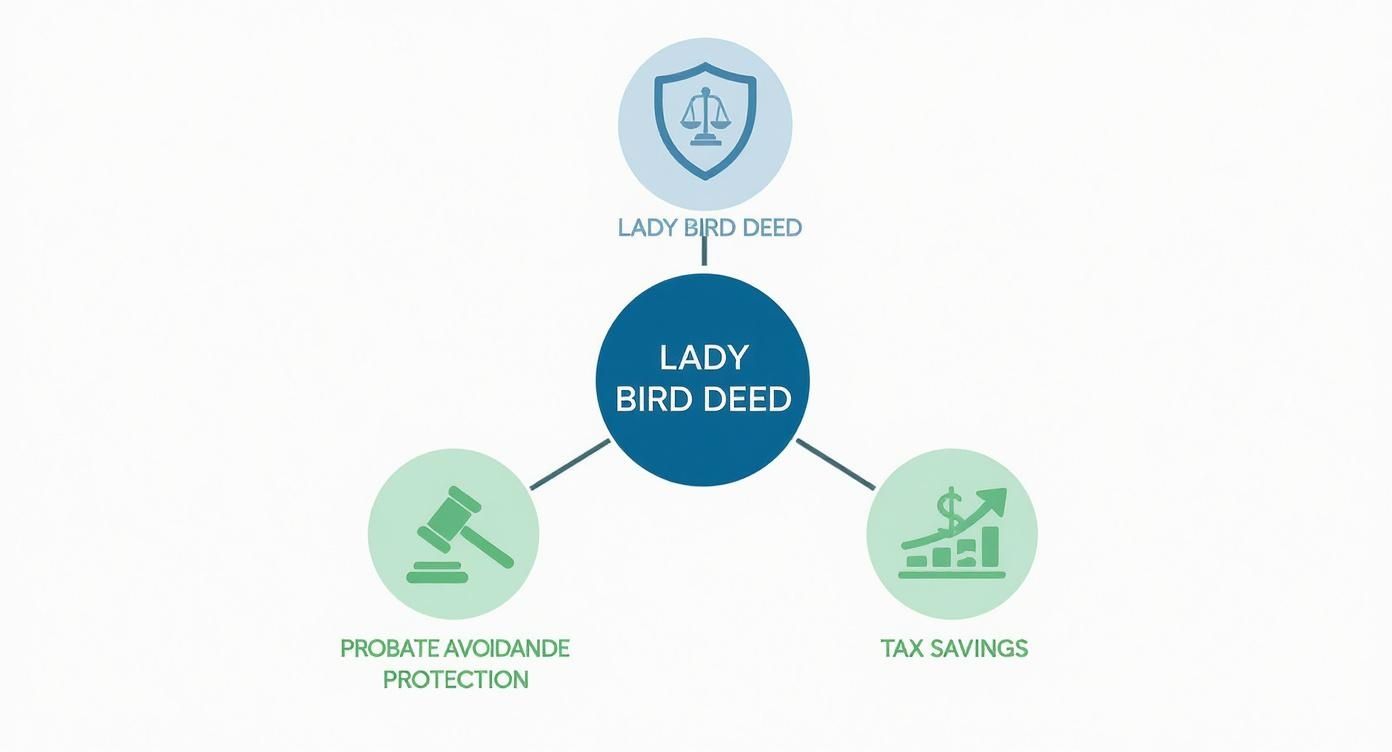
As you can see, these three core advantages combine to offer solid protection for what is often your most valuable asset.
Lady Bird Deed vs. Traditional Life Estate Deed
A Traditional Life Estate Deed also lets you transfer property upon death and avoid probate. But it comes with a major catch: you give up a significant amount of control the moment you sign it.
With a traditional deed, your beneficiaries (the “remaindermen”) get a real, vested interest in your property right away. That means you cannot sell, mortgage, or even change the deed without getting their written permission. Your home is essentially locked up, and your flexibility is gone.
This is where a Lady Bird Deed really shines. You keep complete control. You can change your mind, name a different beneficiary, sell the property, or take out a mortgage—all without needing anyone's signature but your own. This is a game-changer, since life is unpredictable.
Lady Bird Deed vs. Revocable Living Trust
A Revocable Living Trust is another fantastic tool for avoiding probate. It’s a comprehensive document that can manage all of your assets, not just your house. But that comprehensiveness comes at a price.
Setting up and funding a trust is usually more complex and expensive than drafting a Lady Bird Deed. It requires you to formally retitle your assets into the trust’s name, which means extra paperwork and careful attention to detail. For many Texas families whose main goal is just to protect their home, a Lady Bird Deed is a much more direct and cost-effective solution. If you’re weighing these options, you might find our guide on whether you should put your house in a trust helpful.
Lady Bird Deed vs. Transfer on Death Deed (TODD)
Texas also allows for a Transfer on Death Deed (TODD), which functions very much like a Lady Bird Deed—it’s revocable and it avoids probate. For a long time, they’ve been a popular alternative.
However, there’s a critical difference when it comes to Medicaid planning. A property passed through a TODD is subject to a claim from the Medicaid Estate Recovery Program (MERP), while a property passed via a Lady Bird Deed is not. In plain English, this means if you used Medicaid for long-term care, the state could force the sale of your home after your death if you used a TODD. A Lady Bird Deed offers superior protection in this specific, but vital, scenario.
Lady Bird Deed vs. a Will
Many people believe that having a Will is enough to transfer their home. This is a common and often costly misconception.
A Will does not avoid probate. In fact, a Will is your set of instructions for the probate court. Your home will still have to go through the full court process, which can be expensive and time-consuming for your heirs.
A Lady Bird Deed, on the other hand, bypasses probate entirely. The property transfers to your beneficiary automatically and instantly upon your death. This makes it a far more efficient tool for transferring real estate than relying on a Will alone.
Lady Bird Deed vs. Other Estate Planning Tools in Texas
To make things even clearer, let's look at these tools side-by-side. This table breaks down the key differences in how each one handles probate, control, and Medicaid protection.
| Tool | Probate Avoidance | Retained Control | Medicaid Protection | Complexity & Cost |
|---|---|---|---|---|
| Lady Bird Deed | Yes | Complete | Yes | Low |
| Traditional Life Estate Deed | Yes | Limited | Yes | Low to Moderate |
| Revocable Living Trust | Yes | Complete | Yes | High |
| Transfer on Death Deed (TODD) | Yes | Complete | No | Low |
| Will | No | Complete | No | Moderate to High |
As you can see, the Lady Bird Deed hits a sweet spot for many Texas homeowners, offering maximum control and protection with minimal complexity and cost. Every family's situation is unique, and making the right choice depends on your specific goals.
Potential Drawbacks and Common Mistakes to Avoid

While a Lady Bird Deed is an incredibly effective tool for many Texas families, it’s not a one-size-fits-all solution. Before you jump in, it's critical to understand its limitations and the common pitfalls that can trip people up. An improperly drafted or poorly thought-out deed can create the very headaches and family drama you’re trying to prevent through estate planning.
To know if it's right for you, you have to take a careful, honest look at your unique family dynamics and financial situation. A Lady Bird Deed shines in straightforward scenarios, but life is rarely that simple. Knowing the risks is the first step toward building a plan that truly protects your assets and your loved ones.
Potential Family Complications
One of the biggest areas where things can go sideways involves family relationships, especially when you have more than one child or beneficiary. While it's easy to name all your children as remaindermen, doing so can unintentionally plant the seeds for future conflict.
- Disagreements Among Beneficiaries: Imagine you leave your home to your three children. The moment you pass, they become co-owners. What happens if one wants to sell immediately, another wants to move in, and the third thinks it should be a rental property? You've just set them up for a potential legal standoff.
- Death of a Beneficiary: Life is unpredictable. What happens if one of your named beneficiaries dies before you do? Without specific language in the deed spelling out how their share is handled, you create ambiguity that can lead to ownership disputes and family feuds down the road.
These are exactly the kinds of "what-if" scenarios where professional drafting makes all the difference. An experienced attorney can add clauses to address these possibilities, making your wishes crystal clear and legally enforceable.
Financial and Title Insurance Hurdles
Beyond family issues, a Lady Bird Deed can occasionally create financial hiccups, particularly with mortgages and title insurance companies. While you absolutely keep the right to mortgage your property, some lenders and title companies aren't as familiar with Enhanced Life Estate Deeds as they should be.
This lack of familiarity can sometimes cause delays or require extra explanations during a sale or refinancing transaction. A few title insurance companies may even hesitate to issue a policy on a property with a Lady Bird Deed, though this is becoming less common as they grow in popularity.
It’s also vital to think about any existing mortgages or liens on the property. A Lady Bird Deed transfers the home along with any debt attached to it. This means your beneficiaries will inherit not just a valuable asset, but also the responsibility for any mortgage payments or liens.
Common but Critical Mistakes to Avoid
Even with the best of intentions, simple mistakes in how a Lady Bird Deed is written and filed can make it completely invalid. These errors can kick your property right back into the probate system, defeating the very purpose of creating the deed in the first place.
Here are the most common mistakes we see people make:
- Imprecise Legal Language: Using a generic, fill-in-the-blank form you found online is a huge risk. The deed must contain very specific legal language that grants you the "enhanced" powers to sell, mortgage, or change your mind without the beneficiary's consent. Vague wording could lead a court to interpret it as a traditional life estate, which would strip you of that crucial flexibility.
- Failure to Properly Record the Deed: A signed and notarized Lady Bird Deed is just a piece of paper until it is officially filed with the county clerk's office where the property is located (for example, the Harris County Clerk). This final step is what makes the deed a legally recognized public record. Forgetting it is a fatal flaw.
- Incorrect Property Description: The legal description of your property has to be perfect—down to the last letter and number. A simple typo or using an old, outdated description can create a "cloud on the title," causing major headaches for your beneficiaries when they try to sell or inherit the property.
These potential issues really highlight why getting professional guidance is so important. The compassionate team at The Law Office of Bryan Fagan can help you weigh these factors and ensure your deed is prepared and executed flawlessly. Schedule a free consultation to get the clarity and peace of mind you deserve.
Your Next Steps to Secure Your Texas Property
If a Lady Bird Deed sounds like the right tool to protect your home, your next move is to take clear, decisive action. While the concept is wonderfully simple, the legal execution has to be precise to hold up under Texas law.
Getting this process right is what ensures your family actually gets the full benefits of avoiding probate and protecting your most valuable asset. The journey starts with preparing for a productive chat with an experienced legal professional. This first step will give you the confidence and clarity to move forward.
Preparing for Your Consultation
To make the process as smooth and efficient as possible, it helps to gather a few key items before meeting with an attorney. Having this information ready lets your legal counsel give you the most accurate and personalized advice for your unique situation.
Here's your essential prep checklist:
- Your Current Deed: Bring a copy of the most recent deed to your property. This document contains the exact legal description needed for the new deed, which is non-negotiable.
- Key Information: Know the full legal names and current addresses of the people you plan to name as your beneficiaries.
- Your Goals and Concerns: Be ready to talk about what you're trying to achieve. Are you mainly focused on avoiding probate? Is planning for potential Medicaid needs your top priority? Or are you simply trying to make the transfer to your loved ones as smooth as possible?
The Legal Process from Start to Finish
Once you've decided to move forward, a seasoned Texas estate planning attorney will walk you through the formal steps. This is absolutely not a DIY project; professional drafting is crucial to avoid costly mistakes that could invalidate the entire deed down the road.
Here is what you can expect:
- Strategic Confirmation: First, your attorney will confirm that a Lady Bird Deed truly aligns with your bigger estate planning goals and doesn't conflict with other parts of your plan.
- Professional Drafting: They will then draft the deed using the specific legal language required by Texas law to create the "enhanced life estate," making sure you keep full control during your lifetime.
- Signing and Notarizing: You will sign the new deed in the presence of a notary public. This formality is legally required to authenticate the document and make it official.
- Recording the Deed: Finally, the attorney will make sure the signed and notarized deed is properly filed with the county clerk's office (like the Harris County Clerk or Dallas County Clerk) where your property is located. This makes it a public record.
Beyond just creating the deed, it's vital to manage all your essential property documents. Using tools like real estate document management software can help keep your important papers organized, secure, and accessible when you need them.
Protecting your home is one of the most loving and responsible things you can do for your family. At The Law Office of Bryan Fagan, we are committed to providing the compassionate guidance you need to secure your legacy. Schedule a free consultation with our team today to get personalized direction on protecting your family’s home and future.
Frequently Asked Questions About Lady Bird Deeds
Estate planning conversations naturally bring up a lot of questions. When Texas families hear about Lady Bird Deeds, they want to know the practical, real-world details. Here are some clear, straightforward answers to the questions we hear most often.
Can I Still Sell My House?
Absolutely. This is one of the biggest advantages of an Enhanced Life Estate Deed. You keep 100% control over your property for as long as you live. That means you can sell it, gift it, lease it, or even take out a mortgage without ever needing a signature or permission from the beneficiaries you've named.
If you do decide to sell the property, the Lady Bird Deed simply becomes void. The sale proceeds go directly to you, to use however you see fit. This incredible flexibility is a primary reason so many families in Harris and surrounding counties rely on this powerful tool.
Does a Lady Bird Deed Affect My Property Taxes?
Nope, not at all. Setting up and filing a Lady Bird Deed isn't considered a transfer of ownership for tax purposes. You'll keep paying your property taxes just like you always have, and it will not impact your current exemptions, including the valuable Texas homestead exemption.
What If a Beneficiary Dies Before Me?
This is a critical "what-if" that really shows why professional legal drafting is so important. A properly written Lady Bird Deed will always include contingency plans that spell out exactly what happens if one of your beneficiaries passes away before you do.
Typically, you can decide whether their share should pass to their own children, be split among your other surviving beneficiaries, or even return to your estate. Without these clear instructions, you're leaving behind a legal gray area that could unfortunately lead to disputes among your loved ones.
Is This Different From a Transfer on Death Deed?
Yes, and it's a crucial distinction, especially for any family thinking about future long-term care costs. While both a Lady Bird Deed and a Transfer on Death Deed (TODD) are great for avoiding probate, only the Lady Bird Deed offers protection against claims from the Medicaid Estate Recovery Program (MERP).
At The Law Office of Bryan Fagan, PLLC, we understand that protecting your home is really about protecting your family’s legacy. If you have more questions about whether a Lady Bird Deed makes sense for your situation, we're here to help.
Schedule Your Free Consultation Today to get the clarity and peace of mind you deserve.