Skip to content
Texas law lays out clear rules for last wills and testaments in Title 3, Subtitle G of the Estates Code. These templates aren’t just checklists—they walk you through naming an executor, dividing assets among beneficiaries, and appointing guardians for minor children, so your wishes hold up when it matters most.
Using A Texas Last Will And Testament Template
Before you grab a template, make sure you qualify:
- Any testator aged 18 or older (with exceptions if you’re married or serving in the armed forces)
- A written document bearing your signature
- Two credible witnesses, each 14 or older, signing in your presence
- (Optional) A self-proved affidavit to speed up probate
This snippet from Title 3, Subtitle G in the Texas Estates Code highlights witness requirements and self-proof rules.
It’s a handy reminder: miss these formalities and you risk a will contest.
Comparison Of Will Formalities
Before you decide on a format, here’s how attested and holographic wills compare under Texas law:
| Requirement | Attested Will | Holographic Will |
|---|---|---|
| Writing | Typed or printed copy | Fully handwritten by the testator |
| Signatures | Testator plus two credible witnesses | Testator only |
| Notarization | Optional (recommended for self-proof) | Not applicable |
Key Takeaway: An attested will—signed, witnessed, and optionally notarized—offers the strongest protection in Texas.
If your estate tops out at $75,000 or less, a small-estate affidavit in Harris or Dallas County might let you bypass full probate. For additional forms and estate-planning checklists, see our guide on Estate Planning Documents.
Ready to protect your legacy? Download your sample will today.
Completing The Template With Practical Guidance
Think of the opening declaration as your will’s backbone. A line like “I, Jane Doe, a resident of Harris County, Texas” makes it unmistakably yours and ties it directly to Texas law.
Include your full legal name, birth date, and address next. One Travis County judge sent a will back for clarification simply because the county name was missing, tacking on two weeks and extra fees.
Clause Highlights
Break the document into clear, labeled sections. Simple headings guide both your executor and the court.
- Opening Declaration – Testator’s name, county residency, and intent to create a will.
- Testator Details – Date of birth, current address, and marital status when relevant.
- Executor Appointment – Primary and alternate executor names with contact info.
- Gift Clauses – Specific bequests for jewelry, family heirlooms, or digital assets.
Executor Powers And Duties
Granting independent administration can speed probate along. In about 80% of Texas probates, executors act without constant court oversight.
- Obtain an EIN for estate tax purposes.
- Settle valid debts, taxes, and court fees.
- Gather appraisals and coordinate real estate sales.
- Distribute assets according to your instructions.
- File the final accounting when everything’s wrapped up.
Refer to Texas Estates Code Sections 401.001–.101 to make sure your executor’s powers are crystal clear.
Pro Tip: Ask your executor to draft a quick communication plan for beneficiaries. Regular updates can nip misunderstandings—and family tensions—in the bud.
Sample Property Language
Distinguishing community from separate property is crucial under Estates Code Chapter 112. Here’s a handy table to illustrate:
| Property Type | Sample Clause |
|---|---|
| Community Property | “I give my community interest in 789 Elm Street to my son.” |
| Separate Property | “I give my separate brokerage accounts held solely in my name.” |
Guardianship Clauses For Minors
Naming guardians upfront spares your kids from having a stranger thrust upon them. Under Texas Estates Code Title 3 Subtitle G, you can pick both a primary and a backup guardian.
- Full name, address, and relationship of your chosen guardian.
- Alternate guardian if the first choice can’t serve.
- Specific authority over education, healthcare, and finances.
Without this clause, courts follow default rules that might not match your wishes. In Tarrant County, one family endured months of hearings before a relative was approved—simply because Mom’s will didn’t name anyone.
Executing Your Will Legally
Getting your will across the finish line means more than signing on the dotted line. In Texas, overlooking a single formality can spark disputes and delay probate. By following the requirements in Texas Estates Code Title 3 Subtitle G and using our Texas last will and testament template, you’ll have confidence that your wishes hold up in court.
Selecting Credible Witnesses
Texas law insists on 2 disinterested witnesses to watch you sign. They must:
- Be at least 14 years old
- Sign in your presence, on the same document
- Have no claim to your estate or financial interest
Preparing Self-Proving Affidavit
A self-proving affidavit is a game-changer when probate rolls around. Swear the affidavit before a notary, and the court can skip live testimony of your witnesses.
- Arrange an appointment with a notary public in Harris, Travis, or Dallas County.
- Complete the notarization on the same day as your will signing.
- Keep the affidavit attached so judges waive witness appearances.
“A self-proved will can cut weeks off probate in Texas,” notes Bryan Fagan.
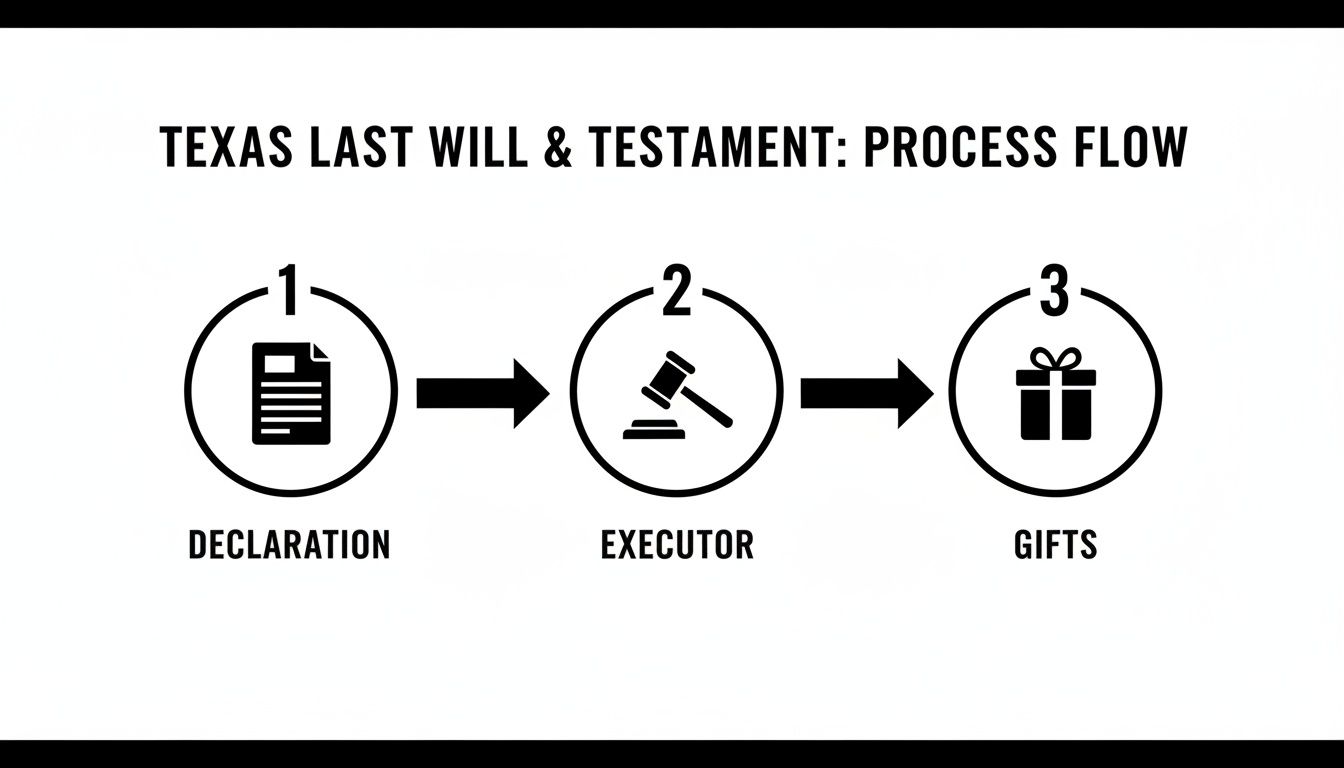
Below is a visual map of the three core steps—Declaration, Executor, and Gifts—that bring your will from draft to done.
Storing Your Will Securely
Once signed and notarized, keep your original will out of harm’s way:
- A fireproof safe at home
- A bank safe deposit box
- Your attorney’s secure file vault
Tell your executor where it lives, so nobody hunts through filing cabinets at crunch time.
Handling Property And Guardianship Clauses
When you’re ready to spell out property gifts, crisp language is everything. A clear distinction between community property and separate property makes sure your heirs aren’t left guessing.
| Property Type | Sample Wording |
|---|---|
| Community | I give my interest in homestead property at 123 Elm Street to my daughter. |
| Separate | I give my separate brokerage account at ABC Bank to my son in fee simple. |
Texas Estates Code Title 3, Subtitle G governs guardianship of minors. Skip a guardianship clause, and Texas courts can end up appointing someone you didn’t choose—sometimes after lengthy hearings.
In one Travis County case, a father died without naming a guardian for his children. After weeks of testimony, his niece was appointed, though she lived out of state and struggled with the sudden responsibility.
Guardianship Procedures in Texas
Families often face emotional and financial challenges when seeking guardianship. Understanding each step helps you prepare before, during, and after court:
Establishing Guardianship
Under Texas Estates Code Sections 1101.001–.002, you begin by filing a petition in your county’s probate court (e.g., Harris County Probate Court). Practical steps:
- Gather supporting medical and financial records.
- Serve notice on the proposed ward and close relatives.
- Attend a hearing where the court evaluates capacity and best interests.
Hypothetical: When Sarah petitioned to become guardian for her mother, she prepared a social history and letters from doctors, easing the court’s review.
Emergency or Temporary Guardianship
In urgent cases (Section 1104.001), you can request temporary guardianship to handle medical decisions or pay bills immediately. Steps:
- File a sworn affidavit explaining the emergency.
- Attend an expedited hearing—often the same day.
- Provide bond or financial assurances if ordered.
Guardianship Disputes
Contested guardianships can arise if family members disagree. Families should:
- Consider mediation through a local probate court program.
- Exchange witness lists and expert reports ahead of trial.
- Keep communication compassionate—courts value cooperation.
Visit our Probate Disputes page for tips on resolving conflicts.
Alternatives to Guardianship
Guardianship can be costly and restrictive. Texans often use:
- Durable power of attorney for finances (Estates Code §752).
- Medical power of attorney for healthcare decisions.
- Supported decision-making agreements for limited assistance.
These tools can delay or eliminate the need for full guardianship.
Rights and Duties of a Guardian
Once appointed, guardians must follow Texas Estates Code Sections 1103–.1105:
- Manage the ward’s assets and file annual accountings.
- Make personal decisions about health, education, and residence.
- Report any major changes (relocation, medical treatments) to the court.
Termination and Compliance
Guardianship ends under Section 1201 when:
- The ward regains capacity or a court restores rights.
- The ward passes away (executor duties then apply).
- A successor guardian is appointed.
Afterward, file a final report and account with the probate clerk.
For more on selecting guardians, explore our Guardianship guide.
Avoiding Common Mistakes In Texas Wills
Probate fights in Texas often boil down to tiny oversights.
Before you sign:
- Verify each beneficiary’s full legal name and relationship.
- Confirm that all witnesses signed in your presence on the correct document.
- Inspect every page for notarization dates and a proper seal.
- Review Texas’s small-estate threshold if assets total under $75,000.
| Common Error | Impact | Solution |
|---|---|---|
| Unclear Beneficiary Names | Will Contest | Include Full Legal Name and Relation |
| Missing Notary Seal | Invalid Self-Proof | Affix Seal and Date |
| Outdated Witness Information | Formality Failure | Update Witness Details Annually |
National surveys show only 24% of U.S. adults had wills in 2025, leaving more than 75% vulnerable. Learn more at Caring.com’s Wills Survey.
Reviewing A Filled Template With A Real Scenario
Imagine a Houston couple molding a Texas-style last will and testament to their own story. John Ramirez and Maria Hernandez, both with separate bank accounts and two young children, wanted to make every clause count.

They:
- Assigned clear executor powers, citing Texas Estates Code sections.
- Named primary and alternate guardians for their minors.
- Included a self-proving affidavit ready for notarization and witness signatures.
By opting for independent administration powers, they trimmed the typical probate timeline by about 80%. Visit our Estate Planning page to download their filled sample.
Next Steps And Frequently Asked Questions
Wrapping up your last will and testament template Texas isn’t just paperwork—it’s a moment of relief for you and everyone you love. A brief conversation can clear up questions and ensure your will aligns perfectly with Texas Estates Code Title 3 Subtitle G.
- Does moving to a new county invalidate my will?
- How do I update beneficiary information?
- Who qualifies as a credible witness?
- What happens if I don’t name a guardian?
Moving To A New County
Under Texas Estates Code Section 251.101, a valid will stays effective regardless of county. Swapping the county name in the header can prevent probate clerk hiccups.
Updating Beneficiary Information
To keep assets flowing:
- For bank accounts, file a fresh payable-on-death form.
- For your will, draft a codicil or a new will under Title 3 Subtitle G.
Credible Witness Criteria
Each witness must be at least 14 and free of any financial interest. Both sign in your presence on the same document. Learn more in our Guardianship guide.
Naming A Guardian
Skipping a nomination for minor children hands that choice to the court under Chapter 112. Always list a primary guardian and at least one alternate with full contact details. For more, see our Probate resource.
Protecting your family’s future is too important to leave to chance. Schedule a free consultation with Law Office of Bryan Fagan, PLLC today.