Skip to content
When a loved one passes away, your family is already navigating a difficult emotional journey. The last thing you need is a complex and stressful legal process. Fortunately, Texas law offers a unique and simplified probate process called a muniment of title. This guide will walk you through what it is, how it works, and whether it could be the right path for your family, all in plain English. Think of it as a court-certified shortcut for transferring property to beneficiaries when there's a valid will and no outstanding debts, other than a mortgage on a home.
Understanding This Texas Probate Shortcut
Navigating the grief of losing a family member is hard enough without the added burden of a drawn-out court case. A muniment of title is Texas’s way of recognizing this, offering a more direct path for certain estates and providing peace of mind during an emotional time.
Instead of a full, traditional probate—which involves appointing an executor, formally notifying creditors, and continuous court oversight—a muniment of title simply asks the court to legally recognize the will. The court order does one thing: it validates the will, and that order itself becomes the legal authority to transfer ownership of the deceased’s property to the heirs named inside it. This process is a clear example of how Texas law, particularly within the Texas Estates Code, aims to simplify estate settlement for families.
Key Benefits for Texas Families
For qualifying families in Harris County, Dallas County, and across the state, the biggest draws are efficiency and cost savings. This process can provide tremendous relief during an already challenging time.
- Faster Process: A muniment of title is generally much quicker than a full probate. It often wraps up in a matter of weeks, not the months or even years a traditional probate can take.
- Lower Costs: You skip the appointment of an executor and many of the administrative steps of a full probate. This means legal fees and court costs are typically far lower, easing the financial strain on your family.
- Reduced Complexity: The paperwork and court requirements are significantly less intensive, making the entire experience less overwhelming for a grieving family.
At its heart, a muniment of title is a legal declaration that allows beneficiaries to prove their ownership and transfer real property. This is often finalized using instruments like a Warranty Deed, making it especially useful for cleanly passing on the family home. It’s also important to understand how different assets are treated in this process; you can learn more by reading our guide on probate and non-probate assets.
Muniment Of Title Vs Traditional Texas Probate at a Glance
To really see the difference, it helps to put the two processes side-by-side. This table quickly shows why a muniment of title is such an attractive option for estates that qualify.
| Feature | Muniment of Title | Traditional Probate |
|---|---|---|
| Executor Required | No executor is appointed by the court. | Yes, an executor or administrator is appointed. |
| Court Oversight | Minimal; the court's main job is just to validate the will. | Significant; the court oversees the entire process. |
| Timeline | Typically much faster, often completed within weeks. | Can take several months to over a year to complete. |
| Cost | Generally much less expensive because there are fewer steps. | More costly due to ongoing legal fees and admin tasks. |
| Ideal For | Estates with a valid will and no debts (except a mortgage). | Estates with debts, complex assets, or potential disputes. |
Ultimately, choosing this path really comes down to your family’s specific situation. It’s a powerful tool designed to honor a loved one’s final wishes without getting bogged down in a complicated legal proceeding. If you think this might be the right fit for your family, talking to a compassionate probate attorney can give you the clarity you need to move forward.
Qualifying for a Muniment of Title
Is this simplified path an option for your family? Not every estate gets to take this shortcut. The Texas Estates Code, Section 257.001, is very clear about who qualifies, laying out specific rules to make sure the process is used correctly.
The basic idea is that a muniment of title is reserved for straightforward situations—where a loved one left a clear will and didn't leave behind a messy financial situation. We know that digging through legal codes can be a headache, so let's break down exactly what the probate courts in Texas, from Harris County to Williamson County, are looking for.
The Three Pillars of Eligibility
To successfully probate a will as a muniment of title, the estate has to meet three key conditions. If you can't say "yes" to all three, the court will almost certainly require a more traditional probate administration.
- A Valid Will Exists: The person who passed away must have left a legally sound Last Will and Testament. This can't be a copy; you need the original document, properly signed and witnessed as required by Texas law.
- No Unpaid Debts: The estate can't have any outstanding debts. There's one big, common-sense exception to this rule: a mortgage or other debt secured by a piece of real estate is perfectly fine.
- No Need for Administration: The court has to agree there's no other reason to open a full, formal probate administration. This usually means there aren't complicated assets that need active management or brewing disputes among the heirs that require a judge's oversight.
Think of it like a simple checklist. If you can confidently tick all three boxes, a muniment of title is likely an excellent, efficient, and more affordable choice for settling the estate. If the estate doesn't have a will at all, you may need to look into an alternative to guardianship or probate, like the Texas small estate affidavit form.
Understanding the Debt Requirement
That "no unpaid debts" rule is the one that often causes confusion. It is essential to get this part right. It means that all other bills—credit cards, final medical expenses, personal loans—must be settled before you file.
Example Scenario in Harris County
Let's say Maria’s father passed away in Houston. He owned his home outright, had a modest savings account, and his only remaining debt was a final utility bill. Maria paid that bill herself. His will was valid and left everything to be split between Maria and her brother. Because the only assets are the house and savings account, and there are no other outstanding debts, his estate is a perfect candidate for a muniment of title in the Harris County Probate Court.
The exception for a home mortgage is practical. The law recognizes that many people pass away while still paying off their homes. The people inheriting the house simply take over the property along with the existing mortgage.
The Four-Year Time Limit
There's one more critical piece to this puzzle: a deadline. In Texas, you generally have to file an application to probate a will—including as a muniment of title—within four years of the person's death.
If you wait longer than four years, things get much more complicated. While there are a few very narrow exceptions, the courts are incredibly strict about this deadline. Acting promptly doesn't just keep simpler options like muniment of title on the table; it also helps you avoid major legal headaches and the potential loss of inheritance rights down the line.
Your Step-by-Step Guide to the Filing Process
Navigating the court system after losing a loved one can feel like an impossible task. We understand. This guide breaks down the muniment of title process into clear, manageable steps, removing the legal jargon and providing a simple roadmap for your family to follow.
This visual shows the main requirements for using the muniment of title process, focusing on having a valid will, no outstanding debts, and acting within the legal time frame.
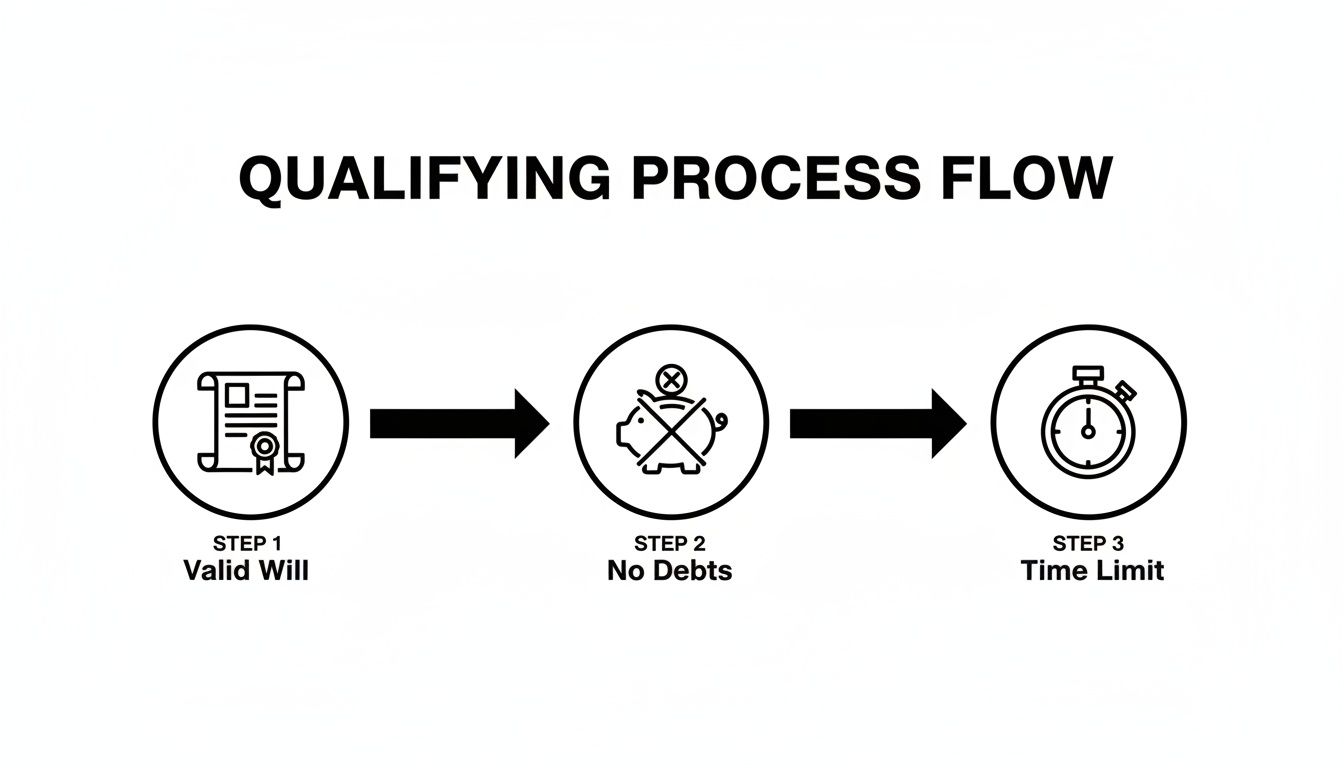
As you can see, these three pillars—a valid will, a debt-free estate, and timely filing—are the foundation of a successful muniment of title application. Let's walk through how it all works.
Step 1: Filing the Application
The journey begins by filing a formal document called an “Application to Probate Will as a Muniment of Title.” This application is submitted to the probate court in the Texas county where your loved one resided.
This document tells the court you have the original, valid will and that the estate meets all the specific requirements, like having no debts other than a home mortgage. It formally asks the judge to recognize the will as the legal instrument for transferring property.
Step 2: Posting the Legal Notice
Once the application is filed, Texas law requires a public notice to be posted at the courthouse. This is a standard procedure in all probate matters, so don't be alarmed.
This notice is simply an official announcement that a will has been submitted for probate. It typically stays posted for about 10 days, giving any interested parties a chance to see it before a court hearing is scheduled. This waiting period is a crucial part of ensuring the legal process is transparent.
Step 3: The Court Hearing
After the notice period wraps up, a court hearing gets scheduled. This is a short, formal appearance before a probate judge, and it’s far less intimidating than it might sound.
During the hearing, the person who filed the application (the applicant) will need to provide testimony. The judge will ask a series of straightforward questions to confirm a few key facts:
- That the person who passed away has, in fact, died.
- That the will presented to the court is their true and final will.
- That the estate has no unpaid debts (other than any secured by real estate).
- That the court has the proper jurisdiction to hear the case (meaning it's the correct county).
This testimony gives the judge the legal basis needed to approve the application. It's a necessary formality to ensure every box under the Texas Estates Code is checked. For families wanting to dig deeper into will validation, our article on probating a will in Texas offers more helpful details.
Step 4: The Court Order and Final Steps
If the judge is satisfied that all requirements have been met, they will sign a court order. This order officially admits the will to probate as a muniment of title.
This court order is the most important document in the entire process. It becomes the legal equivalent of a deed, giving beneficiaries the official authority to claim and transfer the property listed in the will.
With this certified order in hand, you can take it to banks, financial institutions, and the county clerk’s office. The last critical step is to record a certified copy of both the will and the court order in the real property records of every Texas county where the deceased owned property. This act officially updates the property records, finalizing the transfer of title to the new owners.
While this process is simpler than full probate, the details matter. Missing a step or misunderstanding a requirement can cause frustrating delays and unnecessary stress. Our team is here to provide the clarity and support your family deserves.
Comparing Probate Alternatives in Texas
While a muniment of title is a fantastic tool for Texas families in the right situation, it’s just one of several paths you can take to settle an estate. Think of these options like different tools in a toolbox. You wouldn't use a sledgehammer to hang a picture frame, right? In the same way, you wouldn't choose a complex, costly probate administration when a simpler tool will do the job perfectly.
Understanding the full landscape of options is what helps you and your attorney make the smartest, most compassionate decision for your family. Each path is designed for a different scenario, with its own level of court involvement, cost, and complexity. Let's see how a muniment of title stacks up against the other common procedures in Texas.
Muniment of Title vs. Independent Administration
The most common form of probate in Texas is what we call an Independent Administration. This process is definitely more involved than a muniment of title, but it's still designed to be quite efficient compared to probate in other states.
- The Executor Role: With an independent administration, the court officially appoints an executor. This person is given the legal authority to manage the estate—paying off debts, gathering up assets, and distributing property to the heirs—all with minimal court supervision. A muniment of title, on the other hand, has no executor at all.
- Handling Debts: This is the big difference. Independent administration is the correct choice when an estate has debts beyond just a home mortgage. The executor is legally responsible for notifying creditors and paying valid claims before any assets are distributed to the family.
- Court Involvement: It requires more steps upfront than a muniment, but it’s far less supervised than a dependent administration, which helps keep legal costs and time down.
So, if an estate has a valid will but also has a few debts floating around, like credit card bills or medical expenses, independent administration is almost always the most practical choice.
Muniment of Title vs. Dependent Administration
Now, let's talk about the other end of the spectrum. A Dependent Administration is the most formal and heavily court-supervised probate process in Texas. It's usually what happens when there's no will, or if the will doesn't name an independent executor and the family can't agree on one.
In this process, the court-appointed administrator has to get a judge's permission for nearly every single action they take, from selling a car to paying the electric bill. This intense level of oversight is designed to protect heirs and creditors in messy or contentious situations, but it also makes the process drag on much longer and cost significantly more.
A dependent administration is probate with the training wheels on. It provides maximum protection but at the cost of speed and flexibility. A muniment of title is for estates that can ride on their own without court supervision.
Muniment of Title vs. a Small Estate Affidavit
For very small estates where the person died without a will, Texas offers another highly simplified option called a Small Estate Affidavit (SEA). This tool is even more limited than a muniment of title.
An SEA can only be used if:
- The person died without a will (intestate).
- The value of the estate (not including the homestead) is $75,000 or less.
- The estate's assets are worth more than its debts.
An SEA avoids a formal court hearing entirely. Instead, the heirs present a sworn affidavit to banks and other institutions to collect property. It’s a great tool for truly modest estates, but a key limitation is that it can't be used to transfer title to real estate other than the family homestead.
Handling Out-of-State Wills in Texas
What if the deceased lived in another state but owned property here in Texas? Thankfully, Texas law has an efficient path for this, too. Instead of a full-blown "ancillary probate," an out-of-state (or "foreign") will can often be filed as a muniment of title under Texas Estates Code Chapter 503.
This streamlined process allows for the transfer of Texas real estate based on a valid will already probated in another state, saving the family from unnecessary complexity and expense. You can discover more insights about this efficient process for out-of-state estates.
Knowing these alternatives is the key to having a productive conversation with your probate attorney. If you're feeling unsure which path is right for your family's situation, we're here to help. Schedule a free consultation with The Law Office of Bryan Fagan to get clear, compassionate guidance tailored to your needs.
Common Issues and When to Seek Legal Help
Even a process as streamlined as a muniment of title can hit some snags. While it's designed to be a simpler alternative to full probate, life and family matters are rarely straightforward. Knowing when a small hiccup is actually a major legal roadblock is crucial for protecting your family’s inheritance and honoring your loved one’s final wishes.

We get it—facing legal hurdles while you're grieving can feel like too much to handle. The goal here isn't to scare you but to empower you with knowledge about real-world situations where bringing in an experienced probate attorney becomes absolutely necessary.
When Complications Arise
Some situations are immediate red flags, signaling that a muniment of title might not be the right path—or even a legal option anymore. If you run into any of these guardianship disputes or estate issues, it's time to pause and get professional advice.
- Discovery of Unexpected Debts: What happens if you file for a muniment of title, believing the estate is debt-free, only to find a huge unpaid medical bill or credit card balance? This is a deal-breaker. A core requirement is that the estate has no unsecured debts. This discovery could invalidate the entire process and force the estate into a more formal Probate administration.
- A Contested Will: If another family member suddenly appears to challenge the will's validity, the situation immediately becomes a contested matter. A muniment of title is not built to handle family disputes or will contests. The court will require a formal probate proceeding to sort out the conflict.
- Beneficiaries Are Minors: When a will leaves property to a child, a muniment of title just isn't enough. Texas law demands a separate legal process, usually a Guardianship, to be set up. This ensures the child’s inheritance is properly managed by a guardian until they become a legal adult.
Trying to navigate these scenarios on your own can lead to frustrating delays, legal missteps, and could even put the estate's assets in jeopardy.
Navigating Property Title Issues
The very name "muniment of title" underscores how important clean property records are. The word "muniment" actually comes from a Latin term meaning "to fortify." Think of these documents as fortifying your legal claim to a property.
But even with a will, problems with the property's history can surface. Understanding potential challenges is key. There are several common issues in title verification that can pop up during property transfers, like old liens, boundary disputes, or unclear property descriptions. Any of these can cloud the title and stop the transfer in its tracks.
An experienced probate attorney can conduct a thorough title search to uncover and resolve these issues before they become major headaches. This ensures the property passes cleanly to the rightful heirs without the threat of future legal challenges.
Why an Attorney Is Your Best Ally
Sure, a muniment of title is simpler than full probate, but it's still a formal legal proceeding with very specific rules. A good attorney does more than just fill out forms—they act as a critical safety net.
An expert can spot potential problems before they arise, make sure every action complies with the Texas Estates Code, and quickly shift to a different probate strategy if the situation changes.
Our compassionate attorneys at The Law Office of Bryan Fagan are dedicated to guiding Texas families through these exact challenges. We're here to help you make informed decisions, avoid common pitfalls, and find the most efficient and secure path forward.
If your situation involves any of these complexities, please don't try to go it alone. Schedule a free consultation with us today for personalized guidance and the peace of mind you deserve.
Common Questions About Muniment of Title in Texas
Stepping into any legal process can feel overwhelming, and it's natural to have a lot of questions. We find that when Texas families have clear, direct answers, they feel much more confident about the path ahead. Here are some of the most common questions our attorneys hear about using a muniment of title.
What Happens if I Find a Debt After the Process Is Finished?
This is a great question, and it gets right to the heart of why being thorough is so important. If you probate a will as a muniment of title and an unpaid, unsecured debt—like an old credit card bill or a surprise medical expense—surfaces later, it can create a serious legal problem.
The "no debts" rule is a non-negotiable requirement under the Texas Estates Code. Discovering a debt after the fact could actually invalidate the muniment of title. In that situation, the beneficiaries might have to go back to court and open a more formal probate administration to handle creditors and pay the debt. This is exactly why working with an attorney to perform a diligent search for any outstanding debts beforehand is so critical.
Can I Use This for Bank Accounts and Not Just a House?
Yes, absolutely. While people often associate a muniment of title with transferring a house, it's a powerful tool for many other types of assets. The court's order, combined with the will, acts as the legal key for beneficiaries to claim assets from financial institutions.
You can present a certified copy of the will and the court order to banks to move funds from checking or savings accounts to the rightful heirs. It works for brokerage accounts, stocks, and even vehicles. Just be aware that some out-of-state banks might not be familiar with this unique Texas process and could ask for "Letters Testamentary," which aren't part of a muniment of title case. An attorney can easily help you clear up that confusion if it comes up.
How Long Does a Muniment of Title Take in Texas?
One of the biggest draws of this process is its speed, especially when you compare it to a full probate administration. While every case has its own unique details, a muniment of title is often wrapped up in a surprisingly short time.
Here’s a general timeline you can expect in most Texas probate courts, like those in Harris or Dallas County:
- Filing and Notice Period: Once the application is filed, there's a mandatory waiting period of about 10-14 days.
- Court Hearing: A hearing can usually be set just a few weeks after that waiting period ends.
- Final Order: Once the judge signs the order, the process is effectively complete.
From start to finish, a straightforward muniment of title can often be finalized in just four to six weeks. That's a huge difference from a full probate, which can easily stretch on for six months to a year, or even longer.
What Are the Cost Savings Compared to Full Probate?
The cost savings can be significant. A muniment of title is designed to be a simpler path—it avoids appointing an executor and skips many of the administrative hoops of a full probate. As a result, the legal fees and court costs are much lower.
It's tough to put an exact number on it without knowing the estate's specifics, but it's not uncommon for families to save thousands of dollars. You completely avoid the costs tied to:
- Executor fees and commissions.
- Preparing and filing a detailed inventory of the estate.
- The formal process of notifying every potential creditor.
- Ongoing court oversight and reporting duties.
The financial relief, paired with less stress and a much shorter timeline, makes it a compassionate and incredibly practical choice for estates that qualify.
Can It Be Used for Property with a Complicated History?
Yes, in fact, a muniment of title is frequently used to clear up the chain of title for properties that have been passed down through a family for generations. Sometimes, proving clear ownership means digging into historical records. For instance, federal land patent records track the transfer of millions of acres from the government to private individuals between the 1780s and the 1960s.
Thanks to digitization, it's become much easier for legal professionals to research these records and build a solid chain of title for family properties with deep roots. You can learn more about these historical property records and their impact on modern genealogy. An attorney can leverage this kind of research to strengthen the legal standing of the will being used for the muniment of title.
At The Law Office of Bryan Fagan, PLLC, we believe settling a loved one's estate should be as clear and stress-free as possible. If you have more questions about whether a muniment of title is the right choice for your family, we are here to provide the answers and support you need. Contact us today to schedule a free, no-obligation consultation and let us help you find the best path forward.