Skip to content
When you're facing the tough reality of needing to protect a loved one, a guardianship letter acts as your formal recommendation to a Texas court. It’s your chance to explain, in your own words, who you believe is the absolute best person to care for a minor child or an incapacitated adult. While it isn't legally binding on its own, its power should not be underestimated. This letter is a crucial piece of evidence that gives a judge a window into your wishes and what's truly in your loved one's best interest.
What a Guardianship Letter Really Is and Why It Matters

When Texas families are grappling with the need for a guardian, the legal process can feel overwhelming. A guardianship letter is a compassionate and practical first step. It transforms your heartfelt concerns into a clear, written statement for the court. Think of it as your opportunity to speak directly to the judge before you even set foot in the courtroom.
For instance, if you're a grandparent in Harris County worried about your grandchild’s stability, this letter is where you lay out your case. If you're an adult child in Dallas trying to help a parent with dementia, this letter explains why a specific person is the right choice for their care. It’s a tool that provides essential context, demonstrates your thoughtful planning, and shows your deep commitment to your family’s well-being.
The Purpose of Different Guardianship Letters
Not all guardianship letters are the same. Their purpose shifts depending on who needs to see them and why. Understanding this distinction is key to drafting a document that is effective for your specific situation.
- Letters to the Court: This is the most formal version, used in official guardianship proceedings under the Texas Estates Code to nominate a guardian for a minor or an incapacitated adult.
- Letters for Schools: Often used for temporary situations, these letters can authorize a grandparent or another relative to make educational decisions for a child when a parent is unavailable.
- Letters for Doctors: These are critical in emergencies. They grant a temporary caregiver the authority to consent to medical treatment when a parent or guardian cannot be there.
- Letters for Banks: This type helps a proposed guardian manage the financial affairs of an incapacitated person, usually as part of a formal guardianship of the estate.
The need for clear legal frameworks isn't just a Texas issue. As families in 195 countries navigate similar challenges, the global demand for guardianship services is on the rise. This worldwide trend underscores just how vital documents like sample guardianship letters are for protecting vulnerable individuals everywhere.
Key Takeaway: While a judge makes the final decision based on the Texas Estates Code, your letter is a critical piece of the puzzle. It guides the court by providing specific, personal reasons why your choice is the best one for your loved one.
To help you figure out exactly what you need, it's useful to see how these letters are used in different scenarios.
Guardianship Letter Types and Their Common Uses
This table helps Texas families quickly see which type of guardianship letter is needed for different situations, from medical decisions to school enrollment.
| Letter Type | Primary Purpose | Common Recipient |
|---|---|---|
| Nomination of Guardian | Formally recommend a guardian in a court proceeding. | Probate Court Judge |
| Temporary Guardianship (Medical) | Authorize urgent medical decisions for a minor. | Doctors or Hospitals |
| Temporary Guardianship (School) | Grant authority for school enrollment and decisions. | School Administrators |
| Letter of Support (Financial) | Justify the need for access to financial accounts. | Banks or Institutions |
Ultimately, drafting this letter is a profoundly responsible and loving act. It ensures your voice is heard, providing a path forward during what is often a very challenging time for a family.
For a deeper dive into the official court documents that come next, you might find our guide on Letters of Guardianship helpful.
The Building Blocks of a Persuasive Guardianship Letter

Moving beyond a basic template is what separates a good guardianship letter from a great one—the kind Texas courts and other institutions take seriously. A truly persuasive letter isn't just a form you fill out; it’s a carefully constructed argument that tells a story of care, responsibility, and unwavering commitment to your loved one’s well-being.
Each piece of the letter must work together to build a compelling case. Your goal is to persuade a judge or an official, much like you would in a high-stakes job application. Applying the same principles of persuasive letter writing can make a huge difference here. The final document must be clear, factual, and written with a blend of compassion and legal precision.
Key Identifiers for Everyone Involved
The absolute foundation of any strong guardianship letter is clarity. Before you even get into the why, you have to spell out exactly who is involved. This simple step prevents confusion right from the start and establishes the proper legal context for the court.
Your letter must include:
- The Declarant: Your full legal name and how you're related to the person needing a guardian (e.g., parent, grandparent, sibling).
- The Proposed Ward: The full legal name and date of birth of the child or incapacitated adult.
- The Proposed Guardian: Their full legal name, current physical address, and relationship to both you and the ward.
Forgetting this step can cause frustrating and unnecessary delays. A judge in a Montgomery County Probate Court needs this information just to begin considering your request. Think of it as introducing the cast of characters in your family's story—the judge needs to know who's who.
A Clear and Confident Statement of Intent
Once you've identified everyone, your letter needs a direct and unmistakable statement of purpose. This is no place for vague language. You must clearly and confidently state that you are nominating a specific person to become the guardian.
For example, a son seeking guardianship for his elderly mother with Alzheimer's might write: "In the event of my incapacitation or death, I nominate my sister, Sarah Jenkins, to serve as the guardian of the person and estate of our mother, Eleanor Jenkins."
That single sentence sets a clear direction for the rest of the letter, leaving no doubt about your wishes. This statement is your thesis. Everything that follows should support this declaration with specific, factual details that align with the requirements of the Texas Estates Code, particularly Title 3, Subtitle G, which governs all guardianship proceedings.
Our Commitment to You: We understand that articulating these sensitive details can be emotionally taxing. Our approach is to help you frame your letter in a way that is both legally sound and reflects your family’s unique circumstances with dignity and respect.
Describing the Ward's Situation with Sensitivity
This part of the letter explains why a guardianship is necessary. It requires a delicate balance—you have to provide factual, honest information while maintaining the dignity of your loved one. Whether you are describing a child's needs or an adult's incapacity, the goal is to be direct and respectful.
If the proposed ward is an adult, you'll need to carefully describe their inability to manage their own affairs. This might involve mentioning a specific medical diagnosis, cognitive decline, or physical limitations that prevent them from making sound decisions about their health, finances, or daily life.
When the ward is a minor, the focus shifts to explaining why the parents are currently unable to provide care. This section has to be handled with immense care, focusing on facts rather than placing blame. The objective is to show the court why your proposed guardian is the best choice to provide the stability and care the child needs.
This part of your letter is your chance to connect the dots for the judge, demonstrating a clear and urgent need for the protective measures of a guardianship.
The next steps in our guide will provide downloadable sample guardianship letters you can adapt for these real-world situations. For personalized advice, schedule a free consultation with our team to discuss your family’s needs.
Downloadable Sample Guardianship Letters for Real-Life Situations
Knowing what should go into a guardianship letter is one thing, but seeing how it all comes together is another. To help you get it right, we have put together some practical, customizable sample guardianship letters you can adapt for your own family’s needs here in Texas.
Each template is built around a common, real-world scenario. We will even set the scene with a short story so you can see exactly when and how a letter like this would be used. Think of these as a solid starting point. The goal is to give you the confidence to turn your intentions into a clear, effective document that schools, banks, and doctors will understand and respect.
Letter to a School for a Grandchild
The Situation: Maria’s daughter, a single mom, just got deployed overseas for a six-month tour. This means Maria is stepping in as the full-time caregiver for her 8-year-old grandson, Leo. To get Leo enrolled in her local Bexar County school district and handle all the things a parent normally would, Maria needs a formal letter of temporary guardianship.
This letter gives the school the official permission it needs to work directly with Maria.
[Your Full Name]
[Your Address]
[Your City, State, Zip Code]
[Your Phone Number]
[Your Email Address]
[Date]
To the Office of the Principal,
[School Name]
[School Address]
[City, State, Zip Code]
Re: Authorization for Temporary Guardianship for Minor Child, [Child’s Full Name]
Dear School Administrators,
I am writing to inform you that I, [Parent's Full Name], the legal parent of [Child’s Full Name] (Date of Birth: [Child's D.O.B.]), am granting temporary guardianship authority to my mother, [Grandparent’s Full Name], for all school-related matters.
Due to my military deployment from [Start Date] to [End Date], my mother will be my son's primary caregiver. She lives at [Grandparent’s Full Address].
Effective immediately, this letter authorizes her to:
- Enroll [Child’s First Name] in school and sign all necessary registration documents.
- Make all educational decisions on his behalf.
- Access his school records, including grades and attendance reports.
- Provide consent for school-related activities and field trips.
- Serve as the primary emergency contact for any school communications.
For your records, I have attached a copy of my deployment orders. Please direct all future correspondence regarding [Child’s First Name] to [Grandparent’s Name] until I return.
Thank you for your cooperation and understanding in this matter.
Sincerely,
_________________________
[Parent's Printed Name]
Letter to a Bank for an Elderly Parent
The Situation: David’s father, Robert, lives in Tarrant County and is in the early stages of Alzheimer’s. While Robert has his good days, he's getting more confused about his finances and has missed paying a few important bills. His doctor has already certified that he can no longer manage his financial affairs, so David is petitioning the court for guardianship of his father's estate. The bank, however, has requested a formal letter explaining his authority to even ask for account information.
This type of letter provides the necessary declaration to a financial institution.
[Your Full Name]
[Your Address]
[Your City, State, Zip Code]
[Your Phone Number]
[Your Email Address]
[Date]
[Bank Name]
[Bank Branch Address]
[City, State, Zip Code]
Re: Declaration of Proposed Guardian for Account Holder, [Parent's Full Name]
To Whom It May Concern:
My name is [Your Full Name], and I am writing to you about my father, [Parent's Full Name], who is one of your clients. He holds the following account(s): [List Account Numbers, if known].
This letter serves as formal notification that I am in the process of seeking legal guardianship over my father’s estate.
My father has been diagnosed with [Medical Condition, e.g., Alzheimer's disease], and his diminished capacity now prevents him from managing his financial affairs. I have attached a letter from his physician, Dr. [Doctor's Name], which confirms this assessment.
An application for guardianship was filed with the [County Name, e.g., Tarrant County] Probate Court on [Date of Filing]. I am the proposed guardian named in that filing. This step is crucial to protect my father’s assets and ensure his bills and medical expenses are paid properly.
At this time, I am only requesting access to account statements and related information to prepare the inventory required by the court. I am not requesting the authority to make any transactions. My attorney is [Attorney's Name], and they can be reached at [Attorney's Phone Number].
Thank you for your attention to this sensitive situation.
Sincerely,
_________________________
[Your Printed Name]
While these documents are incredibly useful for handling day-to-day matters, some situations are genuine emergencies. If you believe a loved one is in immediate physical or financial danger, you may need to learn about seeking an emergency guardianship in Texas, which moves along a much faster legal track.
Letter Supporting a Doctor's Medical Assessment
The Situation: Sarah is seeking guardianship for her brother, Mark, who suffered a severe traumatic brain injury in an accident. The court requires a formal Physician's Certificate of Medical Examination. To help the doctor write a thorough and accurate report, Sarah decides to write a cover letter. It gives important context about Mark's daily struggles—things the doctor might not see in a brief office visit.
This letter helps the physician grasp the full picture of the proposed ward’s incapacity. And while it's a different legal tool, looking at a co-parenting agreement template can sometimes offer useful insights into how to structure documents involving care arrangements.
[Your Full Name]
[Your Address]
[Your City, State, Zip Code]
[Your Phone Number]
[Your Email Address]
[Date]
Dr. [Doctor’s Full Name]
[Medical Facility Name]
[Facility Address]
[City, State, Zip Code]
Re: Supporting Information for Physician's Certificate of Medical Examination for [Proposed Ward’s Name]
Dear Dr. [Doctor’s Last Name],
Thank you for agreeing to complete the Physician's Certificate of Medical Examination for my brother, [Ward’s Full Name]. I am writing this letter to provide some additional context about his condition that I hope will be helpful for your assessment.
Since his accident on [Date of Accident], I have observed several challenges in his daily life that may not be apparent in a clinical setting:
- Memory and Cognition: He often forgets to take his medication, cannot recall conversations we had just hours before, and is unable to follow simple multi-step instructions, like how to prepare a meal.
- Financial Judgment: He recently tried to give a large sum of money to a telemarketer and doesn't seem to understand the consequences of his financial decisions.
- Personal Safety: He has wandered away from home on two separate occasions and has trouble recognizing potential dangers, such as leaving the stove on unattended.
These examples are why I believe he no longer has the capacity to manage his own healthcare or financial affairs. Your medical opinion is a critical piece of the puzzle in ensuring he gets the protection and support he needs.
Please let me know if you require any other information from me to complete the court-required form.
Sincerely,
_________________________
[Your Printed Name]
Our Compassionate Guidance: We understand that these letters often represent some of life's most difficult chapters. They are more than just paperwork; they are acts of love and protection. If you need help tailoring a letter to your unique situation, our team is here to provide the support and legal clarity you deserve.
From Template To Tailored: A Practical Walkthrough
Taking a generic sample guardianship letter and personalizing it is the most critical step in this process. Think of a template as just the starting point—it's your personal details and careful wording that will give the document its real power in a Texas probate court. It’s like moving from a black-and-white sketch to a full-color portrait of your family's situation.
This walkthrough is all about giving you practical, actionable advice for personalizing your letter. The goal is to craft a document that is respectful, factual, and directly addresses what the Texas Estates Code requires a judge to consider. It’s about being clear and persuasive, not overly emotional.
Striking the Right Tone
One of the biggest mistakes families make is writing a letter that’s either too emotional or too vague. While your feelings are completely valid, a judge in a Harris County Probate Court needs objective facts to make a decision based on the “best interest of the ward.”
Your tone should be:
- Respectful: Always speak of the proposed ward with dignity, even when describing their limitations.
- Factual: Replace emotional pleas with specific examples. Instead of saying, "he needs help," describe what that looks like: "He has forgotten to take his heart medication on three occasions this month."
- Confident: Clearly state your nomination and the reasons for it without hesitation.
A measured, professional approach shows the court that your request is based on thoughtful consideration, not just a momentary crisis.
The flowchart below offers a simple decision tree to help you select the right starting template based on who the letter is for, whether it's a school, bank, or doctor.
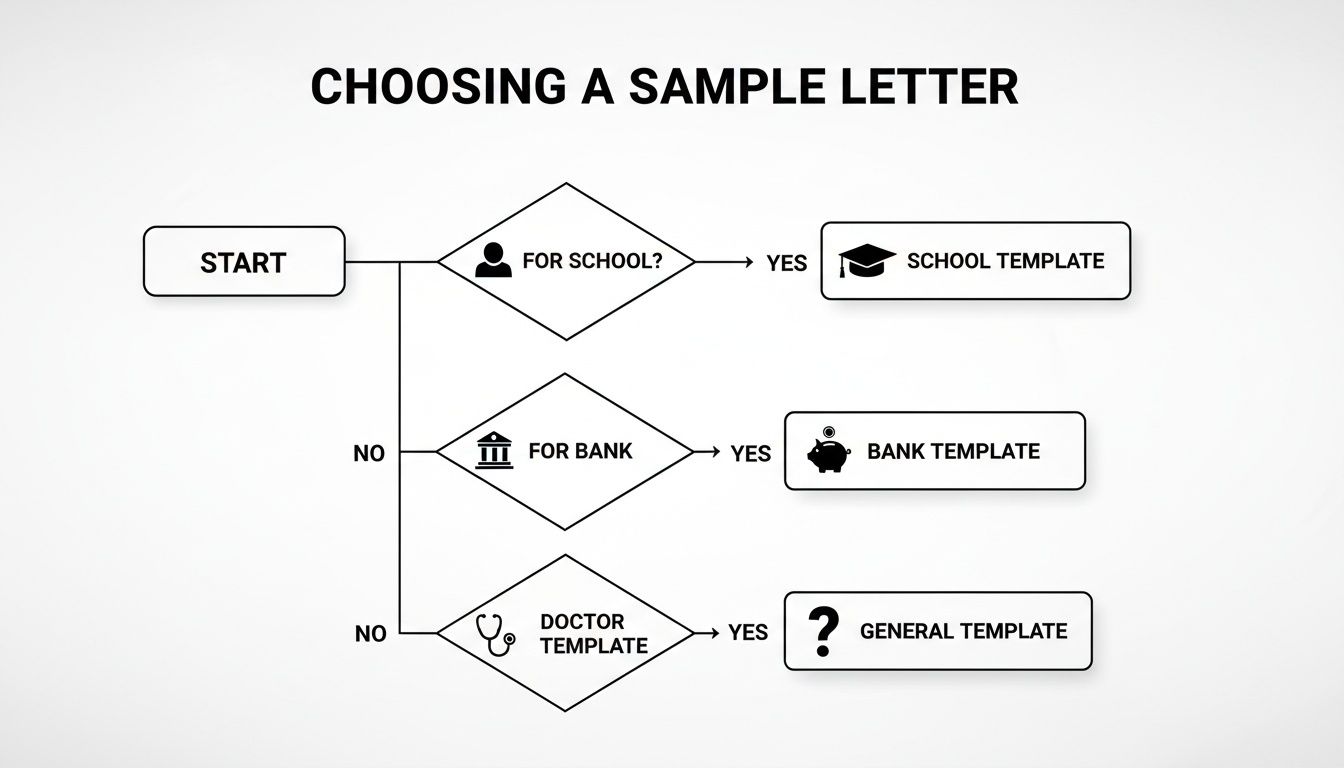
This visual helps simplify the initial choice, ensuring you start with a structure already aligned with your specific goal. That makes the tailoring process much more direct.
Gathering Your Supporting Evidence
Your letter tells your story, but supporting documents provide the proof. In cases of adult incapacity, the most crucial piece of evidence is the Physician's Certificate of Medical Examination. This is a court-required form, completed by a doctor, that provides the official medical opinion that guardianship is necessary.
When you ask the doctor to complete this form, including a cover letter (like the sample in our previous section) can be incredibly helpful. It gives the physician the real-world context they need to write a thorough report addressing the legal standards for incapacity under the Texas Estates Code, Title 3, Subtitle G.
We understand the emotional and financial challenges families face when pursuing guardianship. Our mission is to guide you through these legal requirements with clarity and care, ensuring every document you prepare is as strong as it can be.
The need for stable, legally sound placements is growing. Guardianship has become a vital permanency option for foster youth in the U.S., accounting for 10% of all exits from foster care in recent years. Of the 184,095 youth who left the system in one year, approximately 18,410 moved into guardianship, showing just how critical these arrangements are for securing long-term care. You can discover more insights about these foster care statistics.
Do's and Don'ts for Drafting Your Guardianship Letter
To help you steer clear of common pitfalls that could weaken your case, we've put together a practical checklist. Following these simple guidelines will help ensure your letter is effective, respectful, and professional in the eyes of the court.
| Do | Don't |
|---|---|
| Be specific and use concrete examples. (e.g., "She cannot recall her own address.") | Use vague or emotional language. (e.g., "She is just not herself anymore.") |
| Maintain a respectful and dignified tone. | Blame or criticize other family members. |
| Reference the proposed guardian’s stability. (e.g., "He has a stable job and a safe home.") | Forget to include full legal names and addresses. |
| Get the letter signed and notarized. | Contradict information in other legal documents like a will. |
| Focus on the “best interest of the ward.” | Make it about what is convenient for you. |
By carefully tailoring your letter and avoiding these common mistakes, you create a powerful document that truly serves its purpose. The journey through the probate system can be complex, but a well-prepared letter is a huge step in the right direction. For personalized guidance on your specific situation, we invite you to schedule a free consultation with our experienced team.
What to Do After Your Letter Is Written

Drafting a thoughtful guardianship letter is a huge step forward, but it’s the beginning of the formal legal journey, not the finish line. Once you’ve put your wishes down on paper, your focus must shift to the practical, procedural steps that make your letter an effective part of a Texas guardianship case.
This next phase is all about turning your written document into official action. It involves legal formalities—signing, notarizing, filing, and notifying family members—that ensure the court takes your request seriously. Understanding these next moves will demystify the road ahead and bring you closer to securing the protection your loved one needs.
Making It Official: Signing and Notarization
Before your letter can be considered by a court, it must be properly executed. This is a straightforward but absolutely non-negotiable step that gives your document its legal weight.
You must sign the letter in the presence of a notary public. A notary is an official who verifies your identity and witnesses your signature, confirming you signed the document willingly. This simple act turns your letter into a sworn statement, which is a powerful piece of evidence in any court proceeding.
Key Takeaway: Whatever you do, do not sign the letter beforehand. The notary has to physically watch you sign the document for it to be valid. This small formality is crucial for your letter's credibility in court.
Getting your letter notarized helps prevent future challenges to its authenticity, leaving the court with no reason to doubt that it truly represents your intent.
Filing and Serving Your Guardianship Letter
With your signed and notarized letter in hand, the next stage moves into the formal court process. This letter will become a key exhibit in the larger application for guardianship that gets filed with the appropriate probate court—for instance, the Brazoria County Probate Court if your loved one lives there.
Filing the application officially kicks off the legal case. Once it’s filed, Texas law requires that all "interested parties" receive formal notice of the proceedings.
This group typically includes:
- The proposed ward (if they are 12 or older)
- The proposed ward’s parents and spouse
- Any adult children of the proposed ward
This step, known as service, ensures that key family members are aware of the guardianship request and have an opportunity to be heard. It’s a fundamental part of due process that is strictly required under the Texas Estates Code and helps keep the process transparent.
Preparing for the Court Hearing
The final step in this phase is getting ready for the guardianship hearing itself. This is where a judge will review all the evidence—including your letter—and make a final decision. It can be an emotional day, but being prepared makes all the difference.
The judge’s decision will ultimately come down to what is in the “best interest of the ward.” Your letter has already helped build that case, but the hearing is where everything comes together. Knowing what to expect at a Texas guardianship hearing can significantly reduce anxiety and help you present your case clearly and confidently.
We know this process carries a heavy emotional and financial weight. Our goal is to stand by your side with clear legal guidance and compassionate support. When you’re ready to take the next step, schedule a free consultation with our team to talk about your family’s unique situation.
Common Questions About Texas Guardianship Letters
When you're trying to protect a loved one, it's easy to get bogged down in questions and uncertainty. We get it. Over the years, our firm has heard just about every question there is from Texas families trying to create and use sample guardianship letters. We've put together some straightforward answers to help you feel more confident moving forward.
Do I Absolutely Need a Lawyer To Write a Guardianship Letter?
While you can write a guardianship letter yourself using a template, it can be a risky move. The Texas Estates Code is specific about what's required. One small mistake in the language or how you file it can cause major delays or even get your request denied by the court.
Having an experienced attorney draft or review your letter is about more than avoiding errors—it's about making your case persuasive. A lawyer knows how to frame the facts to directly address the "best interest of the ward" standard that judges in places like the Harris County Probate Court must follow. That kind of legal precision can be a huge relief during an already stressful time.
We know that families going through this are often dealing with a lot, both emotionally and financially. That’s why we focus on providing guidance that is both compassionate and legally sharp, so your loved one's future is secure.
How Is a Temporary Guardianship Letter Different?
A letter for a temporary or emergency guardianship has a different mission than one for a permanent arrangement. Its main job is to prove there's an immediate and substantial risk of harm to the person you're trying to protect. The entire focus is on urgency—why the court needs to act right now.
On the other hand, a letter for permanent guardianship is about building a comprehensive case for long-term care. It paints a much broader picture, detailing a longer history, providing more extensive evidence, and outlining a clear plan for the person's future. It's about showing why a permanent solution is the only way to ensure their well-being.
Can I Use the Same Sample Letter for a Child and an Adult?
No, and this is a common misconception. The legal grounds for guardianship over a minor are completely different from those for an adult who has become incapacitated.
- For a Child: The letter usually has to explain why the child’s parents can't care for them. The focus is on the child's need for a stable and safe environment.
- For an Adult: The letter must present clear evidence that the adult can no longer manage their own affairs because of a specific medical issue, cognitive decline, or physical disability.
These are two different legal arguments, each requiring its own unique set of facts. A one-size-fits-all template just won't work and could jeopardize your case.
How Do I Get a Doctor's Letter To Support My Application?
The official document you'll need is called the Physician's Certificate of Medical Examination, which is a specific form required by the court. When you ask the doctor for this, it's a very good idea to give them a cover letter.
In your letter, briefly explain why you're seeking guardianship and provide some real-world context about your loved one’s daily struggles. This helps the doctor understand the situation beyond just the medical chart, allowing them to write a much more thorough and supportive opinion that directly addresses the legal standards for incapacity here in Texas.
Going through the guardianship process brings up a lot of questions, and having a legal partner you can trust makes all the difference. At the Law Office of Bryan Fagan, PLLC, our experienced attorneys are here to guide Texas families with clarity and compassion. We can help you draft letters that get results, prepare you for court, and make sure your loved one gets the protection they need. For personalized advice on your unique situation, schedule your free, no-obligation consultation today by visiting our website.