Skip to content
A last will and testament form in Texas is the legal document that lets you decide what happens to your property after you're gone. More than that, it allows you to name the person you trust to manage your estate (the executor) and, crucially, appoint a guardian for your minor children. Taking the time to create one is one of the most powerful things you can do to shield your family from messy legal battles and painful disputes down the road.
Secure Your Family's Future with a Texas Will
Thinking about what happens after you die is never easy, but creating a Texas will is far more than a legal checkbox. It’s an act of care. This document is your voice when you can no longer speak for yourself, making sure your wishes are not just heard but legally binding. It’s a roadmap for your loved ones, protecting them from the stress and confusion that often surface when someone passes away without a plan.
We understand the emotional and financial challenges families face when planning for the future or navigating the loss of a loved one. Our goal is to provide clear, compassionate guidance to empower you. A will is for anyone who wants to have a say in who gets their assets, whether you have a little or a lot.
The True Cost of Not Having a Will
If you die without a will in Texas, you don't get to decide who gets your property. The State of Texas will do it for you, following a rigid set of rules called intestate succession laws, found in Title 3 of the Texas Estates Code. This default plan almost never aligns with what people actually would have wanted.
Imagine a family in Harris County where a parent dies suddenly without a will. The fallout can be devastating:
- Family Conflicts: Arguments can easily ignite between siblings, a surviving spouse, and even children from a previous marriage over who is entitled to what.
- Court Intervention: A judge, a complete stranger to your family, will be forced to appoint an administrator to manage everything. This process is often expensive and can drag on for months or even years.
- Guardianship Uncertainty: Perhaps most importantly, the court—not you—will decide who raises your minor children. This is a decision every parent should make for themselves.
A straightforward, properly executed will can prevent these heartbreaking outcomes. It puts the power back in your hands, replacing legal chaos with clarity and peace of mind for your family.
This guide will walk you through the process of creating a last will and testament form in Texas. We know it can seem overwhelming, but our goal is to show you how you can create a secure future for the people who matter most. A solid will also makes the entire Probate process significantly smoother for your family.
Here at The Law Office of Bryan Fagan, we've seen firsthand how a well-drafted will brings comfort and direction during a family's darkest times. If you have questions about Estate Planning or need assistance with a Guardianship matter, please don't hesitate to get in touch. We offer a free consultation to discuss your unique situation and help you protect what you’ve built.
Meeting the Legal Requirements for a Valid Texas Will
For a will to hold up in a Texas probate court, it has to meet some very specific standards. These aren't just suggestions from the state—they are hard-and-fast rules that a judge in Dallas County or Travis County will use to decide if your final wishes get honored. Getting these details right is the difference between a smooth process for your family and a will that gets thrown out completely.
At its core, the person making the will, known as the testator, must have the legal and mental capacity to do so. This is a plain English way of saying they have to be of sound mind and understand they are creating a document that will distribute their property after they pass away.
This initial decision-making process is a critical first step in securing your family's future.
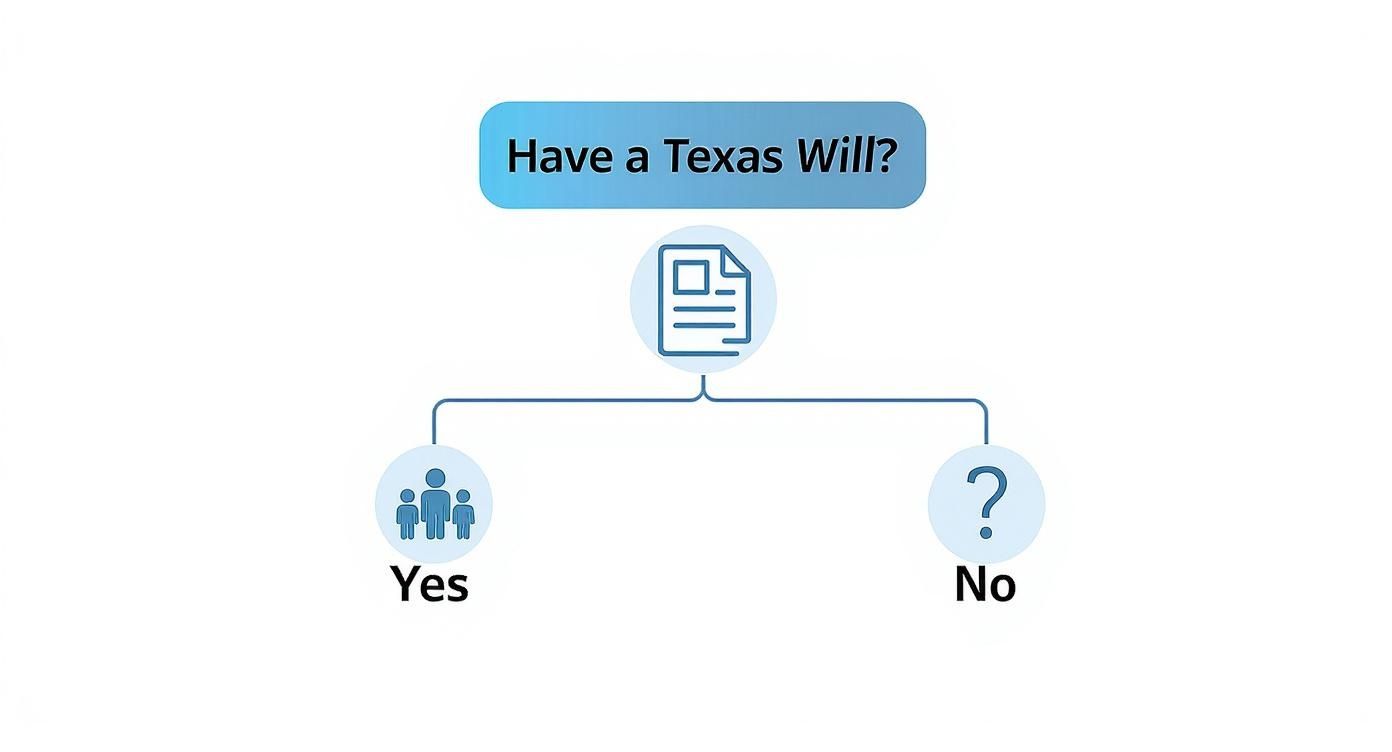
This flowchart simplifies the starting point. It all begins with that one question: have you taken this crucial step to protect your loved ones?
The Core Rules for a Texas Will
Let’s break down the must-haves for a standard Texas will. To be valid, your will absolutely must be in writing. A verbal agreement just won't cut it. Then, you (the testator) have to sign it. If you're physically unable to sign, someone can sign on your behalf, but it has to be done right there in your presence and under your direct instruction.
These might seem simple, but Texas courts are meticulous about them. The rules are laid out clearly in state law, and there’s no room for error. You can dig into the specific statutes and find further details in the Texas Estates Code to see exactly what the courts look for.
To make it easier, here is a quick summary of the essential legal requirements for creating a will that will be enforced in Texas.
Key Requirements for a Valid Texas Will
| Requirement | Description | Texas Estates Code Reference (Example) |
|---|---|---|
| In Writing | The will must be a physical document. Oral wills are not recognized except in very limited circumstances for members of the armed forces. | Sec. 251.051 |
| Signed by Testator | The testator must sign the will, or another person must sign on their behalf, in their presence, and under their direction. | Sec. 251.051 |
| Attested by Witnesses | Two credible witnesses, at least 14 years old, must sign the will in the testator's presence. | Sec. 251.051 |
| Testator Capacity | The testator must be of sound mind and at least 18 years old (or married, or a member of the armed forces). | Sec. 251.001 |
Following these rules isn't just about checking boxes; it's about making sure your will is ironclad when it matters most.
The Critical Role of Witnesses
The witness requirement is where so many do-it-yourself wills fall apart. Texas law is very clear: two credible witnesses have to sign the will in the testator's presence. "In the testator's presence" means everyone is in the same room, fully aware of what the others are signing.
Here are the key rules for witnesses you can't ignore:
- They must be at least 14 years old.
- They cannot be beneficiaries in the will. If a witness is set to inherit property, it creates a conflict of interest that could void their inheritance or seriously complicate the will's validation.
- They must physically sign the will in front of the testator. This is non-negotiable.
A common mistake we see is having witnesses sign the document later or in a separate room. This single error could be grounds for a judge to declare the entire will invalid during probate.
What About a "Holographic" Will?
Texas does recognize a unique type of will called a holographic will. This is a will written entirely in the testator's own handwriting. Unlike a standard typed will, a holographic will does not require any witnesses.
While that might sound like an easier route, it comes with big risks. Proving the handwriting truly belongs to the deceased can be a messy and expensive court battle. Even more, ambiguous phrasing or unclear instructions in a handwritten document often spark ugly family disputes.
For these reasons, a formal, typed will that is properly witnessed is almost always the safer and more reliable choice. By sticking to these legal formalities, you give your family the incredible gift of clarity and peace of mind.
Why a Self-Proving Affidavit Is a Game Changer for Probate
Dealing with the court system after a loved one passes is a heavy burden for any family. The probate process, which is the legal path to validating a will in Texas, can be surprisingly complicated and slow. Thankfully, a simple but powerful legal tool can make all the difference: the self-proving affidavit.
Think of it as an express lane for getting your will accepted by the court.
This special document is an extra statement attached to your will. You and your witnesses sign it in front of a notary public. Its entire purpose is to pre-validate the signatures on your will, essentially proving to the court ahead of time that everyone signed correctly and without any pressure.
Without it, your executor could be forced to track down your original witnesses—who might have moved, passed away, or simply can't be found—and haul them into court to testify. This witness hunt can cause massive delays, drive up legal fees, and add a ton of stress during an already emotional time.
How This Simple Document Works
The magic of the self-proving affidavit is its power to streamline the very first, and often most tedious, step of probate. Under Texas Estates Code, Section 251.101, a will that has a properly executed self-proving affidavit is accepted by the court as valid without needing your witnesses to show up and testify.
This means that instead of a drawn-out hearing just to prove the signatures are real, the court can quickly confirm the will's validity. This lets your executor get on with the important work of managing your estate. It’s a small step to take when you create your will, but it provides a huge benefit down the road.
By adding a self-proving affidavit to your last will and testament form in Texas, you are giving your family the gift of a simpler, faster, and less expensive probate experience. It's a key reason why experienced estate planning attorneys almost always include one.
While Texas law doesn't technically require the will itself to be notarized, getting a notarized self-proving affidavit is an absolute best practice. This is a perfect example of how understanding the small details makes probating a will in Texas so much smoother for your family.
A Tale of Two Probate Cases
To see the real-world impact, let's imagine two different scenarios playing out in a Bexar County Probate Court.
Scenario A: The Will Without an Affidavit
Maria passes away, leaving a will she downloaded online. She and her witnesses signed it, but there was no self-proving affidavit. Her son, the executor, now has to locate the two witnesses. One has moved to another state, and the other is in poor health. The court requires their testimony, forcing delays and adding thousands in legal costs to coordinate out-of-state depositions. The whole process is stuck in limbo for an extra six months.Scenario B: The Will With an Affidavit
John also passes away, but his will included a self-proving affidavit that was signed before a notary. His daughter, the executor, submits the will to the court. The judge accepts the affidavit as proof of the will's validity on the spot. The probate process begins immediately, saving the family precious time, money, and heartache.
These examples show how a single page can completely change the probate experience for your loved ones. The affidavit transforms the will into a "self-proven" document, eliminating a major legal hurdle right from the start. This is a critical feature to look for in any last will and testament form in Texas.
Choosing the Right People to Carry Out Your Wishes

A will is so much more than a list of who gets your property. At its heart, it’s a document that relies on people—people you trust to see your wishes through. Two of the most critical decisions you'll make in your last will and testament form in Texas are appointing an executor and, if you're a parent, naming a guardian for your children.
These aren't just honorary titles you hand out to family members. They come with serious legal and emotional weight. Picking the right people is absolutely fundamental to making sure your plan works, protecting your legacy and, most importantly, your loved ones.
Selecting Your Executor
The executor is the person (or institution) you put in charge of your estate when you're gone. Think of them as your personal representative, tasked with the important job of gathering your assets, paying off debts, and distributing what's left to the people you’ve named in your will. It's a role that demands a unique blend of integrity, organization, and patience.
When you're thinking about who to name, look beyond who you're closest to. The best person for the job is someone who is:
- Trustworthy and Honest: This is non-negotiable. Your executor will have access to all your finances and must be someone who will always act in the best interest of your estate.
- Organized and Detail-Oriented: The job involves a mountain of paperwork, deadlines, and constant communication with courts, banks, and beneficiaries.
- A Good Communicator: They’ll need to speak clearly and compassionately with family members during an emotional time, as well as with professionals like attorneys and accountants.
- Willing and Able to Serve: This can be a time-consuming gig. It's crucial that you ask your chosen person if they're truly comfortable taking on this responsibility.
A spouse, adult child, or a close family friend are common choices. But for complex estates or to sidestep potential family drama, you can also name a professional fiduciary or a corporate trustee.
The duties of an executor are extensive and strictly defined by law. To get a better handle on the scope of this role, it helps to understand what an executor in Texas does and the responsibilities they'll have to uphold.
Naming a Guardian for Your Minor Children
For parents, this is often the hardest part of writing a will, but it's also the most important. If you and the other parent were to pass away, the guardian you name is your choice for who will raise your kids.
If you don't make this designation, a judge in a Tarrant County or Harris County court—a complete stranger—will make that life-altering decision for you.
This choice requires immense care and thought. The person you pick will be responsible for everything: your child's day-to-day care, their upbringing, their values, and their emotional well-being.
As you consider your options, think about:
- Parenting Style and Values: Does this person share your core beliefs on education, faith, and what it means to raise good kids?
- Existing Relationship with Your Children: It’s best to choose someone your children already know, love, and feel safe with.
- Age and Health: Are they physically and emotionally up to the challenge of raising a child to adulthood?
- Financial Stability: While your estate might provide the funds, their own financial stability is still an important factor.
- Location: Would your children have to move, change schools, and leave their entire world behind?
Once you have someone in mind, sit down and have a real, honest conversation with them. Explain why you've chosen them and make absolutely sure they are willing and able to accept this profound responsibility.
It's also a smart move to name an alternate guardian in your will, just in case your first choice can't serve when the time comes. This single decision provides an irreplaceable layer of security for your children during what would be an unimaginably difficult time.
Avoiding Common Pitfalls of DIY Will Forms

Grabbing a do-it-yourself last will and testament form in Texas can feel like a smart, budget-friendly move. And while the initial savings are tempting, we've seen firsthand how these generic documents can be riddled with hidden traps. These traps often spring on the very families you're trying to protect, causing major legal and emotional turmoil down the road.
The problem is, a form can't ask you clarifying questions. It doesn't understand your family's unique dynamics or the nuances of Texas-specific laws. This lack of personalized guidance is where small mistakes grow into costly, heartbreaking problems during probate—and unfortunately, many families only discover these issues when it's far too late to fix them.
It's surprising how many people put off formal estate planning. Recent national surveys show that only about 24% of Americans have a will, a big drop from 33% just a few years ago. The most common reason? People just don't get around to it. This is a risky gamble in Texas, where our specific community property and probate laws can seriously complicate how your estate is distributed without a valid will. You can discover more insights about these national will-making trends on caring.com.
The Danger of Vague or Ambiguous Language
One of the most frequent problems we see with DIY will forms is unclear language. A phrase that seems perfectly clear to you might be interpreted in a half-dozen ways by your beneficiaries or a probate judge.
Consider this hypothetical scenario from a Dallas probate court. A man wrote in his DIY will, "I leave my car collection to my son." Simple enough, right? But he had two sons. That single vague sentence, which a quick conversation with an attorney would have caught, ignited a bitter and expensive legal feud that permanently destroyed the brothers' relationship.
Ambiguity is the enemy of a sound will. Every instruction, from distributing personal heirlooms to naming an executor, must be crystal clear and legally precise to prevent misunderstandings and conflict.
An experienced attorney's job is to translate your intentions into legally sound language that leaves zero room for debate.
Forgetting About Non-Probate Assets
Another critical error is trying to use your will to pass on assets that, by law, are distributed outside of probate. Certain assets have their own beneficiary designations that legally override whatever your will says. It's a classic DIY mistake.
Here are some common examples of non-probate assets:
- Life Insurance Policies: The money goes directly to the beneficiary you named on the policy itself, not the person you name in your will.
- Retirement Accounts (401(k)s, IRAs): Like life insurance, these funds are transferred to the designated beneficiary on the account.
- Payable-on-Death (POD) Bank Accounts: The money automatically goes to the person you designated with the bank.
- Property Held with "Right of Survivorship": Jointly owned real estate often passes directly to the surviving co-owner.
Failing to coordinate these designations with your overall Estate Planning strategy can lead to your assets going to people you never intended, sometimes disinheriting a loved one by complete accident.
When Professional Guidance Is a Necessity
While a simple form might seem adequate, working with an experienced attorney provides crucial safeguards that no template can offer. Think of it as the difference between a one-size-fits-all t-shirt and a custom-tailored suit.
This table breaks down some of the most common issues with DIY forms and shows how professional guidance makes all the difference.
Will Form Pitfalls and Professional Solutions
| Common DIY Mistake | Potential Consequence | How an Attorney Prevents This |
|---|---|---|
| Ambiguous Language | Family disputes and costly court battles over interpretation. | Drafts legally precise language that clearly reflects your specific wishes. |
| Improper Execution | The will is declared invalid for failing to meet witness or signature rules. | Supervises the signing ceremony to ensure every Texas requirement is met. |
| Forgetting Life Changes | An ex-spouse inherits assets, or a new child is unintentionally left out. | Advises you to update your will after major life events like divorce or birth. |
| Ignoring Non-Probate Assets | Beneficiary designations on accounts conflict with the will's instructions. | Conducts a full review of all assets to create a cohesive and effective estate plan. |
At the end of the day, a last will and testament form in Texas is your final message to your family. The cost of getting professional guidance is truly minor compared to the financial and emotional price your loved ones could pay for a flawed document.
Protecting your family's future is our priority. If you're considering your options or have questions about an existing will, we invite you to schedule a free consultation with our team for personalized guidance.
Knowing When a Simple Will Isn't Enough
A straightforward last will and testament form in Texas is a fantastic tool for many families. It gives you a clear way to pass on your assets and name guardians for your kids. But let's be honest, life is rarely that simple.
Figuring out when your situation has outgrown a basic, fill-in-the-blank document is one of the most important things you can do to protect your family. It isn't about overcomplicating things; it’s about being realistic. Certain family dynamics and asset types create wrinkles that a standard form just can’t smooth out. Ignoring these red flags can accidentally cause the exact confusion and family fights you’re trying to prevent.
Red Flags That Signal You Need More Than a Basic Will
If any of the following sound familiar, it’s a strong sign you need a more robust estate planning strategy. These situations often demand specialized legal tools to work correctly under Texas law and truly protect the people you love.
- You're in a blended family. If you have children from a prior marriage, a simple will can be a recipe for disaster. It can unintentionally disinherit them or, worse, spark bitter fights between your current spouse and your kids. A more structured plan is the only way to balance everyone's interests fairly.
- You own a business. A will alone does nothing to create a succession plan. Without one, your business could be forced into a fire sale or crippled by leadership battles, wiping out the value you worked so hard to build.
- You have significant or complex assets. If your estate includes multiple properties, assets in other states, or large investment portfolios, a will is often not the most efficient way to manage and transfer them.
- You need to provide for a loved one with special needs. This is a big one. Leaving assets directly to someone with special needs through a will could instantly disqualify them from essential government benefits like Medicaid or SSI. A specialized legal tool is absolutely required to protect both their inheritance and their eligibility for care. This is a key alternative to guardianship to consider.
When a simple will falls short, families often turn to the specialized expertise of estate planning attorneys. You can learn more about how these legal professionals reach their clients by exploring marketing strategies for estate planning attorneys.
Introducing Trusts: A More Powerful Planning Tool
When your life involves these kinds of complexities, an attorney will often recommend adding a trust to your Estate Planning. The word "trust" might sound like something reserved for the super-wealthy, but it’s actually a very flexible and common tool that offers protections a will simply cannot.
A trust is a legal arrangement where you (the grantor) transfer assets to a trustee, who manages them for your chosen beneficiaries. Think of it as creating a private rulebook for your property that operates completely outside of the public probate process.
A will is a public document that only takes effect after you die and must go through probate court. A trust is a private arrangement that can manage assets during your life and after death, completely bypassing the delays and costs of probate.
A trust gives you a much higher degree of control. For example, you can specify that a child receives their inheritance in stages—maybe at ages 25, 30, and 35—instead of all at once. For a loved one with disabilities, a Special Needs Trust can hold their inheritance without ever jeopardizing their vital government benefits.
Protecting Your Family Is Our Priority
The entire point of estate planning is to create a secure future for your loved ones. That means choosing the right tools for your specific circumstances. While a basic last will and testament form in Texas is an excellent starting point for some, recognizing when you need a more tailored solution is a critical act of love and responsibility.
From navigating the challenges of a blended family in Collin County to creating a succession plan for a business in Houston, every family's story is unique. Your estate plan should be, too. It needs to be a precise, legally sound document that leaves no room for doubt and gives your family a clear path forward during a difficult time. We are here to provide that clarity with compassion and care.
At The Law Office of Bryan Fagan, PLLC, we understand that every family's needs are different. We are committed to helping you create a plan that truly protects your legacy and the people you care about most. If you have questions about whether a will is enough for your situation or want to explore other estate planning tools, we invite you to schedule a free, no-obligation consultation with our experienced team.